
Jocko Podcast 281 w/ Major General Clay Hutmacher. Flying, Fighting, & Taking Care Of People.
2021-05-13T19:06:02Z
Underground Premium Content: https://www.jockounderground.com/subscribe Join the conversation on Twitter/Instagram: @jockowillink @echocharles @SOFWarriorFND 0:00:00 - Opening 0:07:42 - General Clay Hutmacher 1:41:58 - Final thoughts 2:02:30 - How to stay on THE PATH. JOCKO UNDERGROUND Exclusive Episodes: https://www.jockounderground.com/subscribe Jocko Store Apparel: https://www.jockostore.com Jocko Fuel: https://jockofuel.com Origin Jeans and Clothes: https://originmaine.com/durable-goods/ Origin Gis: https://originmaine.com/bjj-mma-fit/ 2:27:12 - Closing Gratitude.

AI summary of episode
You know, of course, that kid, crowed about that, you know, and I mean six months later, I'm hopping on a C-17 pulling a pump over to Iraq and this sergeant, you know, is crawling into my fart sack, you know, getting ready to take my ambient, go to La La land and he, he said, hey, sir, I just want to tell you, you know, that kid still just brags about change in policy. You know, but you come with that sort of, hey, we can do this and you know, I took more of a focus on the human side, you know, and, you know, build in the unit, doing a lot of leader development stuff and PT and the crap out of them every chance I got, you know. And, you know, at first it was quite a, you know, quite a dust up, you know, I'd walk into, you know, a little bird company and, you know, the guys are like, what the hell are you doing down here? And he said, but I got to go out and run with like the slowest people out there and formation run, you know, it's a bunch of garbage, you know, why don't we have an incentive P.T. program, which is pretty common, you know, you score above a certain score and you, you know, you can sort of do your own thing. Probably environmentalists were our biggest challenge just like you said, those sams are you see one of those things coming on me and you're like, Mommy, you know, I mean it's like, you know, this is not going to end well, you know. You know, Saoam like, you know, they're giving me some army report about, you know, readiness and like, so certainly you know about this. It's still, you know, I mean, you know, it's wrapping up there in Afghanistan now, but, you know, the ones, you know, I always joked when I'd talked to my counterparts. You know, but, and I wouldn't get into a, like, flying instruments in it or anything like that, you lose more of the procedural stuff, like, you know, all instruments is, you know, flying into clouds. You know, they're not going to get everything, you know, but, you know, I tried to, you know, make sure they understood, they were appreciated. In fact, Cindy Meyer used to call it Uncle Clay's story, you know, if I'd sit in there and, you know, chat with them, but I'd always ask them, hey, you know, what, what could I do, you know, what can I do to make the unit better, what can I do to make your job easier. And, of course, I didn't, you know, why can't we have, you know, women in the barracks, you know, blah, blah, blah, blah, you know, why can't we run a prostitution ring out here? I mean, I, you know, what, this wasn't, you know, like rocket science to me, you know, so I sort of went through the course pretty quick. It's interesting how you physically write it adds to like what he call like the experience you know where you know a normal book cool love it of course you know boom I mean, I had to report it on the standard operap kind of stuff, but I think, you know, the army just hated Jaffitalities, and we didn't, you know, they we lost, you know, probably a hundred million dollars worth of aircraft, but we didn't have a fatality. And then we'd pick them, you know, and it was funny, because the DEA, you know, they're like, you know, they're very worried, understandably so about insider attacks, right? I said, look, I know we got to learn lessons from this, but the fact is, I extended them well beyond their day, and this was, you know, they weren't flying, you know, supplies back and forth, they're doing combat. You know, you know, you see a young officer, you know, who's got it, who's not going to go far. And I relied on these, you know, young, 18, 19 year old kids that were bore scoping engines and, you know, doing stuff that they had no idea of probably their criticality to us maintaining the right number of aircraft to deploy, but I clearly know. They thought that, uh, Norway, I get my sport in there, you know, who ever thought it went into the Catholic, you know, the papalan, and then see if we got sick, you know. What the, you know, so anyway, you know, we should have been more responsible is you know, senior go foes, but we weren't at least I was just never going to have a good time. I actually got to start it, but the, you know, the Air Force has like these, you know, they're, they have a lot more rags, regulations and stuff that you got to learn, and the army, it's like, much less. One day I was walking around the hangar and she said, you know, yada, go spend some time with these young troops, you know, because they want to hear from the batanguander, what's happening, you know? But because at the end of the day, you know, I'm not going to leave you in an HLZ and that, you know, and I'm not, you know, if you need combat power, we can provide it if it's physically possible. Worst in the southern part, down in Helman and down in those areas around Cantehar, less so up in, you know, up in, you know, Hindu Kush Mountains up in the north, but, you know, I mean, it was brutal fly and brutal. But, you know, and I said, don't you have to have a degree and I probably had, you know, I don't know, less than a year of college at that time. I came in and I, you know, the exo is sort of the, you know, he's the guy in charge of all the staff and, you know, logistics and all that kind of stuff. But I thought, you know what, you know, just take a look, I said, hey sir, you know, this was not the only thing he talked to about the conversation. You know, I'm sure we made a lot of mistakes, but, you know, we're pretty disciplined and our planning, and you know, I think we're much better now than we were then. I know that the, I know people are going to be interested in, you know, in trying to find it. So I, you know, I come into their little engine shop this particular time and I call them all in, you know, it's round, you know. So Durat, you know, he's like, you know, like a right, like you may be a foot in front of his legs. You know, I was supposed to go, you're supposed to go before 06 command as you know, you know, but I never went. You listen, you know, you got your time on the rock and I was like, yeah, like twice over, you know. And then, you know, a few weeks later I was deployed, you know, I won't go to the deal, but I was deployed in the Pakistan and basically, you know, the world changed for all of us after that. So, you know, as you know, as a former aide, you know, yeah. And, and, you know, I just kept learning, you know, so when I was, remember I told you I was really worried about chronic fatigue and morale and, you know, families or Fran because of what's, of this optempo. Because we know we have that talent, and we rely on those warrants, you know, primarily, to, you know, make good decisions, and to push the envelope.
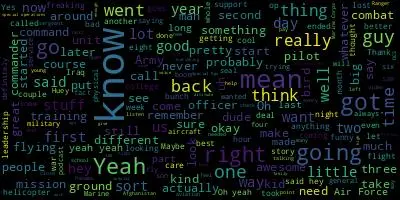
Most common words
Episode transcript
[00:00:00] This is Jockel Podcast number 281 with echo Charles and me, Jockel willing, good evening,
[00:00:06] echo.
[00:00:07] Good evening.
[00:00:08] Alarm goes off.
[00:00:10] I wake up.
[00:00:12] It's 0-600.
[00:00:14] Same time I woke up yesterday.
[00:00:17] And the day before.
[00:00:18] Actually since June 28th, almost 120 days ago.
[00:00:24] Four months.
[00:00:27] It's okay though because if anyone in the Persian Gulf tries to interfere with the policies
[00:00:32] of my sacred country, the United States of America, I'll be there to stop them.
[00:00:39] Two months ago, it was anyone in the Mediterranean.
[00:00:44] Actually we could stop anyone in the world.
[00:00:49] Breakfast time.
[00:00:51] 45 minute weight in line.
[00:00:53] Every meal is the same.
[00:00:55] In line sweating.
[00:00:58] That's okay though.
[00:00:59] There are people in my country who neither know nor care that their freedom is being protected
[00:01:04] at this very moment.
[00:01:08] That too is okay because I do know.
[00:01:14] I'm doing it.
[00:01:17] Go to work.
[00:01:19] The same routine day in and day out.
[00:01:22] It could be compared to being in jail except that the work we do is too hard and too dangerous
[00:01:28] to impose upon a common criminal.
[00:01:33] It would be considered inhumane.
[00:01:37] That's okay though.
[00:01:40] I understand freedom and the sacrifices that have to be made for freedom to be achieved.
[00:01:49] The life we live at the cost of our military members cannot have a price put on it.
[00:01:57] If you saw our paychecks, you would understand.
[00:02:02] Dinner time.
[00:02:04] Chicken and rice again.
[00:02:07] That's okay.
[00:02:10] The opportunities we have in the States are limitless.
[00:02:16] There's nothing that any person cannot achieve if he or she has the heart.
[00:02:26] They don't have those opportunities in the parts I've visited.
[00:02:31] They don't even have Taco Bell.
[00:02:39] That right there is a letter written by Steve Voight, written on October 23rd, 1996.
[00:02:52] He was killed in a helicopter crash on October 25th, 1996, two days after he wrote that
[00:02:58] letter.
[00:03:01] Steve was at Cilteam 8.
[00:03:05] And that helicopter crash happened while they were training.
[00:03:10] And I went through Cilteam with Steve in 1991.
[00:03:15] Buds Class 177.
[00:03:17] He was an old man at the time.
[00:03:21] He was like 28 or 29 years old.
[00:03:24] He was our class leading petty officer.
[00:03:32] It was just an awesome guy.
[00:03:35] I know he was from the South.
[00:03:36] I think he was born in Georgia.
[00:03:38] But he didn't have a typical Southern accent.
[00:03:44] He had this other voice that probably one of the most distinctive voices I've ever known.
[00:03:52] He was really loud.
[00:03:55] We had this distinctive loud, funny voice.
[00:04:00] It was called to like this.
[00:04:03] It's a guy's get over here.
[00:04:06] He had this just totally distinctive voice.
[00:04:09] You couldn't miss it.
[00:04:13] He was tough as hell.
[00:04:14] And the instructors tried to crush him all the time.
[00:04:18] He was an older guy and a senior guy.
[00:04:20] He was a first class petty officer.
[00:04:23] Being that senior going through basic seal training, the instructors are going to get at
[00:04:27] you.
[00:04:28] And they hammered him.
[00:04:31] But they couldn't break him at all.
[00:04:34] They actually couldn't even get him to crack a little bit.
[00:04:37] Because they'd be punishing him and he'd be hitting the surf and he'd be doing pushups
[00:04:42] and he'd be doing sprints.
[00:04:44] And they'd ask him about something and he'd still come off the same with that loud.
[00:04:49] Just crazy, funny voice and weed rally right around him.
[00:04:55] Just a freaking awesome guy.
[00:05:02] And when he died, you know, it was 1996.
[00:05:09] There's no war going on, right?
[00:05:11] So it was definitely a shock to the system to have someone killed like that.
[00:05:22] And I'm just tragic and horrible.
[00:05:25] And I knew that he had a son and he had had a son.
[00:05:29] Because like I said, he was older.
[00:05:31] He had a son that was named after him.
[00:05:33] Another, another Stephen Void.
[00:05:38] And I knew that.
[00:05:39] But I'd kind of lost track with him.
[00:05:41] I was on the West Coast.
[00:05:42] He was on the East Coast.
[00:05:43] I didn't go to the funeral for whatever reason.
[00:05:47] I just carried on with my career and continue to try and serve to the best of my ability.
[00:05:55] Always remembering, always remembering Steve Void and his sacrifice.
[00:06:03] What about a son?
[00:06:06] They're what happened to him.
[00:06:08] Well, fortunately, fortunately, there was support for him.
[00:06:17] And he was able to grow up and he was able to go to college.
[00:06:21] And all that was taken care of by a group called the Special Operations or your foundation.
[00:06:28] And what that group is is one of the things that they do.
[00:06:32] One of the main things that they do is they take care of the children of fallen members
[00:06:37] of the Special Operations community.
[00:06:41] And Steve's son got taken care of in that respect.
[00:06:46] And the Special Operations Warrior Foundation stepped up and paid for his education and gave
[00:06:54] young Stephen the opportunities that his father was not there to give to him.
[00:07:02] But that his dad had sacrificed for.
[00:07:08] And this story is one of thousands of stories of thousands of families that have been
[00:07:14] helped by this foundation.
[00:07:17] And we are lucky enough today to have the president and the CEO of this incredible charity
[00:07:22] here.
[00:07:25] A man who has quite a story of his own from an enlisted Marine at age 17 to 41 years of service
[00:07:36] resulting in the rank of major general two star with service in Panama, Iraq, Afghanistan and
[00:07:45] a bunch of other places around the world.
[00:07:49] General Clay Hotmacher.
[00:07:51] Clay.
[00:07:54] Thanks for joining us.
[00:07:55] Hey, thanks for having me, Jacob.
[00:07:56] I appreciate it.
[00:07:57] That's a great story.
[00:07:58] I had never heard of that letter.
[00:08:00] I appreciate your sharing.
[00:08:01] I was looking at some videos that y'all have produced and Steve Voitt's picture.
[00:08:07] I mean, just a picture of him and his son when his son's young and man, I couldn't
[00:08:12] believe when I saw that.
[00:08:14] And it struck me that, you know, I was in the military.
[00:08:19] What can you do?
[00:08:20] This is something that we always feel when you're in the military.
[00:08:23] You lose somebody.
[00:08:26] You want to help, but you also have a job and you're going to continue to do that job.
[00:08:31] And so organizations like yours that can pick up the slack for the guys that are still
[00:08:36] serving and have a long term strategic plan to take care of these families and just seeing
[00:08:41] his son who definitely looks like him.
[00:08:43] You guys have a video of him on there as well and just seeing his son who looks like him,
[00:08:50] doesn't quite sound like him.
[00:08:51] Doesn't quite sound like him.
[00:08:53] Man, his voice was distinctive.
[00:08:54] Hey, who are you guys doing over there?
[00:08:59] Just awesome to that you have that organization that helps in that respect.
[00:09:06] So we'll get to that.
[00:09:09] But before we get to that, let's start at, well, let's start at the beginning.
[00:09:13] I was like, start at the beginning.
[00:09:14] So where did you grow up?
[00:09:17] I grew up in Washington State.
[00:09:19] I was born and went out to Washington, bounced around a bit and ended up before I joined
[00:09:25] military in a little town outside of Everett Washington called Lake Stevens.
[00:09:32] I was living in a foster home, dropped out of high school and all I knew is I needed
[00:09:37] to kick in the ass and I figured, well, the Marines, they'll definitely do that and they
[00:09:41] did not disappoint.
[00:09:44] So you were in foster homes from what age?
[00:09:47] That was maybe I joined when I was 17.
[00:09:51] I guess, 15.
[00:09:53] My parents divorced when I was young and I bounced around and then a lot of this was
[00:09:58] my own doing.
[00:09:59] It would be perfectly honest where the eye was, you know, done with my parents and wanted
[00:10:03] to, you know, they had moved from Lake Stevens and I was like, hey, I'm not doing that
[00:10:08] with all the wisdom that I've 15 year old.
[00:10:11] And so this is what?
[00:10:14] 1975.
[00:10:15] Yeah, if you want to round up a couple of years, I'll be fine too.
[00:10:18] But I'm saying, in 1975, you're 15 years old.
[00:10:22] You're living in foster homes.
[00:10:23] You're like to hell with the parents.
[00:10:24] I'm doing my own thing.
[00:10:26] What did you have any, did you think?
[00:10:31] We just just short-sighted, not.
[00:10:34] Well, it was, you know, actually it was a little later than that.
[00:10:38] My mother was a writer.
[00:10:39] She passed away last year or December, a year ago last December.
[00:10:44] And she was in South Africa.
[00:10:45] If you ever saw that movie, cry for you to them with Denzel Washington, it was about
[00:10:49] this guy Donald Woods who was the editor of a newspaper over there, which was on the coast
[00:10:54] of South Africa.
[00:10:55] She worked for him.
[00:10:56] So I lost that whole year over there with her in the early 76.
[00:11:00] I came back because it's a cool didn't count.
[00:11:02] Oh, so you went there.
[00:11:03] You went to South Africa, I lived in East London, South Africa between Durban and Cape Town.
[00:11:08] And that was a little slice of the Marine Corps right there.
[00:11:10] I mean, uniforms, haircuts, and school, and the whole deal, which, you know, I did not
[00:11:15] adjust well with that.
[00:11:16] By the way, and received the canning numerous canings for that.
[00:11:20] Oh, they got their corporal punishment.
[00:11:21] Oh, yeah, bamboo canes.
[00:11:23] I mean, once in a wet speedo for not counting off properly and mandatory PT and, you know,
[00:11:29] I got religion pretty quick.
[00:11:30] Learned how to count for sure.
[00:11:32] But yeah, it's a prime apartheid time night to what.
[00:11:37] Yeah, and this was this newspaper was obviously against apartheid.
[00:11:41] So, you know, we're writing a middle of all that.
[00:11:44] I mean, it was really stark seeing the way that the way life was over there.
[00:11:49] So anyway, I came back from that.
[00:11:51] I'd lost here in high school and I'm like, well, you know, look, I wasn't, you know,
[00:11:55] an academic champion anyway.
[00:11:57] So I was like, I'm just going to join the Marines.
[00:12:00] And I got back from there, didn't want to move back where my dad was.
[00:12:04] I was living with a guy and then a foster home took me in.
[00:12:07] It was a pretty cool story.
[00:12:08] He, this family, the Williams family, I'm still in very close touch with him.
[00:12:14] There son had died and he was a modal cross racing is big up there for teenagers.
[00:12:19] And he had died.
[00:12:20] He was my classmate, Jeff Williams, and he had died in a motorcycle crash.
[00:12:24] And so I knew the family from afar, not close.
[00:12:27] I wasn't close friends with Jeff, but we knew each other.
[00:12:30] And so that it was sort of fortuitous, you know, that I providence that I came in his
[00:12:35] same age and ended up with his family.
[00:12:37] And her father, Charlie Williams, was a former Marine from Korea.
[00:12:44] So he was telling me about the Marine Corps.
[00:12:46] And I see also I need to sign up and shipped out to the warm and brace of the Marine Corps.
[00:12:53] So what did you do in Korea?
[00:12:56] Did you capture some of those stories?
[00:12:59] He was in Korea.
[00:13:00] No.
[00:13:01] Yeah, he was, I think he was a combat engineer.
[00:13:04] And so he was, I mean, I don't remember a lot of them, but he talked a lot about combat
[00:13:10] and how bad it's like, but really the best stories for him were boot camp.
[00:13:14] You know, they pulled all of it.
[00:13:16] I never forget one.
[00:13:17] He said they pulled all of his teeth out and were given them dentures.
[00:13:20] You know, when he's in boot camp, right?
[00:13:22] So obviously dental care was not high on his priority list.
[00:13:26] And right after he had that he had stitches in his mouth and the drill instructor pulled
[00:13:30] his dog tags, pulled him towards Murlfast and then extended his fist and punched him
[00:13:34] in the mouth and his whole mouth exploded with blood and everything else.
[00:13:39] We supposed to be laughing at this.
[00:13:40] Yeah.
[00:13:41] I was like, I was like, I think I'll join.
[00:13:42] And also, I mean, those were most of his stories for the trauma.
[00:13:47] You know, when I look at full metal jacket and those boot camp scenes, I mean, my DI set
[00:13:53] a lot of those same phrases that they were, I mean, I thought that was authentic.
[00:13:57] What was that guy who ended up being an actor?
[00:13:59] Oh, the Army.
[00:14:00] Yeah, yeah, yeah.
[00:14:01] He was, you know, the, I guess the first he was a technical guy, but then he ended up
[00:14:05] playing a part and I was like, that dude could have been staff sergeant, Amarine, who
[00:14:09] was my senior DI when I went through his mouth.
[00:14:12] You showed up there in 1978.
[00:14:14] So these guys are, you're still getting Vietnam guys.
[00:14:18] Oh, you're, you're drone structures.
[00:14:20] Yeah, my company, you know, in the Marine Corps and a company you have a first sergeant,
[00:14:24] you know, in the NNCL ranks, you can sort of split at E8.
[00:14:27] You can either be a master sergeant or a first sergeant.
[00:14:30] And in a company traditionally, I have a first sergeant who sort of runs all the admin
[00:14:34] and all that then you have a master sergeant who's does ops, right?
[00:14:37] He's like the ops sergeant.
[00:14:39] And I remember my first ops sergeant, I mean, he had one eye from Vietnam and he was a literate.
[00:14:43] I mean, he would sign like a X on the duty roster and stuff like that.
[00:14:48] I was, you know, I mean, yeah, there was some, there was definitely a lot of Vietnam
[00:14:53] America is there.
[00:14:54] And how do you adapt?
[00:14:57] Candlely poorly at first, you know, I mean, when I got there, you know, I mean,
[00:15:01] it was shock and awe.
[00:15:05] And I, you know, I certainly didn't want to be there and for probably the first few weeks
[00:15:09] thought I had made a monumental error and judgment.
[00:15:12] But there was just enough in me that I felt like, hey, I'm, you know, I'm not going to
[00:15:18] go back to my family, hat and hand with my tail between my legs.
[00:15:21] So I just, you know, tried to do it day at a time.
[00:15:24] But I do remember, you know, the first morning they wake up, it's brutal, right, trash
[00:15:29] cans thrown over a poem, people out of bunks.
[00:15:31] And, you know, there was a lot of physical abuse back then.
[00:15:34] I mean, it was, you know, measured but seemed pretty violent to me.
[00:15:41] But, you know, I remember laying in my rack every morning before, you know, because I could
[00:15:45] hear him moving around, like little mice, positioning themselves before they launch.
[00:15:49] They all out of salt.
[00:15:51] And, you know, I'd be laying there and I'd be like, well, what do I have to look for
[00:15:54] it today?
[00:15:55] Well, that would be nothing.
[00:15:58] So, once I got out of the rack and I started going, you're like, I'm muscle memory,
[00:16:02] I was fine, but those were the worst parts.
[00:16:04] Was that morning laying there, no one this onslaught that was going to, you know, start
[00:16:08] there in a couple minutes.
[00:16:10] But all that being said, you know, I mean, and I, and I think I was sort of a jackwagon
[00:16:14] for my first come as typical, you know, I did well in boot camp.
[00:16:18] I got whatever Maritoria's PFC, you know, all that.
[00:16:22] I think primarily because my drone was starting to was hot for my sister.
[00:16:26] But, you know, I could take any leg up, I could get.
[00:16:30] But, you know, the first couple years I did all this, I went to Luzune to Second
[00:16:34] Maridiv out there and I did all the stupid stuff that young troops did, you know,
[00:16:38] blow all my money for the first three days after payday.
[00:16:41] You know, thank God I had a meal card or I would have started to death.
[00:16:46] But then, you know, I went to Okinawa to Third Maridiv and that's when the sort of
[00:16:49] the light came on.
[00:16:50] I started going to school.
[00:16:51] I got my diploma and started going to college.
[00:16:54] And I mean, you know, and then once you get a little success, you know, you sort of
[00:16:57] build on that. I mean, they're setbacks along the way, but then I was like, OK, I can do this,
[00:17:02] you know, what was your MOS?
[00:17:04] I was an 1833 Amtraker.
[00:17:07] Get some.
[00:17:08] Yeah.
[00:17:09] When you, when you say, was there anything that made you realize, hey, I need to kind
[00:17:16] of step up my game, maybe I should start, you know, going to college, maybe I should
[00:17:20] start my continued education, maybe I should start trying to get events?
[00:17:23] Was there anything that, in particular, do you have a leader that mentored you?
[00:17:26] Did you just look around and say, man, why don't I do a little bit better?
[00:17:30] Well, do you remember what that was?
[00:17:32] Was it think one thing in particular?
[00:17:33] Yeah, it wasn't, you know, there wasn't a specific leader.
[00:17:35] There were later in my life certainly those that, you know, that really inspired me to go
[00:17:41] above and beyond.
[00:17:44] But at that stage, I think it was more seeing people crash and burn around me.
[00:17:48] You know, I mean, getting guys getting kicked out for drugs was ramping back down.
[00:17:53] I mean, it was really ramping.
[00:17:54] And, and guys were getting caught.
[00:17:57] We didn't do urine analysis or anything like that.
[00:18:00] I mean, it was physically caught with, you know, drugs and the barracks.
[00:18:03] And it was open bay, back then we were open bay barracks.
[00:18:07] It courthouse bay, which is where our, our batyne was.
[00:18:11] And I just saw these guys and I mean, I, I just saw them failing.
[00:18:14] And I mean, I knew they were on a downward spiral.
[00:18:16] And I think over time I saw enough of that, or I was like, okay, I don't want that to be
[00:18:20] me.
[00:18:21] And I went to a canal was sort of in, you know, my own personal mandate to, to turn my
[00:18:28] life around and, you know, make something of myself.
[00:18:30] Hey, you know, listen, it was never part of the training, on the training calendar for me
[00:18:34] to be a general officer.
[00:18:35] I remain amazed of the flaws and the promotion system of this day.
[00:18:40] But, you know, I just, I just, my goal was to be a sergeant frankly.
[00:18:45] That was my goal.
[00:18:47] And, you know, but, you know, you get a little victory and you sort of build on that.
[00:18:52] And, you know, and then low and behold, here I am, you know, a flag flying and everything.
[00:18:57] So, you know, as you know, as a former aide, you know, yeah.
[00:19:02] Yeah.
[00:19:03] So, when you, when you, how do you originally hear, because you ended up going to the
[00:19:07] war in officer flight program right, right?
[00:19:09] Right.
[00:19:10] How did you originally hear about that?
[00:19:11] Well, I read when I was at the rock, Ocanawa, I re-enlisted.
[00:19:16] And I went, I got my duty station at choice or whatever and it was Marine barracks,
[00:19:20] woodbeal and Washington, which is now long since close.
[00:19:25] And I was working as a bouncer in the Globe and Anchor Club.
[00:19:27] You know, we had our own enlisted club at the corner of our barracks.
[00:19:31] And there was a reserve, a Marine reserve, hellow unit that was Huey unit that was on the
[00:19:37] base there.
[00:19:39] And some guy, Pixley Euricks was his name, was walking by with this brochure and had
[00:19:46] a cobra hover and over the trees and the morning this coming up and I'm like, hey, what's
[00:19:51] that?
[00:19:52] And he said, hey, it's this army worn officer flight training.
[00:19:55] I mean, I barely knew what a worn officer was.
[00:19:57] I was like, you know, the Marine took memorizing the ranks and all that stuff.
[00:20:00] Very nice.
[00:20:01] I just recited him before he went to bed and boot camp.
[00:20:03] But, you know, and I said, don't you have to have a degree and I probably had, you
[00:20:07] know, I don't know, less than a year of college at that time.
[00:20:10] And he said, no.
[00:20:11] So I started, you know, I was like, hmm, so I took the brochure, he gave it to me.
[00:20:16] And we both ended up, you know, he ended up ultimately joining the code.
[00:20:20] He got into the Army worn officer program and then flew 58, you know, little scout helicopter.
[00:20:26] They ended up transferring into the Coast Guard.
[00:20:28] But I went through the process.
[00:20:30] I drove down to Fort Lewis and did my physical down there.
[00:20:34] It took all my flight out to Tudetus.
[00:20:36] And of course, right before I was getting ready to ship out for this, you know, the Marine
[00:20:40] Corps being the Marine Corps.
[00:20:41] They're like, hey, you've been back, you know, for 18 months from the rocks, we're going
[00:20:45] to send you back to the rocks.
[00:20:46] I was like perfect.
[00:20:47] You know, so the Army graciously delayed my entry into flight school for the 18 months.
[00:20:52] I went over there, did my time.
[00:20:55] You know, it came back from Okinawa to the Separation Center at Camp Pendleton.
[00:20:59] And then three days later, I was at Fort Rucker, Alabama.
[00:21:02] I didn't know anything about the Army.
[00:21:04] I mean, I had nothing.
[00:21:06] You know, and it showed, you know, I mean, like drill and ceremony and all that.
[00:21:10] So they do it, you know, not completely different, but definitely enough that I was dropped
[00:21:15] for pushups frequently and worn off Sir Canada School.
[00:21:18] But went through that opted for blackhawks.
[00:21:21] That was like sort of a new airplane back then.
[00:21:24] It wasn't brand new, but it was, you know, pretty hot rock to get on.
[00:21:27] And I went to the 101st.
[00:21:30] How many, when you were going through the flight training, how many pilots were getting
[00:21:33] trained at a time?
[00:21:35] We just had a Vietnam pilot on.
[00:21:37] And he said, you go out to take off in the morning to be like hundreds and hundreds of
[00:21:41] helicopters taken off in the morning.
[00:21:43] Oh, yeah.
[00:21:44] It wasn't as bad as Vietnam.
[00:21:45] I know the intensity wasn't there.
[00:21:47] But I think they graduated about 50 worn off Sir Palson.
[00:21:52] And there was a commission class that was, you know, sort of our, you know, they went along
[00:21:57] through with us.
[00:21:59] And we brought every two weeks.
[00:22:02] So they were pumping out helicopter policy crazy.
[00:22:06] And what did you fly as a training bird?
[00:22:08] Well, I started out in this airplane, the TH55 helicopter, which was the civilian designation.
[00:22:14] It was a Schweitzer 300.
[00:22:16] It was a resip, reciprocal engine.
[00:22:19] I mean, it sounded like a freaking lawnmower.
[00:22:20] And I was like, you know, you said about hundreds of us, you know, we take off and we're
[00:22:24] all in a line.
[00:22:25] These orange helicopters and flying out to our stage fields and do our stuff.
[00:22:30] And then after we checked out on that, anime was a piece of crap.
[00:22:34] I mean, this thing was, I mean, it's max speed.
[00:22:36] It was like 50 miles an hour or something.
[00:22:39] I switched over to Huey's, went through the, you know, transition into that and they
[00:22:44] do all my instruments and combat training and, you know, tactical training and that.
[00:22:49] And then post flights go on, went into the Black Hawk aircraft call course.
[00:22:54] How much different is it flying there?
[00:22:55] Huey from flying a Black Hawk?
[00:22:58] Much different.
[00:22:59] The motor systems, you know, this is, you know, getting into tech, no key helicopter
[00:23:03] speak here.
[00:23:04] But, you know, the rotor systems different.
[00:23:05] It's a semi-rigin in the Huey and an articulated system in the black.
[00:23:09] So I mean, you can do a lot more in a Black Hawk, you know, maneuvering wise and you
[00:23:13] can do in a Huey.
[00:23:15] The Huey, I think I would put it.
[00:23:16] The Black Hawk is like a G5 in the civilian world jet, right?
[00:23:23] And the Huey's like a DC3.
[00:23:25] You know, so they're, you know, it's just their Vietnam or all these birds.
[00:23:28] You can see on the tail numbers.
[00:23:30] There were 68, 69, vintage.
[00:23:35] But I still like it.
[00:23:36] I got about 350 hours and those things.
[00:23:39] I got about 160 in flight school and then a Black Hawk's are grounded for a mechanical
[00:23:42] issue.
[00:23:43] So I flew, met a VAC around, called in a, you know, call flat iron aircraft.
[00:23:47] So I got a lot of time in Huey.
[00:23:49] So I'm not a lot.
[00:23:50] That, you know, pretty good time.
[00:23:51] We had a top, we had a top, got it found.
[00:23:53] The guy had started top gun was on here.
[00:23:54] Oh, no.
[00:23:55] Those guys were, would just get into random aircraft and just take off in jets by themselves
[00:24:02] that they'd never flown before.
[00:24:04] You know, like, including they had captured a Soviet make and they'd go out in, it was
[00:24:10] in like out in Arizona somewhere and they'd fly out there and they'd get in that thing
[00:24:15] and fly that thing.
[00:24:17] Is it, is it that transferable with helicopters?
[00:24:19] Yeah, I would say, I mean, each airplane's got its own unique handling characteristics,
[00:24:25] helicopter, but, you know, the hard part is starting it for me, like, okay, because you
[00:24:31] don't sum, you got to modulate the throttle and give gas into the turbine to get it going
[00:24:36] and summing up.
[00:24:37] I mean, so if somebody else starts it or walks me throughout a start it, I mean,
[00:24:41] I can, you know, you just sort of react to the plane.
[00:24:44] You know, I mean, you see what it's doing and you do the counter action or, you know, what
[00:24:49] you got to do in the control.
[00:24:50] So the stick and rudder stuff, I think, is pretty transferable.
[00:24:53] I mean, I hopped in a jet-long range or, I don't know, about a year ago and I had flown
[00:24:58] in, you know, I don't know, five, six, seven, eight years and it was no problem because he
[00:25:03] had to start it for me.
[00:25:05] You know, but, and I wouldn't get into a, like, flying instruments in it or anything
[00:25:10] like that, you lose more of the procedural stuff, like, you know, all instruments is, you
[00:25:15] know, flying into clouds.
[00:25:16] There's a lot of procedure and things and you got to stay up on that.
[00:25:19] There's a lot of book works, so you understand what's happening and what your, what your
[00:25:23] responsibilities are like that and those atrophied for me.
[00:25:27] But as far as wiggle in the sticks, yeah, I could hop in a helicopter.
[00:25:31] Oh, frankly.
[00:25:32] Was it hard, was there, did you have any trouble going through, was there a big attrition
[00:25:35] rate?
[00:25:36] Did you have any trouble with anything?
[00:25:37] Uh, not really.
[00:25:39] I, um, instruments was pretty challenging.
[00:25:43] You know, you start in a Huey simulator, which is, you know, um, which was, you know,
[00:25:48] doing climbing descending turns with not, not no outside reference.
[00:25:52] You know, you rely on your visual sense, right?
[00:25:55] So seeing and the horizon and all that way, of course, you don't have any of that in
[00:25:59] the clouds.
[00:26:00] So they train you on how to, you know, get into instruments.
[00:26:02] So that was, that was challenging.
[00:26:06] A quick story.
[00:26:07] I was flying in the Huey simulator and it's just giant, like, warehouse, full of simulators,
[00:26:11] like this, they don't, you know, they're really basic.
[00:26:14] And I'm late at night getting some extra flight time in there and the simulator operator
[00:26:19] comes over to rate because he's your air traffic control or guy too, right?
[00:26:22] He's sort of your, you know, and I, you know, made some radio call and you said, uh, Roger,
[00:26:27] Huey 1, 2, 3, 4, 5.
[00:26:29] You got a flight of geese, uh, your altitude going opposite direction.
[00:26:33] And I'm like, you know, looking at this dude, I'll fly with him like with the hills,
[00:26:36] this dude talking about.
[00:26:38] Next thing I know, this guy's got a mop and he's slapping it on a windscreen, like,
[00:26:43] geese, you know, there's green.
[00:26:44] I was like, little slow out there tonight, bro.
[00:26:47] You know, but yeah, I mean, that was a little challenging.
[00:26:51] It like me, I think with me, when everybody else would say the same thing.
[00:26:55] But no, I mean, now going into special ops and meet no standards in the one 60th
[00:27:01] for, you know, plus or minus 30 seconds and all that, there was some, there was definitely
[00:27:06] some stress there, you know.
[00:27:08] So you get done with flight school and then that's when you went to the hundred first.
[00:27:13] Yep, I was flying Medevac for Delta 326 Med, uh, three 26 Medvetainin and I was flying
[00:27:21] her ambulance stuff there.
[00:27:23] When I actually, when I got out of flight squad orders to Germany to a place called Schwabish
[00:27:28] Hall, because one third of the army back then was in Germany.
[00:27:31] I never realized that.
[00:27:32] I mean, that's pretty significant.
[00:27:33] That was the investment we had in the Cold War.
[00:27:37] But I heard about this secret unit, you know, uh, in Fort Campbell.
[00:27:41] And I was like, hey, that's what I want to do.
[00:27:44] I went out on what they do.
[00:27:45] I probably ain't good enough, but that's what I want to shoot for.
[00:27:48] So I swapped with a guy who wanted to go to Germany and I went to Fort Campbell and with
[00:27:54] that a month, you know, when I was in the hundred first, I walked over the recruiter.
[00:27:58] The back then, the one 60 didn't have any, they didn't wear patches, anything.
[00:28:01] There was just, you know, all there's, there was no signs in front of their buildings.
[00:28:06] And I said, hey, I want to join the unit.
[00:28:08] And I was like, what we call a wobbly one, you know, a war and officer one junior grade.
[00:28:13] And they laughed at me.
[00:28:14] And I went back every month and said, hey, I'm, you know, they told me what I had to
[00:28:18] do and, you know, make pilot and command and get a lot of night vision goggle time.
[00:28:22] So I was doing my best to do all those things.
[00:28:24] And, you know, I kept, you know, telling them I'm interested, you know, persistence.
[00:28:31] And then I made it, you know, I didn't realize the difference in you, you, you know, in
[00:28:36] your job in the seals, it was a little different.
[00:28:37] But a warrant is a technician, as you know, right?
[00:28:40] So our warrants in the 160th will stay in the cockpit and flying the same missions, what
[00:28:45] that's a little birds or 60s or 47s for 20 years.
[00:28:49] And I loved flying.
[00:28:50] I still loved flying.
[00:28:51] But I also missed the leadership side of that, you know, being an NCO and from your
[00:28:57] Marine Corps days.
[00:28:58] Right.
[00:28:59] Yeah.
[00:29:00] And, you know, there's none of, I mean, there is some of that in war and officer ranks.
[00:29:02] But it's not their main focus right by design.
[00:29:06] So I decided to go to officer candidate school.
[00:29:10] And, and so, you know, I went to officer candidate school.
[00:29:14] So you had to apply for that?
[00:29:15] Yeah, I applied.
[00:29:16] I had been going to college still.
[00:29:18] So I had to have, you know, two years of college to apply for OCS.
[00:29:22] And then you had to have your four year degree by the time you made O3.
[00:29:26] So I applied and got picked up.
[00:29:28] But it was funny.
[00:29:29] I mean, I mean, you have to be had to be commissioned, you probably remember this, by the
[00:29:33] beginning of your 10th year or so, because you had to be able to do 10 years of commission
[00:29:37] time was what you needed to do to retire by 20.
[00:29:41] I graduated OCS with nine years, 10 months and two weeks.
[00:29:45] Like if I went, I got a hang mail or something, I got set back.
[00:29:49] I went to film out, you know.
[00:29:51] And I was a W2 when I was a W2.
[00:29:52] Did you go to full normal OCS?
[00:29:54] Oh, yeah, listen, I got the distinction to have on my head shaved more than anybody else.
[00:29:59] I know.
[00:30:00] No, you're getting a doctorate on a regular basis.
[00:30:03] I'm like the high water bar for you guys on hair over here, which is not say it much
[00:30:07] by the way.
[00:30:08] But yeah, you, so you've been through multitude of fresh and doctrinations.
[00:30:13] Yeah, no, no, no, no.
[00:30:15] So how was that?
[00:30:16] How did they treat you at OCS?
[00:30:17] Oh, like, where is this now?
[00:30:18] So I started in July of 87, graduated October 16th.
[00:30:24] I think of 87 commissioned on that day.
[00:30:27] So I was technically your group 88 because I was after the first of the fiscal year.
[00:30:33] I thought the curriculum at the course was pretty good.
[00:30:36] We spent about between a third and a half of our time in the field.
[00:30:40] So we're doing, you know, it's really infantry oriented, anti-armory, ambitious, and rough
[00:30:44] marches and things like that, which I thought was really good.
[00:30:49] I would say, you know, the cadre at the time and it could be different.
[00:30:54] And I'm in the OCS Hall of Fame, so they made, you know, disown me over this.
[00:30:59] But the cadre were not great.
[00:31:02] I mean, they were guy, you know, we had a couple guys, I think, that it got DUIs and
[00:31:06] got sort of stuck over there, you know.
[00:31:08] So it wasn't, they weren't like a great examples of stellar leadership in my mind.
[00:31:13] I thought the curriculum was really good.
[00:31:14] I thought the quality of the officers that were mentoring us were not.
[00:31:20] And, you know, a lot of the most of the OCS people who go through any army are those
[00:31:24] that have gotten a degree and decide after their outside the window for ROTC to go into
[00:31:30] military.
[00:31:31] So they got to go to basic and then they go to OCS.
[00:31:35] So we had a bunch of, we had masters, we had a couple of PhDs, I think, in there.
[00:31:39] But I mean, they didn't, you know, they didn't know shit from China.
[00:31:42] I mean, they didn't know, you know.
[00:31:44] How's that?
[00:31:45] P-H-D-T-T.
[00:31:46] Yeah, exactly.
[00:31:47] The moral percentage of us that were former, you know, prior service, you know, and they
[00:31:52] sort of carry the class and do a lot of mentoring.
[00:31:54] There was three warrants in our class.
[00:31:56] We had about 240, 250 people in our class.
[00:31:59] So again, good experience.
[00:32:04] You know, I learned a lot.
[00:32:07] I think, for instance, some Marine Corps does a much better job in investing in their training
[00:32:11] base than the army does.
[00:32:13] I mean, I think that's changing now.
[00:32:17] But historically, you know, the Marine Corps puts their best and brightest to develop those
[00:32:22] young troops and officers.
[00:32:26] The army really, they're more focused on their tactical units, which I think is at the
[00:32:30] expense of their future.
[00:32:32] Being my personal opinion.
[00:32:35] Well, when I went to OCS, you're candidate school, it's run by Marine Corps, Jones
[00:32:39] Schrofters.
[00:32:40] Did you go to Rhode Island?
[00:32:41] No, I went down to Pensacola.
[00:32:42] Okay.
[00:32:43] And they're just freaking outstanding.
[00:32:44] I mean, they're just like exactly what you'd expect.
[00:32:48] They're just outstanding professionals across the board.
[00:32:50] Yeah.
[00:32:51] That was my experience.
[00:32:52] I mean, my DIs were really, really sharp.
[00:32:54] I mean, a little twisted, but, you know, little sadism thrown in there.
[00:32:59] But, you know, they were very square away.
[00:33:01] Setic, great example for us.
[00:33:04] So did you, so had you already gone to the one 60th at this point?
[00:33:09] So I was funny.
[00:33:10] I had graduate.
[00:33:11] I was getting ready to graduate.
[00:33:12] OCS.
[00:33:13] I have my packet in, right?
[00:33:14] I've been over there all those times as a warrant.
[00:33:18] And I called the recruiter a right before I was getting ready to graduate.
[00:33:21] And I was ordered to go to the 80 second and fly for the 80 second.
[00:33:27] And I graduated pretty high.
[00:33:28] I wasn't the number one, but I was like to know what's the Hall of Fame all about?
[00:33:33] Well, if you, you know, listen, if you make it past Colonel in OCS, they like, they'll
[00:33:39] the foot of the guy say, hey, do you want to be in OCS Hall of Fame?
[00:33:42] I was like, sure, I never went to the little ceremony, right?
[00:33:45] But they said, okay, send us 250 bucks so we can do your Piggas and that's a great deal.
[00:33:51] And so, somewhere in some hall over there for betting my pictures up on a wall a little
[00:33:55] bio, but I've never seen it.
[00:33:57] Well, at 250 bucks a pop, you might be, yeah, I was like, a lot of company.
[00:34:01] Yeah.
[00:34:02] I was like, seriously, you guys are going to charge me to put me in the hall?
[00:34:05] I was like, typical, right?
[00:34:06] I'm sure, if you wait for the day, be all of OCS, all of a, it's probably very similar.
[00:34:10] Anyway, I was getting ready to graduate and, and I thought, you know what, I'm just going
[00:34:16] to call this the recruiter.
[00:34:18] Because you have to go through a week long assessment process just to get accepted, conditionally
[00:34:23] into the, you know, check rides, some physical standard stuff.
[00:34:28] And I talked to this guy and he said, and I was, you know, going to be a second lieutenant.
[00:34:32] They only took guys that were had previous flight experience, you know, so you had to
[00:34:37] get one or two tours.
[00:34:38] But because I had flown as a warrant, I had about, you know, 750 hours and I had approaching
[00:34:44] 100 NVG hours at the time, which was pretty good for back then, right?
[00:34:50] NVGs, you know, now, you know, that wouldn't even, you know, raise an eyebrow.
[00:34:54] The back then it was okay.
[00:34:56] So they agreed to put me through the assessment, which pissed my assignment off, so
[00:35:02] off, because that was how my way to the 80s second.
[00:35:04] And they told me going, hey, look, we don't take the tenants, but, you know, you do really
[00:35:08] well, and maybe we'll bring you back.
[00:35:11] So I went, I sort of approached it with, well, I'm going to give it my all and, you know,
[00:35:15] they took me.
[00:35:17] So I went there as a second lieutenant.
[00:35:18] They made me go into headquarters for a while to learn out of, you know, collect for, you
[00:35:23] know, Army emergency relief and do all that kind of crap that you have to do as a young
[00:35:27] fellow, and then I went to a platoon, and I ended up being the first adaption leader, the
[00:35:33] attacks, 60s, and he probably saw those, and I rack several times.
[00:35:37] You know, I had a great platoon, Mike Durant, Cliff Walkot, it was killed in Somalia,
[00:35:42] October.
[00:35:43] In fact, my middle son had just graduated college a couple of weeks ago as Mitchell
[00:35:46] Walkot, Hupmacher, and Donovan Brieley's copa, they were killed in super-61.
[00:35:51] So I had a great platoon, went to Panama together, I went to the golf line off the
[00:35:56] Kirk, Bart Herk, and Lee's.
[00:35:58] So what was going on, and that's what happened first, that was your first.
[00:36:01] Right, yeah, I was like big time, you know, I mean we flew into Bob Rayne.
[00:36:06] So this is what, like 87.
[00:36:08] 80, I got there, I did my, yeah, I got there, actually I got to the unit, because I
[00:36:13] went through airborne school and did all that stuff at Benning.
[00:36:16] I got there around February of 88, and I did my first tour over there is like, there
[00:36:22] was a logistics cell at the ASU Bahrain, and so I did that, and then when I went through
[00:36:28] my training and got checked out as an MH60 pilot, I went back over into two more tours.
[00:36:33] We fly into Bahrain, and the outgoing crew would fly off the barge, park it on the ramp,
[00:36:41] and we basically swapped that with him.
[00:36:44] Like we get there combat vs, they gave us their knee board packets, you know, we've been
[00:36:47] on this freaking rotator from hell for like two days, you know, stopping everywhere,
[00:36:52] a second hour, all those places.
[00:36:55] And we'd hop into airplane, and they'd get on the commercial flight going out, we'd
[00:36:59] hop on those helicopters and fly back out to the barge, and start missions the next
[00:37:04] night.
[00:37:05] When you talked about the training, like, so once you got to the 160, how many hours
[00:37:10] are you putting in, what kind of stress are they put, what are they doing to you to get
[00:37:13] you up to speed?
[00:37:14] How long does it take?
[00:37:15] Well, it's different now than it was then, but we had a, I think it's a three week,
[00:37:22] three week for the O's, the officers and warnafzers, ground phase training.
[00:37:27] So it's rock marches, you know, grappling, you know, all those kind of things shooting,
[00:37:34] we were carrying MP5s, which we ditched after Somalia.
[00:37:39] And so we do a lot of that shooting, and then we go into our, you know, we sort of split
[00:37:44] apart the officers do.
[00:37:45] And so you're either a little bird driver, you're a 60 driver, you're a 47, and then
[00:37:50] you go through that, you know, and you go through what we call a basic nav phase.
[00:37:56] And it's basically every night you go out, you got to compass and a clock and a map.
[00:38:01] You have no, you know, there's no GPS, no INS, no nothing.
[00:38:07] And they still do it to this way, this way, to this day.
[00:38:11] And you're expected to hit targets plus or minus 30 seconds.
[00:38:14] And then you take a check right and then you get all the bells and whistles and learn
[00:38:18] all the systems and how to air refuel and gunnery and all those kind of things.
[00:38:25] And they, you know, they're still very true to that.
[00:38:27] If we tell you we're going to be there, plus or minus 30 seconds, we're going to be there.
[00:38:31] And, you know, once we put you in, we're always going to come get you out.
[00:38:34] That I used to tell guys that all the time.
[00:38:35] Hey, we put you in, we're coming for you, man, doesn't matter.
[00:38:39] You know, whatever it takes, we're going to come get you.
[00:38:41] Which I think is unique, I'm not saying that other folks aren't dedicated, but that's
[00:38:45] all we do, right?
[00:38:46] It's completely dedicated.
[00:38:48] We don't care if it's a seal, a ranger, green beret, marsawk, radar, a f-sawks,
[00:38:54] special tactics guy, we don't care.
[00:38:55] If you're on the ground, you know, you're our customer and we're going to do whatever
[00:38:59] it takes.
[00:39:00] So, the training really infuses that.
[00:39:02] And I mean, I was taught a young age.
[00:39:04] Hey, they're the customer.
[00:39:06] We do whatever it takes to support them.
[00:39:08] And that really is their ethos in the whole unit.
[00:39:11] How much is your level of flying improve in that first, like six months that you're there?
[00:39:18] Well, you know, it's sort of an eat probably found out.
[00:39:20] I think like when you go into that unit, the unit's operating up here, right, and you're
[00:39:25] down here.
[00:39:27] And it really is, sink or swim.
[00:39:28] You either come up here or your history, you know?
[00:39:33] And that's true across the soft community, the special ops community.
[00:39:36] So I mean, I improved, you know, significantly.
[00:39:41] I didn't really realize it, right?
[00:39:42] Because it's like when you're in a midst of it, I mean, you know, it's like leaving the
[00:39:46] seal team and getting in charge of a recruiting battalion or recruiting squadron or whatever
[00:39:50] they have in the Navy.
[00:39:51] You're like, okay, I can't just send him a ton of things, you know?
[00:39:55] Is the same thing.
[00:39:56] When you're in it, and remember, I came there as a second lieutenant.
[00:40:00] My first two were outside of soft.
[00:40:03] Was as an O5.
[00:40:05] So I did, so much of time in the one point years or something.
[00:40:08] Yeah, close to it.
[00:40:09] I mean, I went to Air Force Special Ops Command as an exchange pilot.
[00:40:16] So after Desert Storm, Downing, wanted to sort of bring us together.
[00:40:19] You remember, remember, the MH53 Pavelos and the Air Force in the 160th, I mean, that was
[00:40:25] not a harmonious relationship back then.
[00:40:27] So, you know, into his credit general Downing in General Holland said, hey, we need to
[00:40:33] amend defense. So I went to Hurlberg and flew and then they sent a guy up.
[00:40:38] And I flew there from 92 to 96.
[00:40:41] It was an instructor pilot.
[00:40:42] I met my wife there.
[00:40:43] She was a squadron until dude.
[00:40:47] So my version is, you know, she latched onto the first Army guy.
[00:40:50] She has a slightly different version of that.
[00:40:53] But basically the Army remains a subordinate service to the Air Force and my own house
[00:40:57] to this day.
[00:40:58] Yeah.
[00:40:59] So you, so let's go back a little bit.
[00:41:02] Um, let's go back to Panama.
[00:41:05] So you're, so you're a platoon commander.
[00:41:07] So what does that mean?
[00:41:08] How many birds do you have when you're a platoon commander?
[00:41:10] Uh, eight, six, eight, something like that.
[00:41:15] I had less because the DAP, the Direct Action penetrator, the Defense of Arm penetrator
[00:41:19] depend on when you, what you call it.
[00:41:24] We were brand new.
[00:41:27] But you know, that was big time.
[00:41:28] And I mean, we went down there.
[00:41:30] I had, uh, I had, we had two armed birds, Cliff wall cotton, I were flying together.
[00:41:37] And, uh, was funny.
[00:41:38] We got down there and they had a patchy from the 80s second down there, not with us, but,
[00:41:43] you know, doing their stuff.
[00:41:44] And they wouldn't, uh, our commander at the time.
[00:41:47] For probably good reasons, and what good reasons to me is an old one or two.
[00:41:51] But he said, hey, you're not going to do a tack.
[00:41:53] I need you to do a saw.
[00:41:55] So the age six guys who, you know, out of general principle despise the DAP guys said,
[00:42:01] hey, DAP, what does that stand for?
[00:42:03] Didn't actually participate or didn't attack Panama.
[00:42:06] You picked.
[00:42:07] I don't like you.
[00:42:08] Pastor, you know.
[00:42:09] So I mean, I laughed about it.
[00:42:10] I was very funny.
[00:42:11] But yeah, when down there, it was awesome.
[00:42:13] We rolled off a C5, you know, I got in there about two and a half, or noon, and we started
[00:42:19] banging targets that night.
[00:42:20] Zero one was HR.
[00:42:21] They moved it up on the rescue of Curt Meus, and it was cool.
[00:42:26] I was assigned to a seal element.
[00:42:28] We were going to put seals around the Cuban and Nicaragua and embassies.
[00:42:32] They thought that, uh, Norway, I get my sport in there, you know, who ever thought it
[00:42:36] went into the Catholic, you know, the papalan, and then see if we got sick, you know.
[00:42:41] But, uh, yeah, we were, uh, we were sitting in hangar three at Howard Air Force Base.
[00:42:46] And, uh, it was pretty exciting here at AC 130 Thumpen targets and law common down.
[00:42:51] I see what they're 105 and it one point, somebody ran into the hangar and there was like,
[00:42:57] you know, I don't know, I want to say a thousand.
[00:43:00] I was like, caught sitting in there.
[00:43:02] Somebody said, hey, they're breaching the front gate of Howard and they shut all the lights
[00:43:06] off.
[00:43:07] And, you should, uh, charge an ounce going over where and I was sitting next to Walcott and
[00:43:11] I'm like, no balls to stay.
[00:43:14] Die Gringo, jump up in the L.A.
[00:43:15] You're dark.
[00:43:22] I mean, how long were you flying ops for then in Panama?
[00:43:27] It was pretty quick.
[00:43:28] Yeah, I mean, you know, the real, I mean, I, we flew several night assaults of course
[00:43:32] that was a hunt for Elvis looking for Norway, I get for those first, uh, few weeks, or
[00:43:37] first week, I guess.
[00:43:39] Um, you know, but really major combat ops were, uh, were over pretty quick.
[00:43:45] And then they had, you know, then we started doing some, you know, sort of policing stuff.
[00:43:51] Um, remember the dignity of Italians, they called it, we called them the ding bats.
[00:43:55] That was Norway, I guess, sort of thugs that would, you know, we're trying to rig the
[00:43:59] elections and intimidate people.
[00:44:01] I'll take quick stories.
[00:44:02] So the range, I can't remember the name of the town.
[00:44:05] But north of Panama City, that we called them the ding bats.
[00:44:09] A ding bats removed in there.
[00:44:11] And they were, um, they were harassing the local populists, rape and women, doing stuff
[00:44:17] like that.
[00:44:18] So they sent a range or company up there, you know, to sort of settle things down.
[00:44:23] And they sent a set of this roadblock.
[00:44:26] And, uh, they had, you know, like any kind of blocking position.
[00:44:29] You have an outer cordon and then you have the main, you know, position here.
[00:44:33] And so they're all set up and they're checking cars and this, this car comes, green and
[00:44:38] up to the outer.
[00:44:39] They're like full of four maims, you know, military age males, bus right through the outer
[00:44:45] perimeter.
[00:44:46] So they, you know, they shoot a law at it and this is it.
[00:44:48] It goes over the back of the carpet, then they get to the main position.
[00:44:51] And I mean, they just open up with them, six days, you know, clearly within the ROI and
[00:44:55] just shred these guys.
[00:44:57] Well, it turns out they were four PDF dudes that were completely drunk as hell and, you
[00:45:02] know, and they had just, they just, you know, they were drunk.
[00:45:06] So of course, Ranger humor in the hanger, uh, there was a poster put up, rad, Rangers
[00:45:13] against drunk drivers.
[00:45:14] What's classy?
[00:45:16] Oh, that's freaking.
[00:45:21] Yeah, I don't know who did I just ever see it at.
[00:45:23] I was like a little humor there and, uh, yeah, Howard.
[00:45:27] That blue on blue thing is a, well, these guy PDF guys, these were bad guys.
[00:45:31] I mean, they were, noriegas.
[00:45:32] Oh, they were, they were, they were in the house.
[00:45:34] Oh, yeah.
[00:45:35] Yeah, they were drunk, you know, they were drunk.
[00:45:36] Yeah, they were just, they weren't a threat, but we didn't know, hey, you breathe the,
[00:45:40] you know, the deal, you don't let them out as well.
[00:45:42] Oh, yeah, yeah, for sure.
[00:45:43] Yeah, for sure.
[00:45:44] No, I thought you were saying they were friendly for us.
[00:45:46] No, no, no, these guys were bad dudes.
[00:45:48] We didn't have any Panama.
[00:45:49] Then it gets really, then that, then rad is definitely funny.
[00:45:52] Oh, definitely.
[00:45:53] Yeah, yeah, yeah, yeah, yeah.
[00:45:55] Rangers against truck drivers, I love that.
[00:45:58] How was the, you know, from your looking back now, the mindset down there, you know,
[00:46:05] we just didn't have combat experience.
[00:46:07] Yeah, as a country at that time, I'm sure there was a few Vietnam guys here and there,
[00:46:14] but the bulk of the force or a bunch of bunch of guys that really didn't have combat experience.
[00:46:19] Yeah, no, I mean, I don't think there were, and they're might have been a couple of like
[00:46:23] the senior senior warrants that had some Vietnam, but most of those guys have sort of been
[00:46:28] out before this.
[00:46:29] I mean, you're talking 89.
[00:46:30] So, and we had practice, you know, the original codename for that was blue.
[00:46:35] You know, in the late chains of something, you know, patriotic, you know, just cause or whatever.
[00:46:40] That sounds cooler.
[00:46:41] Yeah, but if you go back to the planning of this blue spoon was the codename for it.
[00:46:46] Yeah, I was, I mean, personally, I was like, hey, this was like, don't get any better
[00:46:51] than that.
[00:46:52] I mean, this is, you know, this is cool.
[00:46:55] So yeah, I think we're over eager.
[00:46:57] You know, I'm sure we made a lot of mistakes, but, you know, we're pretty disciplined
[00:47:01] and our planning, and you know, I think we're much better now than we were then.
[00:47:05] Obviously, we got a lot of combat time.
[00:47:08] So I just remember being, I remember we, I loaded the airplane.
[00:47:12] It was snowing at minus eight at four camel or eight degrees.
[00:47:15] Maybe it was eight degrees.
[00:47:16] I just remember I stripped off all my cold weather gear, gave it to some maintenance warrant
[00:47:21] that wasn't going with us.
[00:47:22] And I said, you know, if I get clipped, you can keep this stuff.
[00:47:25] You know, like you don't got to turn it into the issue facility or whatever.
[00:47:28] You know, very profato stuff.
[00:47:30] Stuff, stuff, stuff, stuff on the ramp.
[00:47:31] You can jog wings, go around.
[00:47:32] Yeah, yeah, yeah.
[00:47:33] Yeah, yeah.
[00:47:34] So I could lieutenant up, my command, run the wascism, you know.
[00:47:37] And, but yeah, I was really excited about it.
[00:47:42] And, you know, another funny story we take off on, like, this is my first combat
[00:47:48] mission, a log in combat time, you know.
[00:47:51] And we are flying from Howard Air Force base out the Cologne to Fort Sherman out there.
[00:47:58] And it was a daylight flight.
[00:48:00] We were just, and we had our, you know, our minigun, you know, a standard procedure.
[00:48:04] I put masterpower on a front and then each of the, each of the doorgunners flips up on the minigun.
[00:48:10] He's got a toggle switch and you put the, all he was looking for is power.
[00:48:13] Because then you got two triggers, a high rate and a low rate trigger.
[00:48:17] But we just checked, makes you got power to the guns.
[00:48:20] And it was funny, Mike Durat, we were just telling, I was with him in Dallas last week.
[00:48:25] He's sitting there in the cargo door with his legs hanging out, they got a cargo strap up
[00:48:29] and the gun is slewed back, you know, to sort of face an aft.
[00:48:34] And the guy on the left says, yep, got power and then they shut it down.
[00:48:38] The guy in the right as soon as he hits the toggle switch, it just starts shooting.
[00:48:43] Dang. Well, when it feels, those triggers were pushed buttons and they had a rubber, like,
[00:48:48] boot over the top of it.
[00:48:49] And when they had somehow something got pushed up against it, jam the trigger in,
[00:48:53] and the trigger in and the bitch couldn't see it.
[00:48:55] So Durat, you know, he's like, you know, like a right, like you may be a foot in front of his legs.
[00:49:01] He got this stream of tracer going out.
[00:49:03] So it wasn't. And actually, you're just cleared the housing area right by the end of the runway.
[00:49:09] You know, and I'm like, so 0.01 a combat time and I attack military housing.
[00:49:16] Perfect.
[00:49:18] So, you know.
[00:49:20] You get done with that. Yeah. And that had to feel like you, you know, you got, you got some at least.
[00:49:27] Yeah.
[00:49:28] Yeah. I mean, yeah. I mean, in rearview there.
[00:49:31] Yeah.
[00:49:32] That's the thing. I mean, we look at all the stuff we did before September 11.
[00:49:35] It's like, it seemed cool at the time.
[00:49:38] Yeah.
[00:49:40] You get back from that.
[00:49:42] And then how much longer? Wasn't that much longer?
[00:49:44] We're, we're jocgin up for, for Desert Storm.
[00:49:46] Yeah. I think it was like August when a Saddam Hussein, you know, rolled in there.
[00:49:51] And we deployed, we deployed out to a place called RAR, AR, AR, way out west.
[00:49:59] We were completely separate from the ground war.
[00:50:02] But we went out there actually to go after those scuds being shot into Israel to keep Israel out of the war.
[00:50:08] If you remember back then, they were threatening to put their own soft elements in.
[00:50:11] And of course, the coalition, the messarians,
[00:50:14] were part of that. So the Arabs, you know, didn't want anything.
[00:50:17] Didn't want the Israelis involved.
[00:50:19] So that was our mission. Again, it was Durant, Walcott, me, and, you know, several others.
[00:50:26] Breyley, you know, probably wasn't there.
[00:50:28] And we were flying. We had four birds, two would go up and do a little hot and the other two were QRF for the ground elements doing ground wrecky up there.
[00:50:38] And, and tackin. And then it was awesome.
[00:50:41] Really, really tough flying.
[00:50:44] I'm crashed. I'm on one of my first flights bounced off the desert floor.
[00:50:48] What was that happen?
[00:50:49] Well, we were doing a little rehearsal and sawty before we went up there.
[00:50:54] And I mean, you get out of town there. It's black.
[00:50:57] I mean, there's no ambient light, your nods, or just, you know, that sparkle you get when you can.
[00:51:02] I mean, you're just like, oh, these things work.
[00:51:05] You know, so we had infilled the daps. We were our original mission is we were going to put in a OP.
[00:51:12] So we had two guys in the back. And once they, the heavy birds landed with their mobility vehicle, their vehicles,
[00:51:19] we were going to, you know, cover them but then land, you know, out off their flanks and drop off these two dudes that we're going to just sort of be in OP form.
[00:51:28] They were getting their vehicles ready for movement.
[00:51:31] And so we had dropped these dudes off and I mean, browned out like I've never browned out before, you know, it was just, it was horrible.
[00:51:38] We were climbing out and the other guy was on the controls and I'm ahead over in the cockpit trying to punch up something on this navigation system because GPS was brand new.
[00:51:48] And the crew chief, who I'm still very close with a promoter a couple times and said, yells out, check altitude.
[00:51:54] And we got a clear screen, you know, in front of me with a, what we call rat out a radar, all timeter, which is absolute altitude over the ground.
[00:52:02] It's not a mean sea level. It is how far you are until you get it to ground. And it said zero.
[00:52:07] And I just reached over with one hand and pulled up on the collective.
[00:52:12] And as we smack the ground and came up in this cloud at dust and bent the antennas on the bottom of the airplanes, split the tail wheel room and half.
[00:52:20] I mean, it was, I mean, I couldn't even talk for like 30 seconds and I look already at a guy I'm like, dude, what the hell?
[00:52:27] It was what I couldn't see. I was like, where are you going to tell me that? We're underground.
[00:52:30] I mean, what was the plan here? Because we just cheated death, you know?
[00:52:34] And we had several close calls over there. Probably any time more than I've had not directly enemy related was, you know, those dust storms.
[00:52:43] You'd hit those things up in western Iraq, which were just fierce.
[00:52:48] There was typical those things. Oh, I know these biblical storms where I was looking going, this is right out of the Bible.
[00:52:56] There's a freaking lot of sand is coming and it's crazy.
[00:53:00] I mean, I mean, it's violent.
[00:53:02] I mean, when it hits you, it's just like, I mean, it's like a tsunami coming at you. I mean, no, you know, I mean, I know you're, yeah, yeah.
[00:53:09] I can exactly picture which you're looking at that.
[00:53:11] Sure. And the bottom of it. There's coming at you. And you're like, oh, yeah, yeah. We're going to redo the windows after this.
[00:53:18] You know, that was bad. Yeah. So what were the profiles like so what were the profiles like for those
[00:53:23] Ops that you were doing out looking for scud missiles in the Iraqi desert.
[00:53:28] So we'd go up there. You know, we had ground elements up there and we'd fly up there and we'd get sometimes we'd get some intel.
[00:53:36] Because there was, you know, before they launched a scud, there were certain things that would happen in advance of that.
[00:53:41] And I think I got the moment, Claytcher, right? But they had an N-tray radar, which was a meteorological radar.
[00:53:47] And that thing would come up a few hours before it'd massed and do a 360-sweet, get a bunch of atmospheric data to plug in.
[00:53:54] Because I mean, the scuds weren't really guided. I mean, they weren't, you know, there wasn't like, hey, we're going to hit this building.
[00:54:01] It wasn't like that. They had a target in mind, but it was a ballistic solution.
[00:54:06] So we'd see that thing come up. And in fact, one night we were up there and they'd rivet join or whatever.
[00:54:12] Call us and said, hey, we got a hit on this entry radar.
[00:54:18] And I was chalked to flying off of Walcott.
[00:54:22] And sure enough, in this little water, this truck was sitting down there like it looks like a common truck with a big box van on it and a mast.
[00:54:30] And I'm like, we smoke that dude. I mean, we came in. And in fact, we got so close.
[00:54:35] The lead bird got so close and they were shooting. They got a secondary off the truck.
[00:54:40] And it shattered to windshield. And copiled, they said every time they got over 100 knots of windshields, started cave and in.
[00:54:46] So we flew with one foot up there, holding the windshield out. We're going back in there.
[00:54:50] I mean, it was cool. So we, you know, shot that. We have some scuds.
[00:54:55] And there's a lot of debate to this day. If you Google it, you'll see pictures of them.
[00:54:59] That they were probably decoys. But they stopped shooting after that. I mean, we basically they quit shooting within a week of us going up there.
[00:55:09] And so we were all over them. You know, our missions were five, six hours long.
[00:55:13] We had to get Ox fuel tank, scrap cargo strap to the floor, just to just to make it up that far.
[00:55:19] Thank.
[00:55:22] That one didn't last very long either.
[00:55:25] No, I mean, for us, it started pretty like I didn't even know the war started except that we had a 10k loop around the airfield that we go run.
[00:55:34] And I remember I went out there was a little sign on an easel out there. Something that said, got to run with your gas mask on your hip, which of course, you know, again, I'm a first Lieutenant. I'm like, yeah, really?
[00:55:44] I mean, come on. Yeah, it's a pain and yes. And that was, and I learned later. I said the war started.
[00:55:50] Well, a funny story. I was out on my first mission flying. And you can thank your brethren in the Navy on this one.
[00:55:59] The other crews were sitting in the air terminal at this RR airfield.
[00:56:06] And in the middle of night, boom, you know, a missile comes in.
[00:56:12] And everybody, it wasn't enough like a bomb, but it was a missile. And everybody's looking and they thought it was a chemical attack. So you know, everybody's, you know, assholes and elbows and trapeen, you know, everybody's putting their mass on and all that.
[00:56:25] What it happened is, is all navigation, all agents supposed to be shut off.
[00:56:31] And they had forgot and left a tack on on, you know, a digital thing at distance.
[00:56:37] And EA six was coming back, going back to the red sea. Now, keep on mind, we're 35 miles inside of Saudi. I mean, it's not like, you know, we're right on the border.
[00:56:47] And this dude lets one of those harm missiles go and it comes in and, you know, those things are like a giant shotgun shell.
[00:56:54] They get to a certain point and then it just opens up and it's like a bunch of buckshot goes in and it takes out the radar and that's what it was.
[00:57:01] In fact, I don't think I still have him, but I had a piece of, you know, US Navy on the radar, you know, it's only a tack was from an EA six off of a carrier in the red sea.
[00:57:12] Ouch.
[00:57:13] Yeah.
[00:57:14] And did you notice, I mean, the mindset, how many how many pilots are how much experience did you bring from Panama now you're doing kind of more operations or was it like, hey, we're still still feeling pretty green at this.
[00:57:29] You know, we certainly, I think the tension and the anticipation we were getting used to that, you know, from Panama.
[00:57:36] Of course, the environment was completely different. This, you know, Panama was basically urban, really, I mean, for the most part.
[00:57:47] The child in the flying was much more difficult on desert storm for sure.
[00:57:52] But remember we'd had prime chance, right, operate enough the barges we'd had just cause now myself and that was pretty much the norm. We'd all sort of been involved in that and now this is our sort of our third gig for that current generation.
[00:58:05] So I think there was a sense of confidence there may be a little overconfidence.
[00:58:12] You know, I don't, I wish I would have got more time flying in the desert and those kind of conditions. I mean, that was like, that was definitely a different level than I'd ever been.
[00:58:21] I'd ever experienced before in humbling. So yeah, you know, planning wise, we were good. We know what we needed to do.
[00:58:29] Got to revise, we were good. Probably environmentalists were our biggest challenge just like you said, those sams are you see one of those things coming on me and you're like,
[00:58:38] Mommy, you know, I mean it's like, you know, this is not going to end well, you know.
[00:58:44] You get done with that. Where's your next, where'd you go after that? So we got out of, we got back from Desert Storm.
[00:58:52] And this is when I went to this, you know, then downings that, hey, I want you, would you, can I was supposed to go fly with the Marines fly cobras at you,
[00:59:00] and then the human is an instructor pilot down there. That's where I was going to go. And then downings that I want you to go to Hurlbert to fly with Air Force Special Ops Command as Exchange Pilot. Let's start, you know, let's start combining you guys. You're, I can't feel them a coi's on there.
[00:59:16] So, I, that's where I went. I went through Kurtland Air Force Base out in New Mexico, you know, to go through the Air Force version of the 60 qualification course.
[00:59:27] And I went to a 50 fifth Special Ops Quadrant, and I mean loved it. Man, it was, you know, I was, I'd never air refuel before I'd never done, you know, and it's just a completely different approach to aviation than the army has.
[00:59:42] I mean, and I love to flew there for four years and you know, flew my butt off ended up being an instructor pilot there and just really,
[00:59:52] and you were still flying 60s though? Yeah, because they, they wanted me to, they were ideally, I would have transitioned over to 53.
[00:59:59] Yeah. The problem was it was just one of those military things. It was a year-long course.
[01:00:05] So they had to do a permanent change of station to give me and, uh, Kurtland, and then another permanent change of station to get back to Hurlbert,
[01:00:12] and nobody wanted to pay for that. So I went there on temporary duty for four months, and I mean, I, I'd already had 2,000 hours in the black cock.
[01:00:21] I mean, I, you know, what, this wasn't, you know, like rocket science to me, you know, so I sort of went through the course pretty quick.
[01:00:28] I just had to learn Air Force Rags on. You, you couldn't convince him, hey, if somebody can just show me how to turn on this 50s, I got actually there.
[01:00:35] I actually got to start it, but the, you know, the Air Force has like these, you know, they're, they have a lot more rags, regulations and stuff that you got to learn,
[01:00:43] and the army, it's like, much less.
[01:00:47] So you said the view on aviation was different. What else was different?
[01:00:51] Um, the culture is a little different. I mean, they're great guys, you know, I mean, the current J.S.
[01:00:56] Commander Scott Howell was in my sister squadron, the current Air Force Special Ops, Command Jim's Slyf, and now they're both 3 stars.
[01:01:03] They were, we were like, run and mate, so with air, you know.
[01:01:08] You know, the Air Force and the Navy with the exception of the SEAL community are really platforms, central, right?
[01:01:14] They've man a platform, the Navy man's a ship, the Air Force man's an aircraft.
[01:01:19] The army and the Marines, and, you know, in the SEALs, we equip the soldier or the sailor or the Marine.
[01:01:29] So it's a different, it's a different mindset there. And I don't mean I would, I'm not implying for a second that they're not good at their job,
[01:01:38] but, you know, they value that platform. I mean, when I was a 160th Commander, I lost three aircraft in a week.
[01:01:48] I had Tusha Knux, Land Hard, and Rift the Gear off one had to be blown in place. It was way up in the Hindu Kush.
[01:01:54] The other we stripped it down in a 53, the Marines slung it out force, and the third was on a day mission in the Helman.
[01:02:01] And got hit with an RPG and crashed. I mean, you know, I think in the Air Force you to get relief for that, you know, in the army I never even got a call.
[01:02:12] I mean, I had to report it on the standard operap kind of stuff, but I think, you know, the army just hated Jaffitalities, and we didn't, you know, they we lost, you know, probably a hundred million dollars worth of aircraft, but we didn't have a fatality.
[01:02:28] And again, it's just a different, you know, and the other thing about us is we only exist to support the guy on the ground.
[01:02:36] I mean, the 160th Army Aviation isn't a, you know, isn't strategic air power, right? It's tactical, you know, we only exist to support it. So that's our mindset.
[01:02:47] You know, the pilots, a lot of the warrants, I mean, a good percentage of our former Green Berets, I had some former seals Bobby Moore was in the 16th of May of former seal, a lot of Rangers in there.
[01:03:00] So there's a great empathy for the guy on the ground, right? And I think that's just our culture.
[01:03:06] Yeah, when I had this guy, Colonel Matt Jackson, who was a Huey pilot in Vietnam, they sent 5,000 Huey's to Vietnam, 3,200 of them were lost in combat. Oh, yeah.
[01:03:21] Oh, yeah, I know lots of guys who were shocked down. We were talking, and I, you know, he said, well, he was a Huey cost, I don't know, a couple hundred thousand dollars back then.
[01:03:30] I said, well, how much is a black hawk? And he goes, I don't know, maybe 500,000, and I was like, I don't know if that's right, sir. But it's like 20 million.
[01:03:39] Right. Yeah, well, one of ours is about 23. I think you could probably in the UH 60 Mike is somewhere between 15 and 20 million somewhere around there.
[01:03:49] I was suspect. They're not throwing those things away. No, but they, you know, but again, I mean, I, when I was the 160th commander at the time, I was told this,
[01:03:58] and I can't prove it, but I'm pretty sure it's true. We had more casualties from any O6 level command in soft.
[01:04:06] We had had more than anyone. And you think about, we had red wing, we had a bunch of those.
[01:04:12] And, you know, but we didn't stop us. I mean, we never changed. I mean, we just kept, we got better, right?
[01:04:21] But we, yeah, we lost a lot of aircraft and a lot of people, should our red wings, we lost, you know, we had the QRF was H sales and we had 816th guys on there.
[01:04:34] Yeah. So you come home. You're now, so now it's like 1991. We're about to enter the kind of the dry years.
[01:04:43] Yep. Go to, you know, AFSOC Air Force Special Ops command from there until 96. This is where you meet your wife.
[01:04:51] Yep. You said she was a, the squadron in Tel-Opser. And, you know, of course, like I said.
[01:04:56] I didn't figure you out. What happened? Oh, she's like, you know, who is the, you know, best looking dude, most manly dude here.
[01:05:03] Clearly, you know, he's made, you know, I mean, I'm a total chick magnet.
[01:05:08] And, you know, but we end up, yeah, we end up getting married and then I went to a classified assignment from there.
[01:05:15] And, and she, we'd already had one kid and then she went, you know, so it was one of those dual military which is tough.
[01:05:23] And then when she got pregnant with our second, she, she elected to get out.
[01:05:27] And, you know, and I'm grateful because we have it about, you know, three boys total. And I mean, she gets all the credit in the world for raising him because I mean her, her deal was,
[01:05:37] you know, that you go out and play Captain America. Oh, you know, take care of the family here.
[01:05:41] So I remain indebted to her and very respectful of her because she would have been at least a colonel in my opinion.
[01:05:48] You know, you know, you see a young officer, you know, who's got it, who's not going to go far.
[01:05:53] And who is, and she was clearly one of those that was going to go far.
[01:05:58] So you get, how long were you at this classified assignment for?
[01:06:02] Let's see, six years. I did a year at Navy, Newport. Okay.
[01:06:09] That's why I met Colin Green, we were next to our neighbors.
[01:06:12] And so I did that in from 96 to 02. Then I went back to the 160th and was exo, first time, and then ended up commanding a couple years later.
[01:06:24] So when September 11th goes down, you're in Newport going to War College or something?
[01:06:28] No, I was in Budapest on an exercise. When it happened, we were over there doing a, you know, was one of those.
[01:06:38] I think it was like a loose, new kind of thing, you know, exercise.
[01:06:44] And that's where I was. And then, you know, a few weeks later I was deployed, you know, I won't go to the deal, but I was deployed in the Pakistan and basically, you know, the world changed for all of us after that.
[01:06:56] So when you started doing missions, when do, when did you get back to the 160th?
[01:07:01] I got back to the 160th in June of, was right around Father's Day of 02.
[01:07:12] And then, you know, I took over as the executive officer of first the 160th, which is, you know, the, the biggest batai in there.
[01:07:21] And that's where I grew up. And then we ended up, you know, a few months later, two months later, I was in Afghanistan, did back to back to back to ours.
[01:07:29] And then we invaded Iraq. How long were your tours over there?
[01:07:33] Back then, we were doing, I was doing about, I did 60 days, so it was back for 30 days, I went back for another 60 days.
[01:07:40] And then I came back, because we had an alert package. So you had to, you know, you had to have that ready to go.
[01:07:46] So when I wasn't forward, I was back sitting on alert. And then I ended up in Iraq and May.
[01:07:53] So what kind of officer you run in Afghanistan? Were you flying as the exo?
[01:07:57] Yeah. Oh yeah.
[01:07:58] Get it.
[01:07:59] Yeah, I was, it was fun.
[01:08:01] I'm gonna have Afghanistan. I mean, that's some challenge in flying right over there.
[01:08:05] I mean, you know, that, you know, that place is like, no, call the rooftop of the world for nothing.
[01:08:09] I mean, I was very, you know, my fondest saying, and I still say it, you know, if you compare Iraq to Afghanistan,
[01:08:17] the enemy in Iraq is the enemy. It's the insurgents, right? I mean, the terrain is, except for those, you know, biblical dust storms over there.
[01:08:25] I mean, it's not very challenging terrain.
[01:08:27] You know, it's usually not very, it's usually predictable, too.
[01:08:30] Yeah, it's got to be hot hot.
[01:08:32] Or in the winter time, it's going to be cold, but it's pretty, it's pretty predictable, yeah.
[01:08:36] Afghanistan, I mean, you know, you're up at the highest altitudes. I mean, everybody's running on that.
[01:08:41] You little birds are essentially worthless over there. You know, if they were carrying anything and the shenooks ended up being the heavy lift or forest in sort,
[01:08:49] ops up in, you know, way up in the Hindu coast, you mean, blackhawks couldn't even do it.
[01:08:54] So very, very challenging flying there.
[01:08:56] And the early days, you know, they were launching on a K2 out of Karachi, Kana-Bad and his biggest and going north and do,
[01:09:03] so is it like when you're flying at that altitude and the helicopter? Is it like you're driving on, on like wet pavement,
[01:09:09] where you just don't get the reactions that you would normally get?
[01:09:13] Yeah, I mean, it depends on the altitude, the aircraft is not as responsive,
[01:09:17] but where you really pay the price is if you get when you're doing an approach in there,
[01:09:22] I mean, you got a closely managed or power, or you're going to get in trouble.
[01:09:27] If you let momentum develop on that descent into the approach,
[01:09:30] I mean, you don't have the power to go around, you know, you're committed regardless of the enemy situation.
[01:09:36] So it's just really, you're just very, very limited on power and options up at altitude.
[01:09:43] So, you know, I remember flying missions up 14,000 feet, so you got to be on O2 with 47's in there.
[01:09:52] You know, they're allowable load was like eight guys and a shenook.
[01:09:57] I mean, usually it's plus or minus a ton of those things, right?
[01:10:01] I mean, you know, just keep back in a man. I've seen a hundred Rangers in a shenook before.
[01:10:05] And you're down to eight eight.
[01:10:07] When you guys knew, did you have any time to say, hey, we better go start flying, you know, around the Rocky Mountains?
[01:10:13] Nope, just figure later we did.
[01:10:15] Later we'd start prepping, we'd go out, fact we lost an airplane, a Mount Masso Colorado guys training up to go in there.
[01:10:21] A lost four guys. I was a commander at the time, but in the initial days, no.
[01:10:26] Nothing, I'm because you know it was a come as you are, deal.
[01:10:29] So do you know, I just knowledge that you know, like, okay, well, we're at altitude.
[01:10:34] This is going to suck. Yeah. Well, I mean, you do the performance planning, right?
[01:10:38] So you get, you understand what the aircraft can, and most importantly, can't do it those altitude.
[01:10:43] So, but you're, you know, you're sort of at denial at those numbers, you know?
[01:10:48] I mean, I never thought I'd say eight guys and a shenook.
[01:10:52] Plus you had to deal with the brownout. That dust was just really, really bad.
[01:10:57] Worst in the southern part, down in Helman and down in those areas around Cantehar, less so up in, you know, up in, you know,
[01:11:05] Hindu Kush Mountains up in the north, but, you know, I mean, it was brutal fly and brutal.
[01:11:12] So you, you first got over there, your first to point, what's your up tempo like?
[01:11:17] So I got over there the first time I was there. I think, September of O2 or August of O2 through maybe October, or maybe in November.
[01:11:29] I can't remember. But we did do fair amount of missions.
[01:11:34] And, and then, you know, I, the last, next time I went over there, I think I was there in January.
[01:11:40] Now, I left December, I'm at right left December, right before Christmas, 30 days to the day. I was right back in the same crappy little tent that there at Boggrum, you know, with rain water.
[01:11:51] I mean, I was just water running through it and everything.
[01:11:55] And then from January through March, because, you know, they were spinning up at the latter part of that to go into Iraq, right?
[01:12:02] We were, they got the word, we're going in.
[01:12:05] And we didn't do much. I mean, because weather was really crappy.
[01:12:10] I did a couple of missions, some pretty challenging ones, way, way up in, in some areas that were very tricky for aviation.
[01:12:20] In fact, I, one, I was so high in a place called Cantigua that we couldn't have any fire support.
[01:12:27] I mean, the airplanes wouldn't perform.
[01:12:29] So I just selected to stay on the axe, right? We infilled and I got the ground force commander, so give me a couple of guys cover our blind spots.
[01:12:37] We're just going to go to ground, I'd a way you guys clear and get whatever you're getting and then hop back in and we'll, normally, you know, the deal.
[01:12:44] We come in, we land, drop off and then split, we did, we just stayed and, you know, pull the engines back, because I didn't, I didn't want to, it took us two hour turn to go get gas down the hill and come back.
[01:12:56] And I didn't want to leave them up there for that long, so we said, he will just hang out.
[01:12:59] How long are you on the ground for? About 45 minutes to an hour.
[01:13:03] It wasn't that bad. It was cold though. I mean, it was freezing snow and everything else.
[01:13:08] It was like I said, February or something.
[01:13:12] How, how, at what point did you notice that people were just like, this is what we're, this is what we're doing.
[01:13:19] This is the new reality. You know, when I talked, you know, you were talking about, I was talking about the mindset,
[01:13:23] you know, when you did Panama and then you did desert storm and you, you're not quite there yet. You know, you're, you're not quite there yet.
[01:13:31] And then, you know, we were talking earlier, my first deployment to Iraq, it's like, oh, we're doing it, you know, it's like, oh, yeah, we're doing another off.
[01:13:38] This is just what we're doing. It's just, think, becomes normal.
[01:13:41] Yeah.
[01:13:44] I think that really, you know, there was the optempo, the operational tempo in Afghanistan, wasn't that bad.
[01:13:52] Just because of the terrain and the planning and we didn't have all the ISR back then, you know, we didn't have all that, all the, you know, the tools to give us good situational awareness on targets like we ended up having an Iraq.
[01:14:05] Where I saw that it was, we really became just sort of another day at the office was an Iraq.
[01:14:10] So I went over in May and I will never forget my boss, the same name, may of both three got it.
[01:14:17] So my boss, you know, they had punched up there around March or so, I think, you know, they did that big, went into Baghdad International Airport.
[01:14:27] I came in and I, you know, the exo is sort of the, you know, he's the guy in charge of all the staff and, you know, logistics and all that kind of stuff.
[01:14:36] And my boss and hey, come over here, we're, we're going to be out of here in 30 days. I just want you to make sure we got property accountability and you get all your stuff and get out.
[01:14:44] And I was like, you know, I mean, I had been to Iraq so I'm like, sign me up chief on my head, you know.
[01:14:50] Yeah, so I showed up there, you know, of course, you know, 30 days never happened, but, man, well, I mean, the best time.
[01:14:59] I mean, we did, we did some ops that were just incredible.
[01:15:05] I mean, the optempo was really, really high. I mean, we were bang and targets.
[01:15:09] We did an op, it's been in several magazines, operandere. It was a bunch of, a bunch of foreign fighters had gathered.
[01:15:18] They were getting ready to split up and attack coalition bases with teams of three.
[01:15:23] And we got the intel on him, a win-in with a half-gaff kind of thing, you know, helicopter, self-force for the audience and ground the soft force on each side of this body.
[01:15:32] And I mean, it was, it was game on. I mean, when we fought for about two hours, killed about a hundred of them,
[01:15:39] a young Ranger took an RPG below the knee. You know, we cast a vacuum.
[01:15:45] I'm still in touch with him, Matt Waters. He's up in Tacoma's a cop right now.
[01:15:49] Yeah, he is. He's done, I mean, the second Ranger with time, B.C.O. 275 was the unit.
[01:15:55] I mean, I was a mission of a lifetime. You know, I was, I was, I was, air-missured commander right in the jump seat of a 47.
[01:16:02] Tracer, coming in underneath the tracer fireman. It was awesome.
[01:16:05] In fact, that was, the tracer fire was coming out my left side. You know, in the course of your chest plates meant to protect your chest.
[01:16:11] I was loose it up my side, stradden, slid it around, just like, I'm going to get clipped.
[01:16:16] It's going to be over here, you know.
[01:16:18] But just a great mission. A.H.6 is just crushing them and it was a fight went on for a couple hours.
[01:16:24] Did a lot of engagements shooting them for us out of the side of the, because the Rangers were so close to the enemy
[01:16:30] that we didn't want to use many guns because they were ricochets.
[01:16:32] So we just hover in there and the A.H.6 guys had taken them out with M4s and pectus and all that.
[01:16:38] So it was a good, now it remains the best mission I ever did. It was awesome.
[01:16:43] And so this is, this is in like, that was June, a little bit of a thousand three.
[01:16:48] And this is now where we're getting into legit optempo. This is what we're doing reload.
[01:16:54] Get jokged up again. We're going out tomorrow. Here's the next target.
[01:16:58] It went from that till, you know, you flash forward now a couple years later, right prior to the surge.
[01:17:04] And we were running, we'd be running seven eight ops and night.
[01:17:08] I mean, I'd have those big screen TVs and I saw our track in multiple ops out of, out of, uh, blood.
[01:17:15] And I mean, it was just nonstop. So you went for 30 days. How long did you end up staying for?
[01:17:21] Well, he said it was going to be 30 days. So I left and August.
[01:17:24] So I was there about 90 or so. And then I came back, was back for two months.
[01:17:29] And then I went over there for Christmas and spent, you know, another 60.
[01:17:33] And then I, you know, a lot of guys can tell you how many times are over there.
[01:17:36] I don't have no idea. I just lost track. I mean, I was just, you know, it was back and forth, back and forth.
[01:17:41] And what point did you go? Were you exiled the whole time or did you eventually freed up?
[01:17:45] No, so that Army does a little different. And so I was exiled from 2002 to 2004.
[01:17:55] And then to command first to the one 60th, it's a special board called the special mission, you know, board that meets.
[01:18:02] And you have to have commanded another O5 level command before that.
[01:18:06] So I got selected, went over to Germany and commanded for two years over at Germany, which was, you know, a great.
[01:18:13] I wouldn't call it a breather, you know, commands command, but I didn't deploy.
[01:18:18] And so I, you know, the family and I, you know, drank a bunch of half-ease and paid a bunch of chocolate.
[01:18:23] You know, it looked like a cross-sauce.
[01:18:25] My wife's like, man, this camera makes us look fat. Oh, yeah, that's definitely.
[01:18:30] And so you did that toward it. And then I got picked up to go back to one one 60.
[01:18:38] And which was O, O, six to O, eight.
[01:18:44] And then the guy that was supposed to take the regiment opted to retire instead, you know, for personal reasons.
[01:18:50] And they, they did a special, they,
[01:18:54] I, my name went into command, you know, to be considered for command and the regiment at the O, six level.
[01:19:01] So I did, I came right out of first in the one 60, moved my box.
[01:19:05] I loved me stuff and walked down the hallway and took over the regiment.
[01:19:08] So I was in command six straight years.
[01:19:11] Day. Yeah.
[01:19:12] But, you know, you don't realize how tired you are.
[01:19:14] My wife's like, yeah, you're smoked. I'm like, nine smoked.
[01:19:17] I'm like, little energized or bunny here. I'm ready to keep going.
[01:19:20] When you, when you went back as battalion commander.
[01:19:22] So what was that? So now now it's 2006. What was your most your focus?
[01:19:26] Iraq. So we were totally engaged in Iraq. So myself, my exo and my opso, we were on a three.
[01:19:33] You know, so it was one of the three of us was downrange as a task force commander forward.
[01:19:37] So I was totally committed.
[01:19:40] We were totally committed to Iraq. We did some other stuff.
[01:19:43] We had some stuff in South America pop up where we deployed operationally.
[01:19:47] There was, you know, some hostage stuff going on down there.
[01:19:50] But we were completely, mainly we were focused.
[01:19:53] And I was really worried about keeping the team together.
[01:19:55] We've never, we've been in a fight now. This is for several years.
[01:19:59] So chronic fatigue was an issue for me.
[01:20:02] I was really worried that wheels were going to come off.
[01:20:04] So a lot of my focus was keeping, you know, making trauma monitoring the players
[01:20:10] and making sure that we're, you know, doing the best.
[01:20:13] And I got my crystal there who is, you know, aviation is the pacing item over there.
[01:20:18] So they want more and more and more.
[01:20:21] So, you know, and I always, I told him a crystal this several years later.
[01:20:24] My job was to try to meet your requirements, but, you know, make sure the units survived.
[01:20:29] And we didn't, you know, we didn't start losing people, the accidents and things like that.
[01:20:33] And we lost a lot of folks, but all, you know, combat related.
[01:20:36] I did have, you know, I lost one bird on Mount Mass of Colorado.
[01:20:40] We lost four, doing high altitude training for preparing to go into Afghanistan
[01:20:45] when I was a regimental commander.
[01:20:46] So we certainly had our share of accidents, but overall I thought it was, you know,
[01:20:51] there was less than what I was expecting.
[01:20:54] Yeah, you wouldn't think that when, when, you know, after, after desert one, right?
[01:21:02] And they formed J sock.
[01:21:04] They weren't trying to put together a bunch of units that would be on sustained combat operations
[01:21:10] around the world, right?
[01:21:11] This was not the plan.
[01:21:13] No, it was hostage ret, it was short intense ops, and then, you know,
[01:21:17] and then, you know, back home to refit and retraining reset, right?
[01:21:22] It wasn't this.
[01:21:23] So, so taking this group of people and just going, oh, yeah, you're going to go to war.
[01:21:29] Oh, yeah, it's going to last about 20 years, which is what happened.
[01:21:32] It's still, you know, I mean, you know, it's wrapping up there in Afghanistan now,
[01:21:36] but, you know, the ones, you know, I always joked when I'd talked to my counterparts.
[01:21:41] I'd say, you know, we've deployed, we're just still waiting for that redeployment order.
[01:21:46] You know, because of the state we're staying over there.
[01:21:49] So aviation is always there.
[01:21:51] Even the ground units are coming in and out, you know, the, they had more of a predictable cycle, right?
[01:21:58] You got your two-year cycle at NSW and there's George and other cycles that the other units use,
[01:22:04] but because aviation is high demand and low density, I mean, you've got to spread the peanut butter a lot thinner.
[01:22:10] And we were rotating all the time.
[01:22:13] You know, we had two CFI, it's C-17s a month coming out of a camel,
[01:22:17] tree place, you know, combat damage, darecraft and bring aircraft back for maintenance and then rotate people in on them.
[01:22:28] Is that they're going to try and make special operations bigger?
[01:22:32] It certainly doesn't seem that way.
[01:22:34] No, you know, I mean, I had the Rand guys come in and see me when I was the regimental commander.
[01:22:39] It said, hey, there's enough demand for a second regiment.
[01:22:43] And I said, I'm sure there is, but there's no way the army could sustain that.
[01:22:46] I mean, we're a talent thief from Army aviation already.
[01:22:49] You know, you don't get assigned to the 160th, right?
[01:22:52] As a pilot, you have to be, you have to apply and go through an assessment process and get selected.
[01:22:58] And you know, and there's the brigades pay a price for that.
[01:23:02] You know, the aviation brigades in the army, they're losing solid folks.
[01:23:05] Now, the nation gains from that, but, you know, if we double the size of that, there's no way.
[01:23:11] No way they could sustain that.
[01:23:13] It's just the nature of the beast.
[01:23:15] You know, I mean, we're going to be, you know, we're going to be forward and we're going to have to operate at a different off tempo than our,
[01:23:23] than the ground forces we support and it's just a fact of life.
[01:23:26] I accepted a long time ago, understood the realities behind it and never pushed back.
[01:23:32] But because at the end of the day, you know, I'm not going to leave you in an HLZ and that, you know, and I'm not, you know, if you need combat power, we can provide it if it's physically possible.
[01:23:42] We're going to do it.
[01:23:44] So from a leadership perspective, that's like full commanders intent right there.
[01:23:49] Like, hey, we are going to support these guys on the ground, no matter what it takes exactly.
[01:23:54] And, you know, you're great as strength carries over to be your greatest weakness.
[01:23:58] I'm sure that some of my senior officers would say that I was pretty aggressive in that.
[01:24:04] And they would be accurate.
[01:24:06] You know, I, but it was, it was, you know, burned into my psyche early on that, hey, that's why we exist.
[01:24:15] So, and I don't care if the ground force commander is in E6 or no6.
[01:24:19] I don't care.
[01:24:20] Doesn't matter.
[01:24:21] I don't care what uniform he's wearing.
[01:24:23] You know, what services in, I mean, if there are responsibility to support them,
[01:24:27] then we're going to meet that responsibility no matter what.
[01:24:30] And I, you know, I take a lot of pride in that, but we also, you know, we can accept more risk into 160
[01:24:36] because we have a special assessment selection process to get our pilots.
[01:24:40] And our pilots stay with us for, I'm not saying forever, but I'll give you an example.
[01:24:47] When you saw the movie Blackcock Down, and you see that little bird landed in the intersection,
[01:24:51] and they pull out the two wounded operators that get shot on, they were on Super 61.
[01:24:56] So, one of the pilots in there was a guy Carl Meyer, who I went through Green Patoon with an 88 early 88 February.
[01:25:04] That happened in 93, right?
[01:25:06] So, he'd already been in the unit five years.
[01:25:08] He retired like two and a half years ago, or not even two years ago.
[01:25:13] It's from the unit.
[01:25:14] Yeah, and he was still flying MH6 assault birds that whole time.
[01:25:18] So, that's kind of...
[01:25:19] That's pretty awesome.
[01:25:20] That's be like you'd be an on a team.
[01:25:21] I mean, you're going back into a building up, Ben Erdundet, got 100 of these t-shirts.
[01:25:25] You know, that knowledge and that competency and proficiency that you get
[01:25:30] out of being able to retain those pilots, what that really translates to is,
[01:25:34] you know, I'm willing, we're willing to push the envelope on ops.
[01:25:40] Because we know we have that talent, and we rely on those warrants, you know, primarily,
[01:25:46] to, you know, make good decisions, and to push the envelope.
[01:25:52] We had an op up in Mosul area, and they went long, right?
[01:25:57] This is, you know, grand guys doing SSC.
[01:25:59] It went long, and I had to extend them beyond, like, 18 hours,
[01:26:03] flight time, which is a long time.
[01:26:06] And they were taxing back into one of the airfields up there to get gas,
[01:26:10] and one of the MH6Ds clipped the side of a hanger with this rotor blade.
[01:26:15] And it was clearly from fatigue.
[01:26:17] And you know, when we did the accident investigation, I told my boss,
[01:26:21] a three star, I said, I own that.
[01:26:24] And they said, what do you mean?
[01:26:25] I said, look, I know we got to learn lessons from this, but the fact is, I extended them
[01:26:29] well beyond their day, and this was, you know, they weren't flying, you know,
[01:26:33] supplies back and forth, they're doing combat.
[01:26:36] The guys were tired.
[01:26:37] I took the risk, so I own that.
[01:26:40] You know, I mean, we pushed them, and we paid them price.
[01:26:43] I mean, it's a small price, frankly, and I would have done it all over again.
[01:26:46] But so cost a couple hundred grand for a rotor blade.
[01:26:50] But you know, what leadership lessons do you have when you look at yourself as a
[01:26:56] platoon commander in charge of eight birds to batallion commander?
[01:27:01] So first of all, you know, I believe that leadership has learned skill, not a natural skill.
[01:27:09] And that those, the skill sets required at different levels change, right?
[01:27:13] So as a PL, a platoon leader, right?
[01:27:15] It's direct leadership.
[01:27:16] Jocco, follow me, you know, we're going here, we're doing that, right?
[01:27:21] And you and your, uh, troop, um, but as you get more senior, now you got these layers of bureaucracy in between you, right?
[01:27:30] And you know, think back to when you're a young, O1, O2, down on the teams, and you got, you know, that ancient dude who is an O5 up there, right?
[01:27:39] And it was clearly clueless because anybody who's above you is clueless, right?
[01:27:43] That's a, you know, common health belief by all.
[01:27:46] And, and, you know, I just kept learning, you know, so when I was,
[01:27:51] remember I told you I was really worried about chronic fatigue and morale and, you know, families or
[01:27:56] Fran because of what's, of this optempo.
[01:28:00] So that, uh, warrant I was telling you about Carl Meyer who was a little bird driver and his wife, Cindy, who I'm still friends with to this day.
[01:28:09] One day I was walking around the hangar and she said, you know, yada, go spend some time with these young troops, you know, because they want to hear from the batanguander, what's happening, you know?
[01:28:19] And it really resonated with me.
[01:28:21] So I blocked out, and this is a small leadership technique, but it was very effective for me.
[01:28:27] I blocked out two hours a week and I went and I never told anybody where I was going.
[01:28:32] And it wasn't an inspection, right?
[01:28:33] I wasn't coming over there and saying, well, like, why do you got a croaky on your freaking sunglasses?
[01:28:38] It was more, you know, just to sort of get a bird's, you know, a ground view of how things are going.
[01:28:46] And, you know, at first it was quite a, you know, quite a dust up, you know, I'd walk into, you know, a little bird company and, you know, the guys are like, what the hell are you doing down here?
[01:28:55] Well, I said I'm the commander of this outfit.
[01:28:57] I'd like to think I could come down here if I wanted.
[01:28:59] But over time they realized it was no threat.
[01:29:02] I nature, I never chewed anybody's ass and I was down there.
[01:29:04] It wasn't, you know, wasn't about that. If I saw something particularly egregious, I'd go back to the exo and say, hey, go down to, you know, Owen's hanger and police those dudes up on the good cop, you're the bad cop kind of thing.
[01:29:15] But what I would do is spend time with troops and it was very low threat.
[01:29:19] So I get them around, sit around and talk with them, hey, you know, what can I do to make the unit better?
[01:29:25] You know, what do you think about it?
[01:29:27] Are you going, I was a big pusher of off duty education because of my personal background, I knew how powerful it was.
[01:29:33] And so I'd always encourage them about that.
[01:29:36] And I'd look for easy wins, low hanging fruit, you know, like if there was something going on that needed to be fixed, but they were just struggling through, you know, multiple forms and triple good to get some crap done or something.
[01:29:48] Then I was short circuit that.
[01:29:50] You know, I've shared this before with other folks, but one day I was in the engine shop.
[01:29:55] And we were turned an aircraft from combat, the damage and, you know, maintenance.
[01:30:00] I mean, it was really we could barely keep up with what we needed to have down range.
[01:30:05] And I relied on these, you know, young, 18, 19 year old kids that were bore scoping engines and, you know, doing stuff that they had no idea of probably their criticality to us maintaining the right number of aircraft to deploy, but I clearly know.
[01:30:20] So I, you know, I come into their little engine shop this particular time and I call them all in, you know, it's round, you know.
[01:30:26] In fact, Cindy Meyer used to call it Uncle Clay's story, you know, if I'd sit in there and, you know, chat with them, but I'd always ask them, hey, you know, what, what could I do, you know, what can I do to make the unit better, what can I do to make your job easier.
[01:30:42] And this one young E4 said to me, you know, so I'm maxed my Army physical fitness test, the APFT, you know, an Army lingo.
[01:30:51] And he said, but I got to go out and run with like the slowest people out there and formation run, you know, it's a bunch of garbage, you know, why don't we have an incentive P.T. program, which is pretty common, you know, you score above a certain score and you, you know, you can sort of do your own thing.
[01:31:06] And I said, that's a good question. Let me get back at that was about one in the afternoon. So I walked back up to the headquarters, got on an email, sent me a lot to the first sergeants and said, hey, do you have an incentive P.T. program?
[01:31:18] If, you know, if not, why not and should we have one? And they basically all wrote back and said, yeah, look, we've been in combat, we just, that kind of stuff is sort of falling off our radar, we should have one.
[01:31:33] So, you know, I got with the serge major, typed up a policy, you know, the agent more accurately typed it up, I signed it.
[01:31:40] And said, if you get above whatever a 290, it's a possible score 300, you can P.T. on your own. I walked right back down about two hours later to that same dude, you know, specialist, you know, I don't remember his name.
[01:31:54] Hand it on the policy letter and said, hey, thanks, you were right. We should have done this, just fell off our radar, you know, you have changed the Italian policy. Here is our incentive P.T. program.
[01:32:07] You know, of course, that kid, crowed about that, you know, and I mean six months later, I'm hopping on a C-17 pulling a pump over to Iraq and this sergeant, you know, is crawling into my fart sack, you know, getting ready to take my ambient, go to La La land and he, he said, hey, sir, I just want to tell you, you know, that kid still just brags about change in policy.
[01:32:28] But, you know, little things like that, the force responds to that, right? They know you give it down and which I do. And, you know, they know they got a voice. And, of course, I didn't, you know, why can't we have, you know, women in the barracks, you know, blah, blah, blah, blah, you know, why can't we run a prostitution ring out here?
[01:32:48] You know, they're not going to get everything, you know, but, you know, I tried to, you know, make sure they understood, they were appreciated. And, you know, that doesn't mean I don't hold the standard, right? I mean, you know, you got to earn the right to be in these units every day.
[01:33:02] And, an an a job for life. But, also, you know, they, they should have faith and confidence in a chain of command that we're going to do the best we can and be transparent as we can. And, you know, I think it worked pretty well.
[01:33:15] How about when you elevated up to then regimental commander? A little harder, right? And it got exponentially harder as a general officer.
[01:33:25] But again, now the bureaucracy increases more and now, you know, as a battalion commander, I'm down and in, right? I mean, I'm dealing with my boss, a regimental commander,
[01:33:35] but really, my focus is combat, right, in my unit. As the regimental commander at the time, I also had a humongous budget. You know, I was the most expensive,
[01:33:47] O6 level command in the army by orders of magnitude, by orders of magnitude. We were also geographically dispersed. I have a battalion up at Fort Lewis, Washington, 416.
[01:33:58] I got a battalion in Savannah, Georgia, 316. You got two battions, operational battions at Fort Campbell, plus a training battalion, plus an R&D outfit.
[01:34:09] I've got guys all over the world. And I'm an O6. So, most of my time, that was the big change. It's now up and out. Now I'm protecting my budget, right?
[01:34:19] Like, I'm the best looking woman at the frapp party. I mean, everybody wants to go out with me. They're trying to steal my cat.
[01:34:25] So, I'm an O6, and I'm dealing with Geos. So, it was much more resource stuff. I'm looking two or three ridge lines down. What do I need to do to make sure that we're adequately resource?
[01:34:40] And that we remain, you know, quoting general or Admiral McCraven. We may not compare it, it may contain that comparative advantage over our adversary. So, that was my focus.
[01:34:49] That was the biggest difference. It wasn't down and it wasn't combat anymore. It was taking care of the regiment down the road and making sure that they had what they needed.
[01:35:00] And that was really this. I mean, that was a great training ground for being a flag officer, because that's exactly what, you know, when you were aiding from a choir,
[01:35:08] I bet most of his stuff was resource stuff, right? Yeah. Oh, yeah, absolutely. Yeah. Yeah. That's what you do.
[01:35:16] You do? Man, I'm training money. Yeah, money. Title 10. And, well, I'm sure you know the Navy. The Seal team's doing always do well in that category. So, it's rough sometimes.
[01:35:26] And, like you said, especially when you're going up against the Air Force and just the amount of platforms that they have is freaking rough.
[01:35:34] Yeah. Because they need so much money for each one of those platforms. It's like way more expensive than a boat.
[01:35:42] Yeah. Yeah. Yeah. Much more. And I think now, though, we're now where we got our, we sort of got our swim lanes, right? So we, you know, we do, we're rotary wing. That's what we do. We do have unmanned. We got, uh,
[01:35:53] Pregraegles, which are basically a predator, you know, improved predator.
[01:35:58] But, you know, we're very focused on what we do, Afsock, very focused on what we do.
[01:36:04] And, you know, going back to my tenure at Afsock as a young captain, those relationships that I built with those Air Force guys,
[01:36:12] really paid huge dividends later, right? Like I, I'm a personal friends with the Air Force Special Ops Commander Jim Slyf, you know,
[01:36:19] I mean, he was a chief of staff. It's so common. I was a three.
[01:36:23] You know, we had, if we have a personal friendship, Scott Howell out of Fort Bragg, we're personal friends. I mean, when I call him and say something,
[01:36:29] there's a trust factor that goes both ways, and it's with numerous other. So I mean, that made my life a lot easier and really broadened my sort of herisances and officer,
[01:36:40] realize it, you know, hey, it really does take a joint force to get this done. And understand the different perspectives, you know.
[01:36:47] Yeah, I was really, my last deployment was in, was in Ramadi and just, I mean, we were, we wouldn't have been able to do anything without the Army and the Marine Corps to have our back.
[01:36:58] Yeah, Q RF, you know, you got stuff, Q RF, Cazovack, just everything that we needed. We needed from those guys. They needed to support us and we needed to support them. It was just an awesome relationship.
[01:37:10] So you get done with that tour, yeah, and then what's next?
[01:37:15] So I had been deferred from the war college like three times. You know, I was supposed to go, you're supposed to go before 06 command as you know, you know, but I never went. I was deferred.
[01:37:25] And so I ended up going after and I made flag office, or while I was in the war college. I mean, I didn't get a nouse because I had to go through all the joint credit stuff, you know.
[01:37:35] And, but I ended up deploying to Afghanistan, is part of, in TMA, National Training Mission Afghanistan.
[01:37:45] And I stood up the Afghan Special Mission Wing to support their Afghan Commandos and the Katehazs.
[01:37:52] Wow, those dudes. And that was another education. So I'm in Kabul.
[01:37:58] And, you know, we stood up this fleet of this unit of MI-17s and ISR birds, you 28 sort of, you know, not with all the high-speed kit that you got on an American bird.
[01:38:10] But fixed wing ISR platforms stood up all the units. Got the funding through DOD.
[01:38:17] And it's still, I mean, it's still banging targets this day. I ran into the unit commander a couple years ago. He was at a conference here or something we got caught up.
[01:38:26] But, I mean, that was another real growing experience, right? Cause it's all about money and I'd have to brief the Pentagon, the Afghan Resource oversight council, you know, why do we buy MI-17s and not American?
[01:38:40] I'm like, well, you said we had to be out here December 14. There's no way I could train them on a new airplane between now and net. So, you know, I'm all about buying American, but, you know, the Russian, the MI's.
[01:38:53] How many birds did they get for there?
[01:38:55] We had a 28, 30 helicopter, 28 were operational, the ministers and everything I always wanted to fly on. So, I bought two extra just to take care of the VIP stuff, which was, you know, we would, you know, as a wicked pain in my ass.
[01:39:10] But, and then we about, I think it was 15, 15 fixed wing birds and we were split across. We had a squadron in conduce. We had a squadron in Helman, and then we had two in Kabul.
[01:39:24] And we did both CT, counterterrorism, and counter narcotics. So, DEA was a player in there and that was actually part of the negotiation, the DEA wanted to make sure that we were still going to hit the DEA target. So, and which we, you know, I gave him my personal guarantee, you know, we're not going to blow that mission off.
[01:39:41] It's really not something military wants to get into, but, you know, we kept that as a primary mission set for them.
[01:39:47] Who's running training for the Afghan pilots? Well, I was interesting, right? I mean, trying to find an Afghan that can read first of all back then, because the schools have been shut down for, you know, what 20 years or so.
[01:39:58] So, we had a core of pilots that have been flying, that have been trained by the Russians that were there a few but not enough.
[01:40:05] So, we ran some of our pilots through UAE. They had some training there that they go over to UAE, or by Abu Dhabi, and they go through, I think it was a rise in flight academy. It's probably still there.
[01:40:18] And then we'd pick them, you know, and it was funny, because the DEA, you know, they're like, you know, they're very worried, understandably so about insider attacks, right?
[01:40:28] So, they came to me one day and said, hey, we got to give these guys a polygraph, and I'm like, okay, well, what are we going to ask them? Because I mean, everybody steals there, right? You know, patronage is part of the deal, right? You know, hey, we'd take my sister to, you know, conduze or whatever, here's 20 bucks.
[01:40:46] I mean, in a US military, that'd be like, you'd be prosecuted for that. Over there, that's just normal.
[01:40:52] So, I'm talking to the DEA guy and I said, so, you know, here's the way I think it needs to go. Okay, Jaco, you want to come to the special mission wing here, put on this little light detector thing,
[01:41:02] they actually had a finger thing, which I think was, I mean, skeptical about that, but it's okay, Jaco, did you steal anything today?
[01:41:10] The answer is yes, did you feel bad about it? And you promise not to steal tomorrow. Okay, you're a go. I mean, it's just a different, I mean, you know, different cultures.
[01:41:20] You know, so we had to, you know, so vetting was a big thing. And then, you know, the insider tax really got worse, you know, later.
[01:41:27] In fact, one of our families was a national guard guy in the S.W.F. that was training with the Rangers. He was a guard guy out of Utah, Brent Taylor,
[01:41:36] Shot and killed, I mean, by an Afghan doing a rock march, pulled out his pistol and shot the dude.
[01:41:42] But, you know, that was a challenge, a human, it's always human talent, right? Humans are more important in hardware. I mean, and it's true.
[01:41:49] You know, getting the right guys, but hey, listen, right after I left, they hit their, did their first NVG, you know, I think it was to the wire or something mission down near J bad.
[01:42:01] I mean, I couldn't have been a pro at those dudes. And they, you know, I get feedback, you know, periodically from folks that they're still, I mean, they're by far the most successful aviation unit over there.
[01:42:12] Yeah, that's outstanding. We had a guy on this podcast, Captain On, who was a, who was a South Vietnamese pilot and flu song missions in awesome.
[01:42:22] I mean, just freaking epic, but he got, he got trained over here.
[01:42:25] Yeah, you know, you got a record probably, right? He got trained over here and then went back over and, um, man, if you get a chance, listen to that one, he's,
[01:42:33] he's, he's a captain and then he eventually made major. He's one of his, as well, his last mission. He was got shot, um, birds going down.
[01:42:47] He's trying to save the bird as he's going down. Everything's on fire.
[01:42:53] The, uh, I guess the yolk, what, what, what is he holding? He's holding the cyclic. Yeah, so he's holding the cyclic. Everything's too hot for him to hold onto.
[01:43:03] You can't hold onto it. So he's got his hands up by his chest.
[01:43:08] And he sees the birds going to crash if he doesn't just grab hold these controls. So he just freaking reaches down, grabs hold the controls, gets the, gets the pilot, gets the aircraft to the ground.
[01:43:20] His hands are just burned beyond anything. And he goes to undo his seat belt and his fingers fall off.
[01:43:29] He goes to undo, but he manages to get it off, you know, hooked on something and get his seat belt off goes to open the door, his, the rest of his other hand, fingers fall off.
[01:43:41] Eventually, gets out of the aircraft, gets away, gets back to friendlies and it up going to hospital, loses both of his hands.
[01:43:55] You know, carries on for a little while, the war ends up in a, in a communist prison camp.
[01:44:02] He gets, you know, can't do, can't do anything. Really, he's got, he doesn't have hands. So they eventually just kind of let him out of the prison camp. And he, he goes on multiple escape attempts trying to get out of there.
[01:44:15] And eventually he does make it out, makes it to America.
[01:44:19] But, um, I'll write the after we're done on right that number down.
[01:44:23] Yeah, definitely. I just subscribe. I'm going to, yeah, I'll definitely look. I'd love to hear.
[01:44:27] Those Kingby pilots over there. Um, this is also guy who was going into a hot LZ where they'd already lost one or two birds.
[01:44:35] And he says, you know, he just takes his leaves his crew chief there, leaves his co pilot. He just takes his gunner.
[01:44:43] Because he's like, hey, we're going in. There's chances aren't looking good. I'm not risking anybody else. We're going.
[01:44:50] Nice. Yeah. Yeah, that's, you don't see that very often.
[01:44:54] Freaking awesome. Spire. Yeah. So you get that stood up. What's next on?
[01:44:59] So then I get, I take command of the Army Special Observation Command of Fort Bragg. I was the second commander.
[01:45:05] Followed the very capable, uh, the, loud, Lieutenant General retired Kevin Mangham. Who was my boss at the regimen. I took over for him there.
[01:45:12] And really, that's a title 10 command. Right.
[01:45:15] Remember I told you I was focused up and out as a regimental commander.
[01:45:18] So the Army leadership recognized that they needed a general officer, the sort of took care of the trained man and a quick stuff and let the regimen really focus on war fighting.
[01:45:28] So I did two years there.
[01:45:31] You know, and really it's like a lot of budget stuff and personnel stuff.
[01:45:36] Then I went to Korea as the DCG of the second infantry division from 14 to 15.
[01:45:42] And that was a blast. How awesome was that? That was.
[01:45:45] I mean, I, I, I family, my wife had just finished her masters and was teaching. My kids.
[01:45:50] One kid was in college. The other ones were in high school. So I said, you know, hey, I'm, you guys, I'll do this year.
[01:45:56] And, you know, I mean, other than not having my family with me, I mean, I was a PT machine.
[01:46:02] And I, you know, you know, Captain Crunchberry and Frick and protein bars and worked out the gym every day.
[01:46:08] And I mean, you know, and dealt with the Koreans learned a lot about, you know, the village ID at up north there, KJU.
[01:46:15] And I mean, it was an awesome awesome tour. I loved it. I loved Korea.
[01:46:20] Love the people there.
[01:46:22] You know, and how awesome is it that you get to go from your entire your career of aviation and then boom, your deputy commander of the second infantry division?
[01:46:30] Yeah, I mean, it was cool. I had a great boss. I mean, you know, and I, I mean, I learned again.
[01:46:35] You know, it's all about the journey, right? There is no destination and leadership. You just continue to learn and get better.
[01:46:41] And you get a lot of failure around that, you know, along the way, which makes you better, ultimately.
[01:46:46] But Korea was broadened my stuff. First of all, I had really spent much time in the conventional military, except for that one battalion, rest time in Sao.
[01:46:54] You know, Saoam like, you know, they're giving me some army report about, you know, readiness and like, so certainly you know about this.
[01:47:02] So I was like, nope. I don't even know what that acronym, you know?
[01:47:07] Yeah, I'm working with out to us here, voice, so the Georgia to step up.
[01:47:11] You know, but you come with that sort of, hey, we can do this and you know, I took more of a focus on the human side, you know, and, you know, build in the unit, doing a lot of leader development stuff and PT and the crap out of them every chance I got, you know.
[01:47:27] So, you know, I mean, it was, it was a blast. And that was a one year tour. One year, yeah, and then I came back. I was the deputy CG, probably, you know, my boss was Tovo.
[01:47:37] Okay. Yes, yeah, he was just breaking all the boss's best boss ever. Yeah.
[01:47:42] So he was the Siege of Sode of Commander when I was in Ramadi. And see, I was in Belad when you were there because I saw Tovo. Mark Irwin was the TF 16 commander then, who's now the CEO of Bardtown, Berben Company by the way.
[01:47:54] I'm not sure how that skill said translated. He makes him kill the Red Bird. I think I do know how that.
[01:47:59] Translate for that. Okay. But anyway, yeah, worked for Tovo for two years and just under two years loved it. Great dude.
[01:48:08] Yeah, he, he, he gave us such incredible support, you know, to my task unit down there in Ramadi.
[01:48:15] You know, it was a, it was a slug fest down there and he knew it. And he just was awesome.
[01:48:21] Was just outstanding. Yeah, Colin said the same thing. You know, funny story about Tovo. Yeah, great sense of humor.
[01:48:27] You know, he sort of a quiet dry sense of humor. And so his aide was this guy, a Carter.
[01:48:34] He will use his last name, but Carter just in case he listens to this podcast. So his, the way our office was laid out is he had an exo was an o5 and then he had an a to was an o4.
[01:48:45] But he worked right outside my desk. And so, you know, great guy Mustang like me was Ranger Regime guy went to West Point and then went SF and, you know, just a stud.
[01:48:57] He's wise a doctor in the Air Force actually. Anyway, so we got a mutually antagonistic relationship, you know, one liners.
[01:49:05] So I started this war between us. So my, my artio, my communicator was a SF guy and his wife was the manager of Victoria secrets in Fayetteville.
[01:49:16] And so he was going on an overseas trip with Tovo. And Tovo had two knee replacements. Every time he went through TSH, I pointed out wanted.
[01:49:25] So we put a, we put a pair of like, I don't know, size 50 thong women's skivies inside of a Carter's coin bag, right? Then we put a throw away on top. So like you're on his day and a half.
[01:49:40] So he opens it up. He's like, oh, you think you're going to get me with these underwear. He doesn't check his coin bag.
[01:49:45] He goes through the Fayetteville international airport there and Tovo's getting wandered the bag goes through the, you know, the X-ray machine. Of course, you know, the TSM was like, hey, we got a check. Yep, just man.
[01:49:57] I'm no, it's my coin bag right in front of Tovo. She pulls out those skivies. And of course he did it was made by the master criminal there.
[01:50:06] So then he starts having Tovo signed these like his command photos and putting him in a frame like with messages, you know, clear, I know him. You're meant to or you know me.
[01:50:16] And he put him in my bookcase, but I didn't have the key to get my shit out of there, right? So I'm like, all right.
[01:50:23] So I have my XO blow up command photo of me like, you know, the drop down ceiling. Oh, you know, they're whatever they're 16 by 16 or something.
[01:50:31] And I put my picture over and put it above the ceiling. I'll love his desk with like a little note, you know, for like three days, I'm sitting in my office and you know, wait for him and I'll be signing a.
[01:50:42] What the, you know, so anyway, you know, we should have been more responsible is you know, senior go foes, but we weren't at least I was just never going to have a good time.
[01:50:53] Yeah, oh yeah, Tovo was definitely the adult leadership. I was the comic relief throughout.
[01:50:58] And then what was after that? So I went to the J3 at Socom. Okay. Yeah, that was March of 17. My wife joined me and the kids. We had to, you know, with finished school year and then they came down and June.
[01:51:12] And you know, there I, again, I didn't know what was next. I was 39 years at that point or, you know, closing in on 40 trying to figure out if you should make a career.
[01:51:22] Well, yeah, you know, I mean, I was still waiting for something to open up and you know, like McDonald's, you're very clean or something.
[01:51:29] And, you know, and you know, General Thomas was a Socom commander at the time and he's now the chairman of the board of the Special Officer Warrior Foundation and my neighbor.
[01:51:40] And he said, hey, I want you to, you know, I'm thinking about moving you to be the chief of staff, you know, and then let's see what happens with a potential thirds are certainly not a lock.
[01:51:51] But, you know, I, I started thinking about that and, you know, I said, hey, look all stay if you need me to stay if you're asking me.
[01:51:58] I think I'm ready to, you're ready to get out. I mean, it'll be close to 41 by the time I, you know, punch out and sort of done, you know.
[01:52:07] And so he, you know, was very gracious and said, yeah, hey, good. You listen, you know, you got your time on the rock and I was like, yeah, like twice over, you know.
[01:52:16] And when I retired there on McDill, my youngest, who's now just finished up a sophomore year at Clemson, was like three months younger than I was when I joined, you know, so, you know, I go in at 17 and I'm out at 58.
[01:52:32] So, how'd you end up at, you know, how'd you end up at the special operations warrior?
[01:52:42] I wasn't on my radar, right? I really didn't know what I was going to do. My figured I'd, you know, be one of those, you know, dudes, you know, trying to sell helicopters to somebody or something.
[01:52:52] But, general brown, who, you know, we discussed before we went live was the chairman of the board of the Special Officer warrior foundation and I didn't know exactly what was going on, but I knew that Joe McGuire had been sort of nmed for that to go to National Counterterrorism Center.
[01:53:09] So that was the last gig when he had, we've, as a deputy, I think, up there before he retired.
[01:53:14] And that was sort of in the works and they asked me, would you be interested, you know, would you be interested, do you have any interest in running a nonprofit?
[01:53:23] And to be honest with you, I hadn't really thought about it, you know.
[01:53:27] And so I, I almost said, no, I think, you know, I'm going to go, I'll do that later, I'll make some money and, you know, then I'll do that.
[01:53:37] But I thought, you know what, you know, just take a look, I said, hey sir, you know, this was not the only thing he talked to about the conversation.
[01:53:44] It was almost like a little sidebar at the end. I said, yeah, I'd like to learn more.
[01:53:49] And I didn't even know it was the S of WF. I just knew it was a nonprofit.
[01:53:53] Because I was in the running, I was a finalist to be the president of the Citadel at the time, which would have been a cool, you know, leader development job, right, which I got ex-doubt by a forced or a graduate, I can't believe it.
[01:54:04] You know, general Walters is doing great there. But then that thing came through with a, for Joe McGuire to go up there.
[01:54:13] And I didn't realize it at the time, but he was a big advocate for me. And I remained grateful to him.
[01:54:20] And I ended up taking over for him. I graduated. I mean, I did my retirement ceremony August 24th of 18 and September 1st.
[01:54:29] And I was wearing my little special S of WF shirt and figure, you know, and figure not out of Panhandle for money, you know.
[01:54:37] So tell us about the mission of the special operations of where you're found to be.
[01:54:42] So, you know, the fourth foundation is just had our 41st anniversary. It was started in Desert 1 when we lost those eight Americans, three Marines, five airmen, left behind 17 kids and there was a commitment by the members of that task force to take care of those kids.
[01:54:57] So that's how we started. And we've evolved over time. Today we have two primary missions.
[01:55:03] We provide immediate financial assistance to severely wounded ill or injured special ops personnel.
[01:55:11] And that comes into form of an overnight check for up to 5K. If another organization like Navy Seal Foundation takes care of their folks.
[01:55:20] And, you know, we work together with them. In fact, I had dinner with the director, Navy Seal Foundation last night, and her husband, who.
[01:55:28] And so we do that. We overnight, a check to them. And that's really put the dog into the county money flying.
[01:55:35] Your mother to watch the kids so you can buy with your loved one. And we also send them a device called the Echo Show, which is sort of like an Alexa with a video capability.
[01:55:44] So they can communicate with their family from the hospital room, they can stream videos, and they're in COVID. That's been a really big hit.
[01:55:52] That's one mission. But our primary mission is a very unique approach to educating the children of fallen special ops personnel and the children of all Medal of Honor recipients, all living and deceased and non-suff.
[01:56:06] Right. So we cover all of that. And our program is we call it cradle to career. It starts in preschool. We fund preschool for up to 8K per year per child.
[01:56:17] We fund unlimited tutoring from that time all the way through college graduation.
[01:56:23] We pay for their college visits. We bring our high school kids about 30 a year or so plus or minus to Tampa for college prep course called epic education preparation information conference.
[01:56:35] We talked about picking a major, picking a school, writing your essay for your common app, financial management, study skills, time management, a lot of leader development stuff, very, very effective.
[01:56:51] We pay for all their college and we don't care if they go to a trade school. You want to be a plumber. You want to be a hairstylist. That's good. We'll fund that.
[01:57:02] If you go to an Ivy, we'll fund that. There is no limitation. It's your passion and potential that will drive where you go and we're going to support you all the way through.
[01:57:13] We have a mentoring program. Keep in mind these are kids in a single parent home.
[01:57:18] You've been through the trauma that goes behind that casualty. That's the real tragedy. It's just unfolding there. We have a mentoring program that starts in eighth grade with these kids.
[01:57:31] Hey, what do you want to be when you grow up, Jocco? If I'm your dad and I'm telling you, you're like, yeah, I'm not listening to you.
[01:57:38] We do that and that continues all the way through helping them secure internships. We pay for study abroad. We pay for internships. We pay a five k-stip and for them to relocate to do an internship.
[01:57:51] We have a special needs program that we got about 25 to 30 kids with varying degrees of special needs.
[01:57:58] I consider special needs kids that have emotional issues associated with the loss of their parent. Not what you would traditionally call special needs, right?
[01:58:10] Because you listen there. There are challenges even in the discipline are as a result of their parent service.
[01:58:16] At least in part, I would say. Not that there's not accountability there because there is. That's part of it, right?
[01:58:22] But we fund that. And you take these kids from preschool. We invest in preschool. Why? Because we've seen that that pays dividends down the road.
[01:58:31] Last year we had 41 kids graduate high school. 38 went right to college to join the military and one took a year off. Well above the national average.
[01:58:42] We had 93% of our kids last year graduate college on time with a degree. And that's consistent and the numbers just get better and better and better. And these are kids that are again single parent home.
[01:58:56] And it's a great mission today. We have 996 kids in the program. The youngest is a just last January was a year old Dustin Art.
[01:59:05] His father Dustin Gabriel Art was a certain first class in third group. He was shot and killed in Afghanistan.
[01:59:12] And I mean our education counselor who are really the tip of the spear for us or six of them said he's class of 242.
[01:59:20] And we make a promise and we say, okay, hey, Dustin, we got you all the way through. You know, you can count on it. We're going to fund that.
[01:59:29] And that's how we do that in accounting and everything that we're going to fund that through. And you know to see these kids reach their full potential after sacrifice and for their country, which they didn't necessarily sign up for.
[01:59:41] I mean to me, it's a great calling and you know, am I, you know, making as much money as I could sell and helicopters and so many probably not, but I look forward to coming to work every day.
[01:59:54] I mean, as I started the whole thing talking about Steve Void and just learning that impact that that the organization has had on him obviously.
[02:00:05] And that, you know, like I was saying earlier, I didn't do anything for Steve Void. You know, I was just framed.
[02:00:12] But the fact, I didn't do anything. I tried to serve the best I could keep him in my mind, but for having an organization that actually steps in and take care of these kids, it's just, it's just outstanding.
[02:00:26] And it's an outstanding organization. And I mean, you know, look at the impact, the mentorship with an eighth grader, like everybody could use that, but especially someone that doesn't have their parent.
[02:00:39] So just an awesome program. I appreciate what you're doing and what your whole team is doing. I know that the, I know people are going to be interested in, you know, in trying to find it. So they can help out.
[02:00:52] I know it's a special ops dot org. That's correct. Is the website.
[02:00:56] Instagram is soft warrior fund FND. Twitter is soft warrior fund FND. So it's S.O.F. warrior FND. Facebook is at warrior foundation.
[02:01:10] And you also actually have a YouTube channel, which is special operations warrior foundation.
[02:01:16] I mean, I think this is a good place to wrap it up. You got anything? No, sir. My pleasure.
[02:01:21] You know, same here guys. I really appreciate the time. And I just got to tell you, you know, I didn't know ahead of time. You were going to tell that story and read that letter.
[02:01:29] But that was really awesome. I mean, you know, and to me, you, you get it. You know what we're doing and why we're doing it. And I really appreciate you sharing that.
[02:01:39] Yeah, I was tempted to do it in Steve's voice, which would have been like this, man.
[02:01:45] I had the most epic voice. I wish you could hear it one more time, man. Clay, thanks for coming on. Thanks for sharing your story with us.
[02:01:55] More important. Thanks for your service. Thanks for your service in the Marine Corps.
[02:02:00] We're all in the Army and special operations. And most important. Thanks for the service that you continue to provide for the entire special operations community.
[02:02:12] Thank you for taking care of our brothers and sisters and arms. I'm always a smile on our pleasure and, you know, again, I'm a small part of the team, but there's a whole group of committed folks at the SOWF are very small, but 100% committed to the success of these families and being there for them. You know, so it's an honor.
[02:02:34] Thanks for the support.
[02:02:38] And with that general clay hot marker has left the building in once again.
[02:02:45] Echo Charles seems like we can do more. And at a minimum, it seems like we can do better.
[02:02:52] Better. Yeah. What can we do to do better? Well, we can do a lot for sure.
[02:02:57] You know, not all of us are going to be flying through biblical dust storms. Just save people, support people. Not all of us.
[02:03:05] Those those dust storms are crazy. Yes, sir. You don't want to be in one. Yeah.
[02:03:11] Find a helicopter. I'm not sure. I imagine that that is true.
[02:03:16] But in the event of us trying to support others, we need to be as capable as possible. We'll just say that.
[02:03:24] Let's say you do for whatever reason have to go through a dust storm in any situation in scenario. How can we be more ready for that?
[02:03:31] Well, let's start with physical physical capability as much as you can.
[02:03:36] Can't just start neglecting your physical capability. So we're working out.
[02:03:40] We're doing you did too, hopefully. So big deal.
[02:03:44] I feel like we've slacked on making it a big deal as it needs to be made.
[02:03:49] It should be, it is a big deal. I think so too. So through our workouts exercising, we're reading hopefully.
[02:03:57] Some people slack on that. You gotta be honest. Not this guy. Not really.
[02:04:02] I'm pretty ridiculous. Yeah. But you know what? Right now, I seem to be.
[02:04:06] I've you ever heard that thing when you're mining your mining and you had a vein of like gold.
[02:04:12] There you go.
[02:04:13] There you go.
[02:04:14] I'm like, I like hate a vein with reading. I'm just starting to get these books that are just stacking up and each one.
[02:04:21] I'm reading. I'll like open one with this one's about.
[02:04:24] I'm going to start going as a vein. I just find a vein. So that fear that I want.
[02:04:29] I don't know if that fear when we started this podcast. I was like, yeah, I probably got ten fifteen books to cover.
[02:04:34] We'll be good. Boy was I wrong.
[02:04:38] Boy was I wrong.
[02:04:40] Yep. So yes.
[02:04:42] So we're reading. So we're reading, working out physical mental, all that stuff.
[02:04:45] Moral too, by the way. But that's one other story.
[02:04:48] Just start with physical mental defense.
[02:04:50] We're going to help us out with our moral and spiritual.
[02:04:55] Maybe health at this time? Maybe not at this time.
[02:04:58] Okay.
[02:04:59] We're sticking with physical. So through physical development, we might need some supplementation.
[02:05:03] It helps.
[02:05:04] Don't worry.
[02:05:05] Jocco has supplementation for us.
[02:05:07] Jocco fuel.
[02:05:08] You know, I was about to commit a sin the other day.
[02:05:11] What?
[02:05:12] Cracked open a discipline. Go.
[02:05:13] I know. I stayed on the straight narrow path.
[02:05:15] My spiritual health was strength.
[02:05:18] But that's not a sin.
[02:05:19] It's a word good. I don't get it. That's not a sin.
[02:05:21] Is it?
[02:05:22] I said I was about to commit a sin.
[02:05:24] Oh, and instead of committing the sin.
[02:05:26] And then I cracked open a discipline go and I was able to get back on.
[02:05:31] Yeah, you're set free.
[02:05:33] On the righteous path.
[02:05:34] Right.
[02:05:34] Just that.
[02:05:35] Boom.
[02:05:36] Spiritual health.
[02:05:37] Yeah.
[02:05:38] I think we could, you know, it's important.
[02:05:39] There you go.
[02:05:40] It's important.
[02:05:41] Guaranteed.
[02:05:42] Yes.
[02:05:42] So discipline go.
[02:05:44] You mentioned.
[02:05:45] Can you can discipline be in a can?
[02:05:48] Can you just have a can of discipline?
[02:05:50] Well, actually, factually, there you go.
[02:05:52] I'm drinking it right now.
[02:05:53] Okay. So instead of this, okay.
[02:05:55] Disciplingo in a can is for us, those of us who are kind of down for the energy drink situation,
[02:06:01] but we're not down with a stigma or what that energy drink situation might entail.
[02:06:06] Doesn't deal from time from for the most part.
[02:06:10] Not anymore, though.
[02:06:11] No. We're good.
[02:06:12] Yes.
[02:06:13] So the energy healthy after you drink it, you're actually better off.
[02:06:16] You're messing trying to pull you off topic and you just bring it right back.
[02:06:19] Well, for you, I need look, these topics.
[02:06:21] I'm not saying are unimportant.
[02:06:22] The ones that you're bringing up or whatever.
[02:06:24] And that they're just for another time.
[02:06:26] Yeah.
[02:06:27] So we're talking about discipline going, you know.
[02:06:29] Also, discipline go is also in other formats.
[02:06:32] Powder.
[02:06:34] Capsules.
[02:06:36] Capsules.
[02:06:37] Yeah.
[02:06:37] So those are good.
[02:06:38] When you're rolling into something, you got to speak.
[02:06:42] You got to make something happen. You're going to be.
[02:06:45] You're going to be having to think on your feet, boom.
[02:06:48] Yeah.
[02:06:49] So it's a, it's a, all formats. It's mental. It's a mind boost.
[02:06:53] Hmm.
[02:06:54] Same saying. So yeah, boom.
[02:06:55] Some people drink energy drinks out of habit.
[02:06:57] Some people drink energy drinks out of, oh, I just need the little bit of caffeine or whatever.
[02:07:00] All that's part of the game, too.
[02:07:02] But this one gives you an actual mental cognitive boost and physical
[02:07:07] boom. So yeah, get down instead of your whack poison is a spiritual boost.
[02:07:12] Well, you know, you know, that's again. That's a whole dog.
[02:07:15] And about also we got health supplementations or supplementation for physical.
[02:07:21] So we got joint warfare for your joints. Keep them in the game.
[02:07:24] Don't even have to worry about them anymore. Also super krill oil.
[02:07:27] There's a lot of studies. I'm not going to say the studies.
[02:07:30] A lot of studies that prove the benefits of krill oil.
[02:07:34] Yeah, you know what's crazy is the subscription rates on krill oil and joint warfare at
[02:07:41] Jocquafuel.
[02:07:43] They're awesome.
[02:07:44] Yeah.
[02:07:44] Because people get them and they're like, oh, yeah, subscribe.
[02:07:47] Yeah, you will feel it. Yeah.
[02:07:49] It's just part of the routine now.
[02:07:50] Because yeah, we don't like worrying about our joints.
[02:07:52] And here's the thing. If you have stay. If you're, if your bedroom is upstairs,
[02:07:56] and you wake up in the morning and you got to walk down stairs,
[02:07:59] and when you wake up, that's when you're the most stiff arguably.
[02:08:02] You're going to feel the difference from day to day. If you're on the super krill oil
[02:08:06] and joint warfare, that's the best combo. My opinion.
[02:08:09] Our opinion will just say general consensus, best combination.
[02:08:13] You're going to feel the difference if your on it versus not on it.
[02:08:16] When you're walking down the stairs in the morning, that's the time you're going to
[02:08:19] really feel it. Not to mention when you're lifting, but, you know,
[02:08:21] of course, a whole lot of other things.
[02:08:23] Also, for your immunity, vitamin D3 and cold war, two options for immunity.
[02:08:29] Boom. Also, supplemental protein. In the form of a dessert, best tasting protein.
[02:08:35] Mix on the market. I kind of went. I hadn't had any mint chocolate for a while.
[02:08:42] Probably like two weeks. Because I just been just been dialing in the peanut butter.
[02:08:48] Yeah. Which is, let's face it. The peanut butter is just freaking delicious.
[02:08:52] I'm facing that fully. Yeah. But then last night,
[02:08:55] for my dessert after I had chicken thighs. That my son cooked on the trigger.
[02:09:02] They might have been the best chicken I've ever had. Think about that.
[02:09:06] I believe in a lot of chicken. That might have been the best chicken.
[02:09:09] And it was just him and me. And so we just were standing there eating.
[02:09:14] Like, put it's whatever. We're just standing there. He's got a big, big,
[02:09:19] big, big, tray full of chicken thighs. And which is what it's eating it. And I eat it.
[02:09:26] And I ate. And it was delicious. I ate a bunch. But guess what I wanted when I was done.
[02:09:30] dessert. I wanted dessert. I wanted dessert.
[02:09:34] And I said, well, no butter. Wait. I could be wrong. Peanut butter and chicken.
[02:09:39] This seems weird, right? It's kind of weird. Anyways, this, the way this chicken was cooked,
[02:09:44] peanut butter wasn't going to be the thing. I went back old school back to my roots.
[02:09:49] And chocolate chip that was good to go. Perfect. Right on the side.
[02:09:54] So good. So freaking good. So this is Nobel Prize. Be little.
[02:09:59] We be little who formulated these things. No, put it together.
[02:10:03] I think I'm thinking Nobel Prize Nobel. What, what, no, well, Nobel, eat Nobel, eat prize.
[02:10:08] I don't know. He's president. Not peace.
[02:10:10] It brings peace. Let's face it. I brought peace to me last night.
[02:10:14] Well, boy, does your boy have a recipe for your, uh, I will find out.
[02:10:18] I will find out. And there could be luck involved because it's face it. You know, it was that good.
[02:10:22] Where you say, man, if you could duplicate this tomorrow, I'd be impressed.
[02:10:25] One night, I'm really impressed. Two nights now.
[02:10:27] Yeah.
[02:10:28] You have a situation you open a restaurant.
[02:10:30] It's interesting.
[02:10:31] I have a chicken thigh recipe too.
[02:10:33] Chicken thighs are just good to go.
[02:10:35] Yes. Yeah. You, you, you do start ahead of the game with the thighs in my opinion too.
[02:10:40] Some people don't prefer that. I do. Obviously, you do too, but I got a recipe too.
[02:10:43] That's why it interests me. Okay.
[02:10:45] Very interested to see this.
[02:10:46] Go ahead ahead.
[02:10:47] Let's have a little cook off.
[02:10:48] And then you have the milk for the, you know, you want any dessert with that?
[02:10:51] Yeah, I do.
[02:10:52] I want the milk right now.
[02:10:53] Yes.
[02:10:54] So yes, these, uh, items.
[02:10:57] This supplementation is available at jockelfuel.com.
[02:11:00] But if you want to go online, you don't have to shop online.
[02:11:02] Go to wall, wall, boom. Actually, wall is just for the energy.
[02:11:06] Just for that.
[02:11:07] If you want the rest of the stuff, you can get a vitamin shop.
[02:11:10] And if you want to get this stuff delivered to your house for free.
[02:11:14] Well, how is it going to get there for free?
[02:11:16] We're going to have to pay some, no.
[02:11:18] For free.
[02:11:20] Go to jockelfuel.com. Subscribe.
[02:11:22] Subscribe to that whatever it is you want.
[02:11:25] It'll come whenever you want it.
[02:11:27] It'll come there for free.
[02:11:29] How freaking legit is that.
[02:11:31] That's that's the we can do competition with the elephant in the room.
[02:11:36] Right.
[02:11:37] The elephant in the room got some weight behind it.
[02:11:40] Yeah.
[02:11:40] But we're over here, scrapping.
[02:11:42] We're over here, scrapping.
[02:11:43] Oh, you want to throw down some free shipping?
[02:11:45] Watch this.
[02:11:47] Yeah, there is a support.
[02:11:49] Something very secure about a free shipping scenario.
[02:11:52] It's like one of those things you just don't have to worry about.
[02:11:55] I don't know.
[02:11:56] Goes deep.
[02:11:57] Also, origin main.com.
[02:11:59] There's American made stuff.
[02:12:01] Good durable goods as it's called.
[02:12:03] I didn't quite know what that meant.
[02:12:05] Just sounded durable, which I like of course.
[02:12:07] But it's like jeans.
[02:12:08] American made denim.
[02:12:09] We got some hoodie's on there.
[02:12:11] We got some shirts on there.
[02:12:12] We got some jiu-jitsu stuff on there.
[02:12:14] No, when they say American made,
[02:12:16] this is from the cotton.
[02:12:17] That's a grown in South Carolina.
[02:12:20] Where's it North Carolina?
[02:12:21] The Carolina.
[02:12:22] It's in America.
[02:12:23] Tell you that actual hot deceit.
[02:12:25] It's actually different.
[02:12:26] It's actually multiple locations where the cotton is grown.
[02:12:28] Both locations.
[02:12:29] In America.
[02:12:30] Yes.
[02:12:31] Boom.
[02:12:32] All the way up and at the end of the chain,
[02:12:33] you got a jiu-jitsu geek.
[02:12:34] You got some denim jeans.
[02:12:36] Made 100% grown in zone.
[02:12:38] In America.
[02:12:40] Same thing with the boots.
[02:12:42] By the way, rift ghee.
[02:12:44] The rift ghee.
[02:12:45] It is another format of clothing.
[02:12:49] I don't know what else to make with that thing.
[02:12:53] But that material that the rift ghee is.
[02:12:56] If you wear a rift ghee, you will not.
[02:13:00] You look you may wear another ghee at some point because you have to.
[02:13:03] But you won't be happy about it.
[02:13:05] That rift ghee is a freaking legit.
[02:13:07] I don't know what else to make.
[02:13:08] What else can we make with that?
[02:13:10] Well, we could go deep into makes and shorts with that.
[02:13:13] Make a casual jacket or some sort.
[02:13:16] I was thinking like, you know, when you go to, you go to Mexico.
[02:13:19] And you get one of the, you know, like that little barh-h jacket thing.
[02:13:23] You know what I'm talking about?
[02:13:24] Oh, yes.
[02:13:25] It's like a pillow.
[02:13:26] It's like a, yeah.
[02:13:27] Maybe one of those.
[02:13:28] Maybe.
[02:13:29] Yeah, it's possible.
[02:13:30] Yeah.
[02:13:31] That'd be dope.
[02:13:32] I think there's a lot of options.
[02:13:33] Just given the, yeah, the fabric, the whole thing.
[02:13:36] Because the thing is that it catch 22.
[02:13:38] And I often don't think about this.
[02:13:41] Not under important circumstances.
[02:13:43] Just wondering, is it a catch 22 to have a comfort like that for you?
[02:13:48] It's not quite austere, is it?
[02:13:50] Hmm, it's a good point.
[02:13:53] But we are highly focused on capability, right?
[02:13:56] Oh, that's true.
[02:13:57] Yeah.
[02:13:58] So not only does it comfortable.
[02:14:00] It's also highly capable.
[02:14:03] Because you go to wash a regular ghee.
[02:14:06] And then you dry it out takes nine days in the dryer to dry it out.
[02:14:09] A regular ghee.
[02:14:10] This thing's this is dry in 14 minutes.
[02:14:12] No.
[02:14:13] It's functionality, bro.
[02:14:14] It's not about comfort back off functionality and sustainability in the field.
[02:14:20] Yeah.
[02:14:24] But what if the, what if you got a regular ghee on and then you're rolling, it's hard.
[02:14:26] You're rolling with somebody, but I don't know, harder than you.
[02:14:28] They go harder than you.
[02:14:29] They're better than you.
[02:14:30] Whatever.
[02:14:30] They have more skills.
[02:14:31] And that ghee is rubbing against your neck.
[02:14:33] Not even in the submission.
[02:14:34] Just rubbing against your neck.
[02:14:36] Versus the riff ghee.
[02:14:38] Not rubbing against your neck.
[02:14:39] Or it could be rubbing against your neck.
[02:14:40] You don't feel that kind of stuff.
[02:14:41] But as a field bad.
[02:14:42] You two focus on your defense, right?
[02:14:44] It's the same.
[02:14:45] So I get it.
[02:14:46] You're right.
[02:14:47] Okay.
[02:14:48] So your weapons are, yes.
[02:14:49] So you have boots, t-shirts.
[02:14:51] Got an origin USA.com as what we're saying.
[02:14:53] Yes, sure.
[02:14:54] Get cool stuff.
[02:14:55] Some things.
[02:14:56] Speaking of cool stuff.
[02:14:57] Jocco has a store called Jocco's store.
[02:14:59] Cool name, cool stuff.
[02:15:01] This one equals freedom shirts.
[02:15:03] Hats.
[02:15:04] Who it is?
[02:15:06] Some soap on there.
[02:15:07] Where your kid soap?
[02:15:08] Jocco soap?
[02:15:09] Trooper soap?
[02:15:10] Killer soap?
[02:15:11] Mm.
[02:15:11] The black charcoal activated anti bacterial soap.
[02:15:16] Have you ever seen those videos?
[02:15:18] Like on social media or whatever?
[02:15:21] And they're just under the broad topic of satisfying.
[02:15:25] Yeah.
[02:15:26] We're seeing these things.
[02:15:27] I don't watch those videos, but I, my daughters will watch, quote,
[02:15:31] Satisfying videos.
[02:15:33] Right.
[02:15:34] It's like a piece of gelo getting sliced.
[02:15:38] It's real weird stuff, right?
[02:15:39] Yeah.
[02:15:40] I don't get it.
[02:15:41] But the closest thing I have is when you take a black soap,
[02:15:46] which is killer soap, you wouldn't think that you could clean yourself with black soap.
[02:15:52] Yeah.
[02:15:53] But it works.
[02:15:54] Yeah.
[02:15:54] It's so satisfying.
[02:15:56] Good.
[02:15:57] I do understand.
[02:15:59] And yeah, everyone's at all, you come across something.
[02:16:02] Like, yeah, that is.
[02:16:03] I guess, given what you're saying is for satisfying those.
[02:16:05] Yeah.
[02:16:06] It's true.
[02:16:07] And yes, the killer soap experience, we'll say, does fall under that category.
[02:16:12] It kind of has a, what do you call it?
[02:16:14] It's not abrasive.
[02:16:16] What's the less of, or what do you call it?
[02:16:18] It's exfoliation or, I don't know, it's something in there that provides a little scrub.
[02:16:23] There you go.
[02:16:24] So this guy would be exfoliation on the last.
[02:16:27] That's on Jockel's story as well.
[02:16:30] These are, these are American made soaps too straight up.
[02:16:33] Yeah.
[02:16:34] No chemicals in this kind stuff by a kid, by the way.
[02:16:36] That building of business.
[02:16:38] A warrior kid.
[02:16:39] Eight in the man providing.
[02:16:41] So we have a subscription situation as well on Jockel's story.
[02:16:45] It's called the shirt locker.
[02:16:47] So these designs are a little bit more, I don't know how to explain them.
[02:16:51] I'm going to try it.
[02:16:52] They're a little bit more.
[02:16:53] Maybe creative.
[02:16:54] Maybe fun.
[02:16:55] Maybe they might jump out at you a little bit more.
[02:16:58] A lot of people have been contacting me saying that they want the shirt from like two months ago.
[02:17:03] I have bad news and I have potential good news.
[02:17:06] Bad news is you can't get it.
[02:17:08] It's because it's a deal for that month.
[02:17:11] You're a subscriber.
[02:17:12] You'll get it.
[02:17:13] It's hard to communicate like all these are going to be cool designs because what does that even mean?
[02:17:18] No one trusts you.
[02:17:19] It's hard.
[02:17:20] It's hard to trust me.
[02:17:22] I'm not saying you but the proverbial you.
[02:17:25] The proverbial you.
[02:17:26] You say something's going to be cool.
[02:17:27] That's such a big opinion thing.
[02:17:29] Yeah.
[02:17:29] It's like you know how to kind of uncounifiable.
[02:17:32] So Dean Lister, our friend.
[02:17:34] Oh, Dean Lister.
[02:17:35] Dean Lister.
[02:17:36] He's like, hey, I have this funny video I'm going to show you.
[02:17:39] And he's like, it's real funny trust me.
[02:17:41] But I'm looking at him, Brad.
[02:17:42] I don't trust you.
[02:17:43] I trust you on a lot of stuff.
[02:17:44] You know you're about to waste one minute and 38 seconds of your life watching the Dean List video of whatever.
[02:17:52] Yeah, whatever some abstract thing in Russia or whatever.
[02:17:55] And the video was like four and a half minutes long.
[02:17:57] I'm like, so right now I either suck it up and in waste four and a half minutes or kind of a fan Dean Lister, which, you know,
[02:18:05] depending on his mood, that might be a mistake in it of itself.
[02:18:08] And the last you see what I'm saying.
[02:18:10] Yeah.
[02:18:10] Like just because Dean says this video is going to be fun doesn't mean it's going to be funny.
[02:18:13] So it's hard.
[02:18:14] So it's hard to trust opinions.
[02:18:15] Yes, but when it goes down and you already missed it, it's like, man, you kind of should have trusted me a little bit.
[02:18:21] And it seems like that's like kind of how it's working.
[02:18:23] Sounds okay.
[02:18:24] Use car salesmen trust me.
[02:18:26] You know, how about this?
[02:18:28] Do your best to trust me.
[02:18:29] Okay.
[02:18:30] That they're good and there is going to be glad you subscribe for this thing.
[02:18:33] You could say that the evidence of past performance of what you say cool, t-shirts cool, fun,
[02:18:40] desirable evidence of that is strong and predicts possibly high levels of coolness in the future.
[02:18:48] There is significant amount of regularity in the satisfaction of the current and past designs. Yes.
[02:18:54] Yeah.
[02:18:55] Here's the good news.
[02:18:56] Maybe I might bring one or two back later on an awareness on an old witch ones.
[02:19:01] I don't know if it's even going to happen, but I might.
[02:19:04] I don't know.
[02:19:05] So anyway.
[02:19:06] That's illegal.
[02:19:07] It is possible, but I'm a side step, some of the red tape that I made by the way, but I'm a side step from it.
[02:19:13] And all so this is what I'll do.
[02:19:14] So we have an email list on the store.
[02:19:17] Jocester on the bottom.
[02:19:19] If you sign up for that email list, if we do bring that back past designs, all emaily.
[02:19:25] Boom. Sign up for that.
[02:19:27] Check.
[02:19:28] Subscribe to this podcast.
[02:19:31] Wherever you subscribe to podcast, we got some other podcast.
[02:19:33] We got Jockel unraveling with Darryl Cooper.
[02:19:35] We're going deep.
[02:19:36] We're going dark too.
[02:19:38] It's been getting real ugly.
[02:19:40] Sorry.
[02:19:41] That's the way the world is.
[02:19:42] You have to learn about history so that you don't repeat it.
[02:19:45] We have the grounded podcast.
[02:19:47] Dean List has been around.
[02:19:49] We need to get that one rolling.
[02:19:50] Warrior Kid podcast as well.
[02:19:52] You can also join us in the underground.
[02:19:55] We have Jockel underground.com where.
[02:19:59] Look, we we're doing a podcast once a week.
[02:20:03] We're doing this so that we have a contingency plan.
[02:20:06] We just did a podcast that when we posted on YouTube,
[02:20:10] we got.
[02:20:12] I won't say we won't.
[02:20:13] We got the warning, right?
[02:20:15] Controversial, whatever fact checking.
[02:20:18] It was about the Armenian genocide and.
[02:20:21] And look, it's just an indication.
[02:20:23] It's an indication that we're not in control.
[02:20:26] So if that was to get really bad,
[02:20:30] we want to have a contingency plan ready to execute.
[02:20:34] So Jockel underground.com.
[02:20:36] If you want to help us be ready for that.
[02:20:39] Happening.
[02:20:40] We hope it doesn't happen.
[02:20:41] But if we have to, you can help us out.
[02:20:44] That way we don't have to have sponsors.
[02:20:46] You only have to listen to Echo Talk for 98 minutes at the end of a podcast.
[02:20:50] But you know you.
[02:20:51] First of all, you're probably not even listening right now.
[02:20:53] Second of all, the first off, it's very valuable information.
[02:20:56] That's first eight dollars and 18 cents a month.
[02:21:00] If you can't afford it, we don't want you to not be a part of the underground.
[02:21:04] If you can't afford it, no problem.
[02:21:06] Email assistance at jockelwinderground.com.
[02:21:09] And we'll take care of it.
[02:21:10] We just want to have a place to go.
[02:21:13] Should things get crazy.
[02:21:16] It's true.
[02:21:21] Also YouTube channel.
[02:21:24] You want to see what our guests look like.
[02:21:26] Or you just prefer the video version, which is a thing.
[02:21:29] Said this for a while.
[02:21:30] You played on the TV in the gym, in the house.
[02:21:33] Wherever you play it on a screen.
[02:21:35] Boom.
[02:21:36] We do have an official YouTube channel.
[02:21:38] Also this excerpts on there.
[02:21:39] So you don't want to listen to the whole podcast necessarily like 20 minutes before work.
[02:21:44] Or whatever or meeting.
[02:21:45] Or sometimes constrained event you have.
[02:21:49] Just listen to some of that.
[02:21:50] Or excerpts get the value.
[02:21:52] What do you know about work and meetings?
[02:21:54] And time constraints.
[02:21:55] This is like I'm learning.
[02:21:57] I've learned it fast.
[02:21:58] We're good.
[02:21:59] Psychological Warfare got an album with tracks.
[02:22:01] If you need a little help over coming some momentary weakness.
[02:22:05] I'll be there for you.
[02:22:06] Press play.
[02:22:07] Psychological Warfare.
[02:22:08] We got flip side canvas, which is Dakota Myers company where he's putting stuff for you to
[02:22:13] hang on your wall.
[02:22:16] Things that say discipline equals freedom.
[02:22:18] Go to flip side canvas dot com if you want to get some of that.
[02:22:20] Got a bunch of books.
[02:22:21] I just posted a little post from final spin.
[02:22:23] Which I think.
[02:22:24] I like it.
[02:22:25] Which I think it's funny because I've kind of I've grown to know your kind of I don't want to say signature but some things that are pretty unique to you.
[02:22:32] When going to comes to writing like the how you'll start the margins like later and later for a certain like psychological psychological effect.
[02:22:40] I noticed some of that.
[02:22:43] But what was it wasn't necessarily surprising as it was like oh I see what you're doing there is that you'll talk and I'll talk like that and then I'll start to kind of rhyme in a way.
[02:22:50] You know what I'm like.
[02:22:51] Oh okay.
[02:22:52] All right.
[02:22:53] It's going to be very interesting.
[02:22:55] Yeah.
[02:22:56] The reactions to that look I posted one bit 200 pages.
[02:23:00] I posted in one page and people were like what I was going to just my my original caption was meat Jessica right.
[02:23:07] That was I was going to leave it that I really wanted to but but then I was like okay that's let's face it we can be too vague in life right that was a little that was a little too vague but yeah got a story novel poem.
[02:23:25] Transcript that's the new thing I added to it transcript because the dialogue in it is just like a transcript this is what someone said.
[02:23:34] And there's no fraykin you know playing around with it.
[02:23:39] This is a transcript of what's been said transcript poem book novel.
[02:23:46] Yeah.
[02:23:47] It's going to be interesting.
[02:23:49] Yeah.
[02:23:50] It's interesting how you physically write it adds to like what he call like the experience you know where you know a normal book cool love it of course you know boom but it's pretty.
[02:24:00] It's very, very very very incredibly basic it's strange because everybody that reads it gets that it's like oh I know exactly what this does yeah it reads the same in your head you like the boom boom it's.
[02:24:15] Yeah.
[02:24:16] So new for new form of literature.
[02:24:20] So I'll go my man.
[02:24:21] Yeah, that's gonna be good.
[02:24:23] It's gonna be fun, I'm pretty sure.
[02:24:24] So check that out, final spin.
[02:24:25] If you want that first to dish, you know the deal.
[02:24:28] Leadership strategy, intact,
[02:24:29] is field manual.
[02:24:30] The code, the evaluation of protocols,
[02:24:31] discipline, it was freedom, field manual, brand new version.
[02:24:33] Way the warrior kid for field manual.
[02:24:36] And then you've got one, two, and three as well.
[02:24:37] Mike in the dragons.
[02:24:38] Hackworth's about face and the OG's.
[02:24:44] Extreme ownership of the decademy leadership.
[02:24:46] Estle on front, have a leadership consultancy.
[02:24:49] If you need help in your organization,
[02:24:53] that help will come in the form of leadership.
[02:24:57] Go to shalomfront.com.
[02:24:58] If you want help with the leadership inside your organization,
[02:25:01] we also do online training.
[02:25:04] EF online.com.
[02:25:05] If you have a question for me, go to EF online.com.
[02:25:09] And I will be there.
[02:25:10] Monday, Wednesday, Friday,
[02:25:13] I'll be there one, two, or three of those days.
[02:25:15] Most of the time, it's three of those days.
[02:25:17] Answering questions.
[02:25:19] Talking about leadership, the rest of the Esslope Front team,
[02:25:21] there as well.
[02:25:22] We have the master, which is the leadership event live.
[02:25:27] We didn't do any in 2020, because Miss Rona,
[02:25:30] but Miss Rona has been kind of handled at this point.
[02:25:33] People are vaccinated and whatnot.
[02:25:35] So luckily we made the decision to execute Orlando May 25th
[02:25:39] in 26th.
[02:25:41] There's still some seats left.
[02:25:43] So if you want to come to the master,
[02:25:45] go to extremeownership.com.
[02:25:46] Get there quick.
[02:25:49] We don't have that many seats left,
[02:25:52] but we do have some seats.
[02:25:53] So if you want to come, that's May 25th in 26th.
[02:25:56] After that, it's going to be Phoenix, August 17th in 18th.
[02:25:59] Las Vegas, October 28th, 29th.
[02:26:02] Get registered to extremeownership.com.
[02:26:05] EF battlefield.
[02:26:06] Pay it.
[02:26:08] If you're interested in doing that,
[02:26:10] we'll keep you posted.
[02:26:12] It's an awesome event, but we don't have another one on the book.
[02:26:15] Right now, as soon as we figured out when we're going to do it,
[02:26:18] we'll let you know.
[02:26:20] And also if you want to help service members,
[02:26:22] active and retired, their families,
[02:26:25] gold star families, check out Mark Lee's mom.
[02:26:27] Mom and Lee, she's got a charity organization.
[02:26:30] And if you want to donate or you want to get involved,
[02:26:33] we'll go to America's MightyWorriers.org.
[02:26:37] And of course, on top of that, we also have
[02:26:40] and you heard me talk about it today.
[02:26:42] This special operations or your foundation.
[02:26:45] You can go to specialops.org.
[02:26:48] You can go to Instagram or Twitter at atsoftWorrierFND.
[02:26:53] And on Facebook at Worrier Foundation.
[02:26:56] You can check that out.
[02:26:57] It's just, you've heard me.
[02:26:58] It's a freaking awesome organization.
[02:27:02] And if you want more of my wher some whiter
[02:27:07] or you need more of echoes in Congress
[02:27:11] and turpentations, you can find us on the in-depth Twitter,
[02:27:14] Instagram.
[02:27:16] Otherwise, notice the gram.
[02:27:18] And Facebook, echo is adequate Charles and I am at
[02:27:21] Jocca Willink and thanks once again to General Clay
[02:27:27] Hotmocker for joining us and for his incredible service
[02:27:32] and sacrifice to this great nation.
[02:27:36] And thanks to everyone at the special operations
[02:27:39] where your foundation for looking after our most precious
[02:27:43] legacy, the children of our fallen heroes.
[02:27:48] And thanks to all the warriors in the military
[02:27:50] that are out there right now standing watch
[02:27:53] and keeping us safe from tyranny and from evil
[02:27:57] and the same goes to those uniform here on the home front,
[02:28:00] our police and law enforcement firefighters,
[02:28:02] paramedics, EMTs, dispatchers, correctional officers,
[02:28:05] border patrol, secret service, and all other first responders.
[02:28:09] Thank you for standing watch here at home.
[02:28:14] And everyone else out there.
[02:28:18] Remember what my friend and my brother Steve Voitt
[02:28:22] said before his last training mission.
[02:28:26] Quote, there is nothing that any person cannot achieve
[02:28:31] if he or she has the heart and quote.
[02:28:35] So you can do it.
[02:28:41] But do you have the heart and if you do well,
[02:28:44] then don't let the opportunities of this life go to waste
[02:28:48] instead go out there and get after it.
[02:28:53] And until next time, this is echo and jacco out.