
Jocko Podcast 19 - with Echo Charles | Bullying | Enabling | Over-Detachment
2016-04-21T00:42:56Z
Join the conversation on Twitter: @jockowillink @echocharles 0:00:00 – Opening 0:03:06 – Book Review. “Red Blood, Black Sand,” by Chuck Tatum 1:12:25 – Internet stuff / Onnit 1:15:05 – Thoughts on OVER-detachment 1:24:00 – Bullying. What if your child is being bullied? 1:29:07 – How to deal with a forced environment. School, etc. 1:39:15 – Does leadership require theatrics/acting? 1:44:05 – Helping VS Enabling. When to cut ties. 1:52:03 – As a new leader, dealing with not knowing everything. 1:57:45 – Use of force. Police, security, etc. 2:15:56 – Aggressive VS proactive.
AI summary of episode
He's not, Yeah, I know everything, you know, it's kind of like, I don't know at all, you know? That's the way it is when you build trust and you take the time and you build the relationship and you prove over and over again that you're going to do the right thing and the right situation and that you're going to take accountability and responsibility when something goes wrong and that you have a good head on your shoulders and that you're not going to get emotional about things and you do all those things and that you're driving and supporting the mission. But some people, they, you know, it's like that's kind of their, I don't want to say they're Lot in life because it sounds kind of like it's a bad thing. A lot of times, you know, how like you'll be like, hey, you know, say something in your saying it at all, call me whatever. So if, if you're wounded in the street, and there's machine gun fire going on, and I say, you know what, I don't want to do this, but I'm just going to pretend to be brave right now. People like you and people like me, people with families and friends and hopes and dreams and jobs and lives. Yeah, you know, you didn't have to face these terrible horrors that lied beyond day, 10, day, 11, 14, 15, you know, and then it just keeps going until you fall off. Now, and also, Michael, in the other direction where you don't want to show that you're frustrated, or you don't want to show that you're angry, or you don't want to show, you know, if you're, if you've got your team looking at you and you, and you're, you don't want to show that you're frustrated. And like I said for the jujitsu versus striking, I think this is spot on the jujitsu and the grappling is as far superior way, like I said of controlling people than striking is. They become defenders because they know what it's like to be bullied so they don't like to see other people get bullied. Where if someone has a cup and is like, you know, help me, you know, give me money basically. Yeah, and you're going to break at some point, you know, and everyone is in like I said, it's just the way you're made up as your genetic code. You know, so it's like one of those jobs where it, it, you know, big way. But before that, I do have to let you know, I don't know, Jaco, just in case you didn't know we were sponsored by on it. They don't want like all this trick in advice, you know, but that generally speaking, I'm not going to categorize there. And some people, their cup, get filled up, especially when they are lucky or unlucky enough as we just discussed, to survive day after day after day after day after day and 14 days of thinking that you're going to die and seeing your friends get wounded or killed. And I think the reading, like, if someone could just inject all the information into your brain, then people would do it, you know. You don't have to know everything about this particular job that you're going into or what you don't need to know everything. And they're like, oh, he's like, hey, well, why don't you lead these people out of here, right? So I know a lot of people, they'll be like maybe a follow-up question to some questions on here, or something that they've heard. So I'm going to contribute to a program that gets people on their feet, Basically giving people the tools to help themselves, right? So if you're like, if you're rolling and you know GJ2 now and a bully tries to bully you, he will gather immediately in this program's like specific programs. Like, you know, so everyone's all nice and real weak and stuff like that. Yeah, it's like his humility is like, it's so genuine that that's one of his many worries of being a leader, you know? If you have time to, I don't know, go to the beach or, I don't know, whatever you do in your spare time. I'm going to fight and I'm going to battle and I'm going to use every tool I have to crush my enemy. But it's one that people always have a hard time getting their head around because I always said like, my boss did whatever I want him to do. I'm going to make, I'm going to lead up the chain of command and I'm going to get my superiors to let us do what we need to do to do it effectively. Because a lot of this negative press, like like this guy is saying, hey, we're getting more shootings, we're getting more beatings.
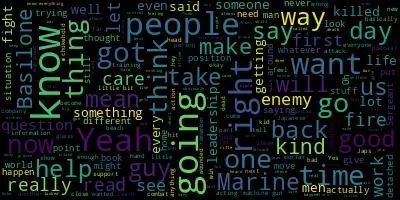
Most common words
Episode transcript
[00:00:00] This is Jocco podcast number 19 with echo Charles and me, Jocco Willink.
[00:00:12] I want you to think about something.
[00:00:17] And I want you to remember it.
[00:00:20] And that is that these books that I review and go through,
[00:00:26] and I want you to be able to do the written by people,
[00:00:36] real people. They're not movies.
[00:00:41] And when you picture what's happening in the book,
[00:00:45] don't picture it as a movie.
[00:00:48] Because we get inundated with so much imagery
[00:00:56] that we actually think the world is movies and television.
[00:01:04] But these books, they're not movies. They're not television.
[00:01:10] They're real. And these things really happened.
[00:01:20] They didn't happen on a screen or just in someone's mind
[00:01:24] and they weren't played by some actor.
[00:01:29] And when I talk about the fear that a soldier and
[00:01:31] a soldier and a girl's father was feeling, it's not part of some script.
[00:01:39] It isn't just a book, it's real.
[00:01:43] That's a real person, a person who really had those thoughts
[00:01:49] and those fears.
[00:01:54] And when I rattle off the figure of 800,000,
[00:01:57] tootsies killed by the Hutus and the Rwanda genocide,
[00:02:04] that's not just a number.
[00:02:07] Those weren't extras in a movie.
[00:02:13] They were people.
[00:02:18] People like you and people like me,
[00:02:21] people with families and friends and hopes and dreams and jobs and lives.
[00:02:34] People.
[00:02:41] And so remember that now.
[00:02:44] As we join,
[00:02:46] United States Marine Corps recruit,
[00:02:51] Chuck Tatum,
[00:02:53] November 1943 at the Marine Corps recruit depot
[00:02:59] in San Diego, California.
[00:03:08] Bayonet Training was a new experience.
[00:03:11] None of us would forget.
[00:03:12] It was tough, rugged, and required perfect physical conditioning.
[00:03:17] After we read the Bayonet Chapter in our guide book,
[00:03:20] Corporal Leary marches to the training range along the shore of San Diego Bay
[00:03:25] to learn this lethal art of war.
[00:03:28] I remember one paragraph in the Bayonet Chapter that got my attention.
[00:03:33] The rifle and bayonet in the hands of a marine become a deadly combination
[00:03:37] of spear, sword, club, and shield.
[00:03:42] At night, this combination weapon can kill silently and with surprise.
[00:03:48] In hand, the hand fighting when the rifle cannot be reloaded
[00:03:52] and the use of grenades would be impractical in practical.
[00:03:56] It is the decisive weapon.
[00:03:59] At these times, the aggressive Bayonet fighter will win.
[00:04:03] Leary quietly explained,
[00:04:08] and assault is the critical moment of any combat,
[00:04:12] and a bayonet assault executed by determined Marines can turn the tide.
[00:04:17] Men eager to engage in enemy with cold steel will strike terror in their ranks.
[00:04:24] He emphasized four points.
[00:04:28] One, get the blade into the enemy.
[00:04:31] It's the blade that kills.
[00:04:35] Two, be ruthless, vicious, and fast in your attack.
[00:04:41] Never pause in your attack until you have won.
[00:04:45] There is only one winner in a bayonet fight.
[00:04:48] Make sure it's you.
[00:04:51] Seek vital areas, but don't wait for an opening.
[00:04:55] Make one.
[00:04:57] The best killing zones are the throat and the belly.
[00:04:59] A solid rifle but stroke in the groin will open your enemy's guard,
[00:05:04] deliver it hard, and then go from the kill.
[00:05:08] Four, protect yourself.
[00:05:11] Your rifle and bayonet make a good shield.
[00:05:14] Use their protection by dodging and parrying,
[00:05:17] but remember, the best defense is to attack first, strike the first blow,
[00:05:22] and follow through.
[00:05:24] So they're training these young Marines.
[00:05:26] Obviously, this is 1943, they're getting ready to go, and fight.
[00:05:30] They know for a fact they're getting ready to go and fight.
[00:05:33] And you can see the psychological aspect of bayonet training.
[00:05:38] You know, it is an absolute, yeah sure, you might get in a bayonet fight,
[00:05:42] but this is a psychological training to get them aggressive,
[00:05:46] to get them in the mindset of striking first,
[00:05:49] to get them in the mindset of killing.
[00:05:51] Because that's what they're getting ready to go do.
[00:05:55] And as they continue to train this episode took place now there,
[00:06:02] they're a little bit further along and training,
[00:06:05] and here we go.
[00:06:07] During a marching break, one hot afternoon, a Marine remarked,
[00:06:10] screw all the training.
[00:06:12] I'm sick and tired of all this pussy footing around.
[00:06:15] I want to get overseas and slap me a jab.
[00:06:16] This remark was made in the presence of Sergeant George Lucas,
[00:06:22] who immediately cut him off saying, hold on, sonny.
[00:06:26] Let me tell all of you a thing or two about the Japanese soldier.
[00:06:30] Number one, he's not the caricature you see in the newspapers.
[00:06:34] With bomb sight, glasses, and buck teeth,
[00:06:37] the average Japanese soldier has five or more years of combat experience.
[00:06:41] Their army doesn't have a boot-dissident division like ours.
[00:06:46] Don't forget the Japs have already conquered half of the nation's in Asia.
[00:06:51] Remember Pearl Harbor?
[00:06:53] Not only are they better trained than you are right now,
[00:06:56] many are old hands at combat fighting,
[00:07:00] and have a strict military code they live and die by, called Bouchito.
[00:07:05] Literally translated, it means way of the warrior.
[00:07:08] With their code combined with their pledge to die for the emperor,
[00:07:14] who they consider God, they will die before surrendering.
[00:07:19] Japs soldiers are well equipped and are experts with their weapons.
[00:07:24] They are trained to endure hardships,
[00:07:27] which would have most of you guys writing your congressmen.
[00:07:30] I don't like Japs, but I respect them as fellow soldiers.
[00:07:34] I learn my respect the hard way on Guadalcanal.
[00:07:39] Japs are the worst, the world's best snipers,
[00:07:43] experts at the art of camouflage, and get by on a diet of fish heads and rice.
[00:07:49] They will never surrender and will commit hairy carry rather than being taken prisoner.
[00:07:55] Heck, they don't even have corpsmen.
[00:07:58] If they are wounded, they are considered damaged goods.
[00:08:00] So, Sonny, mold that over, and don't ever let me hear you complain about your training again.
[00:08:09] It will be a time when your life will depend on what you learn in the days ahead.
[00:08:22] That's...
[00:08:23] Obviously, anyone that's listening, that's in the military, that's in law enforcement.
[00:08:31] That's a message you need to get to your younger troopers.
[00:08:34] That the training that you're doing, your life may very well depend on it at some point.
[00:08:40] In the near future, in the far future, you don't know,
[00:08:45] but you got to take advantage of it.
[00:08:46] Now we get to when Chuck Tatum is done with boot camp,
[00:08:55] and he's checking in and he meets American hero.
[00:08:59] On my third day at Pendleton, this is Camp Pendleton for those of you that don't know what that is.
[00:09:04] It's Southern California.
[00:09:06] On my third day at Pendleton, I was sitting on my bunk when I heard footsteps echoing through the empty barracks.
[00:09:10] I looked up, and through the hallway came a cheerful looking marine and dress greens.
[00:09:16] On his armwear, the chevrons of a platoon sergeant, a hashmark adorned one sleeve,
[00:09:21] and combat ribbons decorated his left chest.
[00:09:25] The lump, this is his buddies, called the lump.
[00:09:28] The lump and I jumped to a meeting attention after spotting the sergeants stripes on his sleeve.
[00:09:32] Looking straight at us, a smile crossing his lips,
[00:09:36] the new arrival said quietly, and with authority,
[00:09:37] at ease, men, how's everything going?
[00:09:40] On platoon sergeant John Basilone.
[00:09:44] He was husky, with genial handsome looks,
[00:09:49] and his uniform had a comfortable, traveled look.
[00:09:52] I noticed strands of jet black curly hair peaking out from under his garrison cap,
[00:09:58] which was set at a cocky angle.
[00:10:00] While I responded to his greeting, it hit me.
[00:10:02] I was in the presence of a marine core legend.
[00:10:07] Manila John Basilone was the first marine enlisted man to receive the Medal of Honor in World War II
[00:10:15] for actions on Guadalcanal.
[00:10:17] We had heard about him in boot camp.
[00:10:21] I never had the courage to ask Basilone directly,
[00:10:25] why he had received the Medal of Honor on the canal.
[00:10:28] I didn't have to ask.
[00:10:29] I already knew. All American knew.
[00:10:33] His story was required reading in every red blooded household.
[00:10:41] Sergeant John Basilone's Medal of Honor citation read,
[00:10:46] while the enemy was hammering at the marine's defensive positions,
[00:10:50] sergeant Basilone in charge of two sections of heavy machine guns,
[00:10:53] fought violently to check the savage and determined result.
[00:10:56] Witnesses who investigated the results of the night's action during daylight
[00:11:03] remarked on the gruesome evidence of wholesale slaughter of Japanese soldiers.
[00:11:08] In front of Basilone's position, they counted 38 riddled and mangled enemy bodies
[00:11:14] and credited the kills to the fighting sergeant, using a 45-calibre pistol
[00:11:19] and his faithful machine guns.
[00:11:21] This remarkable feat was accomplished during a night when Basilone was at the same time
[00:11:27] changing spent machine gun barrels, clearing jams, and running barefoot for ammo
[00:11:32] to keep his sections guns spitting death.
[00:11:37] And so if you know anything about Basilone after he did that on Guadalcanal,
[00:11:42] he pulled him back to America.
[00:11:46] And what they pulled him back to America was basically to go around and make speeches.
[00:11:49] And all this is documented very well or imitated very well or shown very well
[00:11:55] in the movie The Pacific, or the series The Pacific.
[00:12:00] So he gets pulled back to America and they make him go out and do these warbond
[00:12:04] speeches and ease, he's not having a good time.
[00:12:09] It's not who he is, right?
[00:12:11] He's just a guy that wants to get after it.
[00:12:15] And so he literally goes to his commanders and says,
[00:12:17] Listen, I want to go back to fight, I want to go back to war.
[00:12:20] And by the way, when he was doing those bond sales, he was living,
[00:12:23] you know, complete life of luxury, he was meat movie stars, and he was getting treated like a movie star
[00:12:27] and all that did nothing for him.
[00:12:29] He wanted to go back to the fight.
[00:12:33] So he ends up going back now.
[00:12:36] Some of the other training, I had to throw this in there.
[00:12:39] One of the other sergeants that was helping train them was a guy named Bisonette.
[00:12:42] And among Bisonette's other talents was his ability to instruct us in the art of Jiu Jitsu.
[00:12:49] Bisonette taught us how to escape a half Nelson headlock by relaxing, holding our arm straight,
[00:12:54] and letting our body go limp.
[00:12:57] Once out of the hold, we could reach back and pull the legs out from underneath our attacker.
[00:13:01] Then by pulling out a K-bar knife, Bisonette showed us how to dispatch our assaylin.
[00:13:06] So we're even back then, learning a little bit of the Jiu Jitsu.
[00:13:10] Oh, I know a lot of people were recognized that move if you trained.
[00:13:15] And all this, of course, was to prepare for this island hopping campaign in the Pacific.
[00:13:19] That's what it was. And for Chuck Tatum, that started on the black sands of Ewo Jima.
[00:13:35] So they hit the beach on Ewo Jima.
[00:13:44] You know, after the work up going overseas, more training in Hawaii, they finally get to this point where they hit the beach.
[00:13:50] And here he is on the beach for the first time.
[00:13:54] And here's what Chuck Tatum says.
[00:13:56] I noticed a lone marine walking back and forth on the shore, among hundreds of prone figures,
[00:14:00] kicking behind, shouting cuss words and demanding move out, get your butts off the beach.
[00:14:06] He gave the marine core hand signal for follow me, a group of men responded, fascinated,
[00:14:12] I wondered why he was digging in like the rest of us.
[00:14:16] As he advanced, as he advanced, I recognized that the solitary marine was none other than gun resurgent John Basilone.
[00:14:23] Charlie company's living legend and the Marine Corps icon was headed toward me and Steve.
[00:14:30] His donegaries were freshly washed and ironed.
[00:14:34] His helmet strap was unhooked. He held a car-group car-bind in his left hand,
[00:14:39] and he had already ditched his cumbersome gas mask.
[00:14:42] Basilone wore a light-field pack and showed no fear, as if this invasion was no more than a serious training maneuver.
[00:14:47] I also saw Colonel Lewis C. Plain, the 27th Marine's executive officer.
[00:14:54] He and Basilone were the only two men standing up shouting obscenities and orders.
[00:14:59] The forward surge of Basilone's group carried them to our position.
[00:15:03] Only Basilone and Plain defied the firestorm raging around us.
[00:15:08] Move out, move out, get that off the beach, you dumb sons of bitches they screamed,
[00:15:12] kicking us right in the butts, right in left.
[00:15:17] What I thought was getting another mortar shell, falling in the same spot as before exploded 75 feet in front of Stephen Me.
[00:15:24] The blast shockwave whipped up black dirt that pushed its way into my eyes and foresand into my mouth, making me gag.
[00:15:32] It was uncomfortable and nasty, but my worry wasn't for myself.
[00:15:36] I hope the dirt wouldn't foul our weapon. Basilone ran up, whacked me on the helmet and pointed to the area where I thought the mortar shells had been regularly hitting.
[00:15:46] Only when the sand and dust cleared, I could see that Basilone was pointing at the aperture of a reinforced concrete bunker or blockhouse.
[00:15:54] The structure probably housed a 75 millimeter larger cannon whose field of fire was directed down the beach to our right.
[00:16:01] It was a big bastard with incredible killing power.
[00:16:04] It's shells were stalling the advanced by killing men of the fourth division.
[00:16:09] It may have been firing tree bursts, which is basically anti-personnel,
[00:16:15] trappled that explodes in the sky and rains down hell on ground troops.
[00:16:20] Running 35 feet to the spot picked by Basilone, our field of fire was now diagonal to the aperture of the blockhouse cannon.
[00:16:28] We open fire again in the tracer rounds were right on target.
[00:16:31] Now I was pleased. My bullets forced the enemy gunners to close their gun port.
[00:16:37] With their arm report closed, the front of the blockhouse was blind.
[00:16:41] Even though it was temporarily out of commission, I still wanted to fire at it.
[00:16:46] Basilone's signal to me to commence firing again and I directed and then he directed a flame thrower operator.
[00:16:53] Corporal William Pegg, a marine of imposing size to repeat their precarious path taken by the demo man along our line of streaking bullets.
[00:17:01] So you got some cover and move going on. You got Chuck Tayham laying down fire and now you got a flame thrower operator.
[00:17:07] If you don't think about those flame throwers, they're carrying big giant looks like scuba tanks on their backs.
[00:17:12] They weighed 70 or 80 pounds.
[00:17:14] And obviously these are prime targets for the enemy because the enemy hates these things.
[00:17:19] So if you're wearing one of these things on your back, you're getting sniper shots at you and everyone's trying to kill you.
[00:17:27] Basilone whacked me on the helmet to signal cease firing.
[00:17:30] I didn't want to quit everything was working perfectly.
[00:17:33] Why stop? I could see trace around pounding into the building and let and felt extreme satisfaction with my accomplishment.
[00:17:38] Nevertheless, I ceased firing as ordered and Pegg, this is the guy carrying the flame thrower, staggered under the 70 pound weight of his tanks and equipment.
[00:17:46] Causes the move toward the shattered bunker walls.
[00:17:50] Sticking his flame thrower nozzle into the smoldering hole, he ignited his napalm releasing 350 pounds per squareence of pressure in his tanks.
[00:17:58] There was a loud roar of the sound and it looked like a fire-spitting dragon's jaw had erupted.
[00:18:05] The unsuspecting and stunned men inside didn't know the horror that was about to engulf them.
[00:18:09] They were cast instantly in the center of a roaring inferno and incinerating searing hell.
[00:18:16] I felt a surge of allation when the flame shot inside.
[00:18:20] It wasn't because the gruesome conflagration and agony that were about to overwhelm the enemy, but because of our success.
[00:18:27] No one could live through Pegg's napalm pire.
[00:18:31] Sergeant Basilone had directed this operation by the book, exactly the way we'd practiced at Pendleton in Camp Taroa.
[00:18:36] So it's perfect cover move and the reason he sees his fire is because you have to seize fire so that the guy with a flame flow can actually get close enough.
[00:18:47] Because when you're shooting at that building, there's Ricochet going all over the place so that he has to seize fire at the last moment.
[00:18:53] So the guy can get right up close.
[00:18:57] As I lay prone again, ready to fire, Basilone stood astride my back startling me.
[00:19:01] Bending over he grabbed the machine gun bail in one hand with a practice motion unlocked the tripod releasing the gun.
[00:19:08] He screamed in my ear, get the belt and follow me.
[00:19:11] Basilone ran toward the roof of the old blockhouse.
[00:19:14] Grabbed what was left of a claw family belt my arms and I followed him at a gallop up the slopes of the ruined emplacement.
[00:19:22] Standing on top, we could look down on the rear entrance as the rear entrance of the pill box.
[00:19:27] There was a low area 30 feet in diameter where some of the Japanese defenders had run to escape the brulist ring and furno inside.
[00:19:36] Basilone cut them down firing from the hip.
[00:19:39] The machine gun vibrated in his powerful arms.
[00:19:42] He sprayed the enemy soldiers, helped by the Basilone bail.
[00:19:45] A wooden handle fastened by wire to the barrel of the weapon that was inspired by Basilone's metal of honor and engagement on canal when he was burned carrying the hot machine gun.
[00:19:54] Without the bail it would have been nearly impossible to control the blistering machine gun when it's tripod was taken off.
[00:20:01] Mowing down the screaming japs was purely a mercy slaying.
[00:20:07] Pitifully, the men were frantically trying to wipe away the still flaming jelly to gasoline sticking to their tortured bodies.
[00:20:14] The putrid smell of burning human flesh nearly made me want to vomit.
[00:20:18] Basilone's eyes contained a fury I had never seen before.
[00:20:24] His jaw was rigid, clenched hard, and sweat glistened on his forehead.
[00:20:30] He was not an executioner, but a true marine performing his duty.
[00:20:36] For me and others who saw Sergeant Basilone's actions during our assault,
[00:20:41] his leadership encouraged were overwhelming.
[00:20:43] Meanwhile, Charlie Company Rifleman and Steve Evanson shot the japs as they screamed in agony.
[00:20:54] Intense assaults just completely intense.
[00:21:01] And again, this is a guy that's already won the Medal of Honor, and he's out there taking charge and leading troops.
[00:21:08] He has no beard, no was not required to be there.
[00:21:13] He could be back in the States with, you know, in Hollywood, Rubin elbows with the movie stars.
[00:21:20] But there he is back in combat, back on Ewo Jima and leading.
[00:21:27] We came under intense fire from a gun, from gun placements on the slope of Mount Surabachi,
[00:21:32] less than a mile away, and took shelter in a crater made by one of our own 16-inch guns from a very large bomb.
[00:21:39] Murder rounds fired from enemy positions at the north end of the runway started to fall in our immediate area.
[00:21:45] We knew someone was watching us.
[00:21:48] On top of everything else, we began receiving incoming fire from offshore US Navy vessels.
[00:21:54] These were not misguided rounds, we had moved so far and fast that this rolling barrage that was intended
[00:22:00] for the entrenched Japanese defenders was now hitting us.
[00:22:05] So now we were bracketed by Surabachi by the enemy held high ground to the north and by our own Navy.
[00:22:16] I always want to bring up these points of blue on blue, and how chaotic it is, no one realizes that.
[00:22:23] How hard it is to decinflict fires in combat.
[00:22:27] Back to the book of the three dangers we faced, I feared our Navy the most.
[00:22:35] I'd already seen the destructive power that their shells caused when they pounded the Japs Beach defenses.
[00:22:41] I firmly believed we'd be killed if we stayed inside our giant shell hole.
[00:22:46] With what seemed to be an instant common consent, everyone in our small groups started to fall back.
[00:22:50] Basilone stopped the retrograde movement in our tracks by ordering digging and holding this ground come hell or high water.
[00:22:58] I'll go back for more men.
[00:23:05] Manila Johns, that was a John Basilone's nickname was Manila John.
[00:23:10] Manila Johns professional combat expertise had broken up a human log jam on the beach and wiped out a major Japanese defense position.
[00:23:16] Now, his moral leadership would hold together a small group of green troops in advance position.
[00:23:24] I gingerly peered from our position toward the landing beach 75 yards away, a group of Marines was advancing toward the runway with Basilone in the lead.
[00:23:34] This is so, so Basilone had gone back, get more troops, and now they're coming back to their position.
[00:23:39] I felt momentary elation, gunny Basilone was coming back with more men.
[00:23:45] Then I heard enemy rounds falling to earth.
[00:23:49] From the relative safety of our shell hole, I watched in horror as the explosions tore Basilone's body apart.
[00:23:57] It was awful. It looked like Sergeant Basilone was down.
[00:24:01] Sometime that afternoon the word reached us, Basilone's dead.
[00:24:05] America's hero, dead. My own hero killed. How could he be dead?
[00:24:09] I couldn't believe it. The legend of Basilone, a legend born in the jungles of Guadalcanal, the hero killed.
[00:24:23] I had read about in boot camp, who's stature had grown larger on the black and bloody sands of Ewo, as I held the machine gun belt for him. He was gone.
[00:24:42] We will all miss you. I fought as tears cut paths down my grime covered face.
[00:24:48] I fought of Basilone's cocky smile, curly black hair, and the way he wore his hat at a junty angle over one year.
[00:24:58] He had a unique personal style in charisma.
[00:25:03] For me at least, no one could ever be like Basilone.
[00:25:09] America, the United States Marine Corps, and Charlie Company first battalion 27th Marines, had lost a hero.
[00:25:16] Dead at 29.
[00:25:26] Basilone's death strengthened our makeshift squad.
[00:25:31] Resolve showed on the faces of 17 Marines told the whole dark position, come hell or high water.
[00:25:37] We were receiving fire from all quarters. The shells were pouring in on us, and shrieks and house,
[00:25:44] and shredding the earth around us.
[00:25:47] Enemy gunners on Surabachi now turn their ballistic attention on us, using observed and directed fire from their lava layer.
[00:25:55] Five and shells from ships mingled in the brew of devastation, smashing across the landscape.
[00:26:01] Surabachi's defenders continued shooting in us, while Japanese mortar men north of the airfield pursued their deadly pounding of the Marines along the beach.
[00:26:10] The invasion area was a tangle of equipment and supplies smashed vehicles and sunk in naval craft.
[00:26:19] Reserve and support units continued to pile up and congested mess.
[00:26:24] Thousands of men, the dead, the wounded, the terrified, and those trying to unload supplies swarmed over the black sand.
[00:26:34] We were now targeted by our Navy's gunfire.
[00:26:37] I wasn't sure of the size and bore of the projectiles, or if they emanated from a battleship or destroyer,
[00:26:45] but I didn't know that they chilled my blood as they came shrieking in.
[00:26:51] We would be safer if we withdrew to establish lines so that we would be behind instead of in front of the Navy shells.
[00:26:58] But Sergeant Bazlone had ordered us to stay, and that alone was sufficient enough reason to remain.
[00:27:07] None of us would disobey his direct order.
[00:27:10] We believed it was only a matter of time before others would reach us, and we'd be free to move on.
[00:27:17] Brutal.
[00:27:25] And by the way, this is an example.
[00:27:31] This is Chuck Tatum's first combat experience.
[00:27:34] His first combat experience used out of boot camp did some training in Hawaii, did some training on Taroa,
[00:27:39] and then boom.
[00:27:41] Here he is.
[00:27:43] Back to the book.
[00:27:44] I saw an inspiring site.
[00:27:48] Survivors of our Bravo Company with Sergeant Windelout in front, followed by Lloyd heard and the ammo carriers were approaching us.
[00:27:56] What we were witnessing were the remnants of Baker Company.
[00:28:00] We were happily reunited with heard and the other ammo carriers, but devastated by the news.
[00:28:07] Our company had suffered severe losses during the beach assault.
[00:28:10] We had 17 men killed and 51 wounded.
[00:28:16] A couple hours in 17 killed and 51 wounded.
[00:28:28] So now we're eased reflecting on what this morning is feeling like.
[00:28:33] Our first morning on Ewo, when we were pinned helplessly by mortar barrages on the black sand beaches, we were reminded of warnings by veterans who said that
[00:28:44] Japs are the world's best soldiers with a knee mortar.
[00:28:48] Though chilling, those warnings weren't exaggerated.
[00:28:52] Even the blunt advice of the vets didn't convey the pure horror of an enemy mortar attack.
[00:28:57] It was pure hell to be caught in the open when the Japs opened up with a full mortar attack.
[00:29:05] The sound of mortars swishing through the air froze my blood.
[00:29:12] Against these invisible missiles, there was no defense.
[00:29:17] If we were caught in the open, all we could do is hit the deck.
[00:29:21] A foxhole offered little protection from these high trajectory missiles because they dropped straight down on us.
[00:29:31] Again, this is a lack of control of your environment.
[00:29:36] We've heard this over and over again.
[00:29:39] The indirect fire, the mortars, the artillery that you can't control.
[00:29:44] And it's random.
[00:29:46] That's the most horrifying thing to everybody.
[00:29:52] The rear areas, particularly eastern or landing beaches, where support forces were working suffered a bloody pounding.
[00:30:01] Sunken, brooch landing craft piled up along the beaches.
[00:30:05] Multimillions of dollars worth of valuable equipment and vessels had been systematically wrecked by deadly accurate Japanese shelling.
[00:30:12] The debris washed idly back and forth in the frothing surf.
[00:30:17] Human wreckage.
[00:30:19] The wounded, dead and dying littered the cold sand.
[00:30:24] Engineers, C.B.s, and shore party personnel struggled to create order from the chaos.
[00:30:30] Doctors and corpsmen too often fought a losing battle against the grim reach reaper.
[00:30:36] Watching over our battlefield.
[00:30:38] Armed with simple field dressings and infusions of hold blood.
[00:30:44] They tried to stem the tide of human suffering and life's blood pouring into E.O.'s lava hide.
[00:30:53] Our corpsmen turned into angels of mercy.
[00:30:57] They saved hundreds of Marines daily and tried to ease the pain of the hopeless cases with liberal injections of morphine.
[00:31:05] Now, there's obviously a famous picture from E.O. G.M. of the Marines raising the flag on one corpsmen.
[00:31:14] I think raising the flag was a corpsmen raising the flag on E.O. G.M.
[00:31:18] And this is what it looked like for him.
[00:31:23] This is not mean you get the impression that the fighting was over.
[00:31:26] With that, the fighting was not over.
[00:31:28] When you look at the picture, we knew it was the better.
[00:31:30] We hadn't even close yet, but they did take a prominent terrain feature.
[00:31:35] This is what it was like for Chuck Tatum.
[00:31:38] As the 26 Marines pressed their attack, enemy mortars began falling in our rest area.
[00:31:43] Japanese weapons were capable of firing from one end to the island to the other.
[00:31:48] With thousands of Marines crawling around in concentrated areas, it was an easy task to keep our advancing troops under fire.
[00:31:53] From our reserve positions near the beach, it was possible to witness the battle raging for the possession of Mount Serabachi.
[00:32:02] Through sergeant windows field glasses, we took turns watching the upward progress of our men as they approached the steep rocky slopes.
[00:32:11] It appeared the 28th Marines were at the base of the volcano.
[00:32:15] He's from the battle obscured my vision, but we could tell that it was one hell of a fight going on.
[00:32:23] It felt sickening to be in reserve, watching a battle where men were dying almost before our eyes.
[00:32:30] It seemed like watching a motion picture from the wrong end of a telescope, if that makes any sense.
[00:32:37] At about 10 30 a.m., Steve slapped me on the back and pointed third Serabachi shouting,
[00:32:43] Tadeum, do you see that?
[00:32:46] I twisted around and saw stars and stripes clearly on the peak waving in the breeze.
[00:32:53] The 28th Marines were now King of Imo Iwo Jima's Hill.
[00:32:59] Cheers from thousands of Marines and roared and reverberated across the island.
[00:33:04] I felt a surge of pride. I was proud to be a Marine and proud to be an American fighting on Iwo,
[00:33:12] but we weren't attending a picnic.
[00:33:15] Live shells were still dropping on us throughout Iwo.
[00:33:19] Steve and I soon forgot the flag raising, as we basically re-engineered our foxhole, digging deeper into mother Iwo.
[00:33:26] Because like it or not, the word was that the Japanese still occupied more of Iwo than the Marines.
[00:33:34] To prove that they were still the main landlord, the enemy sent a message via concentrated artillery and mortar attack.
[00:33:44] Now, a couple days go by and Chuck Tadeum's feet are getting messed up from being in socks and they're wet.
[00:34:08] And so you need to get some clean socks and there's basically one place to get them.
[00:34:17] Given the condition of my feet, I knew additional socks were imperative.
[00:34:23] I asked Sergeant Wendell for permission to make a run to the dead man or casually piled to look for a pair.
[00:34:29] The dead man or casually piled contained clothing, equipment and weapons of dead or wounded Marines.
[00:34:37] I had to go a quarter of a mile, and as I hobbled there, I felt uneasy and a big guilty about the prospect of being a scavenger.
[00:34:46] But I had no choice.
[00:34:50] The demands and horrors of Iwo's battlefield left no other ready solution to the problem of resupply.
[00:34:56] I hesitantly picked up a pack only to drop it instantly.
[00:35:01] There was a bullet hole straight through it.
[00:35:05] I found another one intact and solely lifted it, trying to see the stencil name of its previous owner.
[00:35:12] Curiosity got the best of me. It wasn't anyone I knew.
[00:35:17] Undoing the straps, I carefully removed the contents.
[00:35:20] There were two perfectly clean and dry pair of green wool socks.
[00:35:26] I saw you lo and folder lay at the bottom of the pack and it felled the ground as I shook out the contents.
[00:35:33] I opened the folder.
[00:35:37] A photo of a smiling girl beamed at me.
[00:35:40] All my love to Joe, Maryland, was neatly written across the bottom of the photograph.
[00:35:48] I carefully replaced the folder in the pack and set a prayer for Joe and Maryland.
[00:35:55] I remember when you were a kid.
[00:36:10] You were taken gear from dead and wounded Marines.
[00:36:13] Now they're out continuing to press through, continuing to make slow progress but they are making progress.
[00:36:32] Leaving our machine guns, we spread out in an infantry style formation to comb the area.
[00:36:38] Our search for snipers was fruitless but we did find a dead enemy soldier in a clump of bushes.
[00:36:46] The smell, rotting his corpse, almost made me puke.
[00:36:52] The stench could gag a maggot, Steve said, bloated.
[00:36:58] The body was a spider trap.
[00:37:01] And almost unrecognizable as having been a human being.
[00:37:09] His uniform was charred so I thought that it might have been hit by a flame thrower.
[00:37:17] Bloding and caused the tunic buttons of the canavers uniform to pop off.
[00:37:22] There note was no skin on what had been the face but the future flesh had scabbed over.
[00:37:27] Swims of flies were attacking the torso and maggots were wiggling in the eyes.
[00:37:35] I guess we were lucky. He will had no buzzards.
[00:37:40] A rifle lay beside the body. No one touched it.
[00:37:45] They might be booby trap. Don't screw with it.
[00:37:50] Later, resting in our reserve area, I looked at my watch.
[00:37:54] Saw it was 330 pm and decided to eat a K ration.
[00:37:59] Seeing the body of dead jabs had become so commonplace,
[00:38:04] I could erase this one from my thoughts.
[00:38:07] It had nothing to do with me.
[00:38:10] I had become as hardened to death as an undertaker.
[00:38:15] Moving on.
[00:38:17] I was causing to consolidate the men were hit with grenades, mortars, and machine gun fire from their exposed flanks and rear.
[00:38:28] This is taking place as there.
[00:38:33] Performing in a soul on a hill.
[00:38:36] Cleverly the Japanese had sprung a trap, mortar fire from behind 362 alfa.
[00:38:47] Caves in front of the cliff opened up, and alfa companies first puttune was the hardest hit in curing heavy casualties.
[00:38:52] At 130 pm, alfa company had to pull back as quickly as the hail of machine gun fire and bullets would allow.
[00:39:00] More men were lost trying to save the wounded.
[00:39:03] The work that had gone into arming and fortifying hit hill 362 alfa, the Japanese version of the Magino line in France, was awesome.
[00:39:15] And it was serving its designers' purpose.
[00:39:18] It was stopping the marines.
[00:39:20] The trap sprang shut and we were in it.
[00:39:24] Japanese mortars winged in, greeting our attack.
[00:39:27] We took cover. Machine guns and rifle fire erupted from every crack and crevice in hill 362 alfa.
[00:39:34] The mountain was spewing death and destruction from every fissure in its volcanic hide.
[00:39:40] There was no way to fight back. We couldn't see our enemy.
[00:39:44] But they could see us, and they had us dead in their sights.
[00:39:49] We scrambled over the rocky terrain without cover.
[00:39:52] Steve and Van carried our machine gun followed by pops, whipped comb, and Lloyd heard our ammo bearers.
[00:39:59] An orchestra of marine and jab borders, machine guns, rifles and artillery created a roaring shrieking clamor,
[00:40:06] inducing terror throughout the ranks, stopping our forward momentum.
[00:40:12] With mounting casualties and nightfall approaching, we consolidated our positions in dug in.
[00:40:18] We were literally nose to nose with our mortal enemies.
[00:40:23] Some of the enemy physicians were less than 40 feet in front of us.
[00:40:27] The days fight had cost the battalion and estimated 100 casualties for gain of 200 yards.
[00:40:35] A typical days fighting on E-Wale.
[00:40:42] Going forward, continuing to push.
[00:40:45] Back to the book, mortar, machine gun, and targeted rifle fire torn to the company.
[00:40:52] Men started dropping on all sides, dirt ripped at my eyes, and the clamor of explosions and bullets pounded against my ears.
[00:41:00] The ridge we faced was alive with an enemy that was impossible to see or kill.
[00:41:05] Captain Manchine kept forward, crept forward. He could see the chaos and disorder of our situation.
[00:41:12] Standing up with a cool, purposeful manner, he took charge.
[00:41:17] He looked as calm as though he were directing a training maneuver at Camp Pendleton.
[00:41:22] We organizing the company, he directed a withdrawal from our untenable position.
[00:41:27] He seemed to be everywhere at the proper moment.
[00:41:30] Personally assisting wounded, making sure everyone got out of the japs trap.
[00:41:36] Captain Jimmy Maynchine never ran out of courage.
[00:41:38] And his selfless, heroic actions saved a problem from destruction.
[00:41:44] But he did run out of luck.
[00:41:47] He was the last man still in the trap.
[00:41:50] When he attempted to withdraw towards our line, Japanese soldiers used him for target practice,
[00:41:56] riddling his chest with multiple bullets wound killing him.
[00:42:00] Reacting to the loss of our favorite officer,
[00:42:03] the company found a collective fury and determination.
[00:42:08] We organized, we rushed to the offensive.
[00:42:12] Because we were too close for artillery, fire support, or air strikes,
[00:42:17] the fight developed in a classic Marine infantry attack.
[00:42:21] Small clusters of men advanced by fire and fast movement until they found
[00:42:26] an obliterated each concealed strong point or individual enemy soldier.
[00:42:30] Vans gun suddenly stopped.
[00:42:35] Looking their way, I saw that he and Steve were down.
[00:42:39] Suddenly I was overwhelmed with rage.
[00:42:42] And all the anger I had stored up against the Japanese burst out.
[00:42:47] Without thought or hesitation, I sprinted into Vans position.
[00:42:52] Vand had been hit in the back near the right shoulder, and the round and exit it is left side.
[00:42:56] Steve had been gut shot twice, and it was white with shock.
[00:43:01] By reflex, he was holding his hands to his stomach, to stem the bleeding.
[00:43:06] Blood poured out around his fingers.
[00:43:09] As he pulled his legs into the fetal position, I could see the pain on his pinched face.
[00:43:16] Knowing that the japs with shoots, Steve and Vand, as they rolled around on the ground,
[00:43:21] I grabbed their machine gun into my arms and fired from the hip, like Basilone did,
[00:43:24] sending lead into the cave to suppress enemy fire.
[00:43:28] I was in a hot rage and swivel the gun about, so its bullets would ricochet throughout the cave
[00:43:33] and decimate those bastards who shot my friends.
[00:43:36] Clouds of rock dust billowed from the cave's mouth.
[00:43:41] I poured fire into the cave's black mouth until the belt round out.
[00:43:45] For a second, I stood there.
[00:43:48] The 30 cows barrel smoking.
[00:43:50] The japs who had shot Steve and Vand were silent.
[00:43:55] Nothing came from the cave, no bonsai charges, no moans, nothing, just smoke and dust.
[00:44:04] My senses returned.
[00:44:07] Dropping the gun, I turned to Steve and Vand.
[00:44:11] I knew they were dying.
[00:44:13] I screamed, corpsman!
[00:44:15] With the cave suppressed and the area safe,
[00:44:18] Doc Marsh ran to Steve and knelt over him, then turned to Vand.
[00:44:23] Seconds tick past, seeming like hours.
[00:44:26] I waited for Docs orders.
[00:44:28] Her grand out to join us, and help me and Marsh drag Vand and Steve to cover.
[00:44:34] Marsh injected Vand with morphine, while I broke open Steve's first aid kit,
[00:44:40] and handed the service, heret to Marsh.
[00:44:43] He shoved the needle into Steve's flesh.
[00:44:45] I screamed, stretch your bears.
[00:44:49] This day of violence, fear, killing, and maming,
[00:44:54] left me on the edge of despair.
[00:44:57] Sergeant Windle talked to me in a personal and marine way.
[00:45:03] Tatum, he said, let's go, we've got a job to do.
[00:45:07] My mind slipped into a productive mode,
[00:45:11] when events beyond my control took over.
[00:45:13] From that afternoon on, I purposely tried to avoid getting to know
[00:45:18] the replacement ammo humbers, and the Marines filling the slots of those we had lost.
[00:45:23] I didn't want to know their names, where they were from,
[00:45:27] or to see their girlfriends pictures.
[00:45:30] I didn't want to get attached to them,
[00:45:33] and suffered through the loss of close friends again.
[00:45:36] The war was still going on 30 feet ahead.
[00:45:40] I wanted revenge.
[00:45:43] Unseen, our enemy continued to punish us,
[00:45:47] as we consolidated our gains for the day and attempt to declare the newly seized territory.
[00:45:52] A new private, a replacement called me the edge of a bluff.
[00:45:57] He had spotted enemy soldiers, clustered in a pill box, and was trying to show me their location.
[00:46:02] I couldn't see what he had found, and was sighting down his arm, while he pointed.
[00:46:06] Our head side by side.
[00:46:11] All of a sudden a crack rang out.
[00:46:15] He jerked forward, and was dead before I could catch him.
[00:46:19] A sniper's bullet had hit him between the eyes.
[00:46:23] Instinctively, I called for a corpsman,
[00:46:27] although the man was beyond help.
[00:46:30] When the medic came up, he said,
[00:46:32] I can't take it anymore. I can't go on. If they want to, they can just shoot me right now.
[00:46:40] The blood that covered the medic's uniform wasn't his own.
[00:46:44] Medics are considered non-combatants under international law,
[00:46:48] but the japs didn't care about international law.
[00:46:51] After ten days on Ewo, he hadn't fired a shot.
[00:46:55] He was too busy stopping the flow of others' blood.
[00:46:58] I didn't know what to tell him.
[00:47:03] I put my arm around his shoulders and said, I understand.
[00:47:08] It didn't seem to help.
[00:47:11] Staring straight ahead, he cried, I just want out of this war.
[00:47:17] Then someone else yelled,
[00:47:20] corpsman, the medic tried his eyes, picked up his kit,
[00:47:24] and left to go patch up another wounded Marine.
[00:47:29] Now it's 12 days into the invasion, so D plus 12.
[00:47:37] March 3rd was a bad day for replacement officers.
[00:47:42] Lieutenant Scarcia, Harrington, and Leach,
[00:47:45] all assigned from the 27th replacement draft, were killed in action.
[00:47:49] We've almost no experience commanding troops in combat or anywhere else.
[00:47:56] Second Lieutenant had been cranked out of officer-candidate's school
[00:48:00] and chronic over junior wholesale.
[00:48:03] The Marine Corps created its new leaders with assembly line speed.
[00:48:08] Harrington and Leach were commissioned officers for five months
[00:48:11] when they were told to lead battoons in deadly combat.
[00:48:14] Brave inexperienced pinch hitters, or substitute quarterbacks
[00:48:20] in a game of death, they never even knew the men they were trying to lead.
[00:48:28] Now he gets to the 14th day.
[00:48:33] By mid-morning, word swept through our ranks.
[00:48:38] Colonel Butler has been killed.
[00:48:40] Butler had been writing in a Jeep to a conference at the Regimental Command Post in order to save time.
[00:48:46] Along the way, he decided to check out the terrain he impotisipated
[00:48:50] will be his men's next objective when the vehicle approached a trail junction near
[00:48:55] old sugar mill.
[00:48:57] His party took a direct 47-millimeter round hit from a Japanese anti-tank
[00:49:03] and he was killed instantly.
[00:49:04] The driver and NCO accompanying him were seriously wounded.
[00:49:10] He was another E-WO tragedy, but not the last.
[00:49:14] Shortly after Colonel Butler's death, a sniper killed my squadmate and camped
[00:49:19] Tarowore placement.
[00:49:21] PFC Lavore Jenkins of freedom Wyoming has arrested between assaults.
[00:49:27] Lavore was 18 days short of celebrating his first year in the corps.
[00:49:31] Jenkins lost, meant the first squad was down to three members.
[00:49:37] Billy Jill, call for our baby face marine, go for Gus, Henderson, and Ralph Jeffers.
[00:49:42] Now they were actually pulled off the line for a bit and had a little bit of a rest.
[00:50:01] During our day of rest, my headache grew worse and I consulted a corpsman.
[00:50:05] My ears ring, I told them.
[00:50:11] Not impressed, he answered, it's normal for ears to ring in combat.
[00:50:16] He gave me some aspirin for my headache and asked, anything else wrong?
[00:50:21] I showed him my leg wound.
[00:50:24] He jokingly said, too bad your wound isn't deeper if it was.
[00:50:29] You'd have a ticket off this damn dilund.
[00:50:31] The aspirin didn't touch my headache, it grew worse.
[00:50:37] My ears rang constantly and I felt nauseous.
[00:50:41] I was getting weaker and I knew it.
[00:50:46] And so what we've got now is the initial stages of combat fatigue.
[00:50:51] He started to feel it.
[00:50:55] When tremella sits one of his other guys, when tremella's gave me hell about something
[00:50:59] and my mind was hazy and numb.
[00:51:03] I didn't answer him.
[00:51:06] About midday, the word came down, move out.
[00:51:10] Our day of rest was over, I reckoned, roofily.
[00:51:14] We formed up to move out in a spread formation and immediately began taking more to fire.
[00:51:20] I mean, it's just a nightmare.
[00:51:23] Take cover, window-hawed, hallowed.
[00:51:25] As we scattered like a cuvvy of quail seeking refuge.
[00:51:29] Around hit a few yards from me, my pulse raced and my battle senses told me to move.
[00:51:34] Sprinting, I ran for a rock outcropping 30 yards away.
[00:51:38] When I was halfway to safety, a close-round knocked me to the ground.
[00:51:42] Mortar artillery shelling it scared the hell out of me since D-Day.
[00:51:45] But the fear I felt now was different.
[00:51:48] My hands trembled.
[00:51:50] Fortunately, the barrage stopped quickly.
[00:51:52] I changed smoke to settle down.
[00:51:56] My head pounded and I gulp down, can't teen water until my stomach was upset.
[00:52:04] My legs felt paralyzed like a childhood nightmare in which I wanted to run, but couldn't.
[00:52:11] The company moved out, but I stayed where I was.
[00:52:14] All I could think was fuck the war, fuck the japs, and fuck this whole island.
[00:52:23] A flood of ever of other fuck everything served through my tangled thinking process.
[00:52:29] Then awareness that I was alone and the fear of becoming a snickers snipers target prompted me to move.
[00:52:35] There was another conclusion.
[00:52:38] If I stayed where I was, the Marine Corps would shoot me as a deserter.
[00:52:41] Self-preservation instincts kicking in, I told myself, get off your butt and start moving.
[00:52:48] I looked for my vanished company.
[00:52:51] Eventually, I heard someone calling my name.
[00:52:55] Through the hazy vision, I saw Sergeant Window walking toward me.
[00:53:01] When he was close enough, he looked at me.
[00:53:04] Tatum, are you okay? He asked?
[00:53:06] Let's join the company and don't worry, you're going to be okay. You're going to make it.
[00:53:13] I followed him without argument or objection.
[00:53:20] Before we set in for the evening at 3.30 pm, Window said to me, Tatum, I'm sending you back.
[00:53:28] Glancing at tremelles, he added, you're out of here too. You're both finished.
[00:53:34] Get the hell back, both of you.
[00:53:38] The trek to the rear and red beach, too, are starting point 15 days ago, took an hour.
[00:53:45] There were no tears in my eyes. I had combat fatigue.
[00:53:50] I was just going to get out of here.
[00:54:00] So, they're done.
[00:54:05] And they get pulled off the island.
[00:54:09] They get pulled off the island. They get pulled off the island.
[00:54:22] So, they're out there on the ship.
[00:54:25] Obviously, they're out there with a bunch of other marines.
[00:54:30] Back to the book, Tramelas and I felt completely out of place.
[00:54:35] We were among seriously wounded marines, and I almost felt guilty that I wasn't wounded physically.
[00:54:42] Our wounds were two our minds, and there were no bandages that could be applied to them.
[00:54:49] There were no drugs that we could take that would erase the images of war that filled our heads.
[00:54:55] Mother nature, where the assistance from modern medicine, could heal the flesh.
[00:55:00] But the mind is different.
[00:55:02] You can never forget the pain you suffered in a place like Ewo Jima, and the scars will always be there.
[00:55:10] Tramelas and I had been labeled SSCF or shell-shocked combat fatigue.
[00:55:20] This label had a negative connotation.
[00:55:24] I suppose this was the result of the general misunderstanding of this type of condition.
[00:55:29] It did not denote a lack of courage or resolve to fight.
[00:55:35] It was a condition caused by the inability to continue past physical or mental exhaustion.
[00:55:42] Most marines who suffered combat fatigue were the ones who had survived to fight another day,
[00:55:49] and another day, and another day.
[00:55:52] The lucky ones got the million dollar wound on the first day and lived to recover.
[00:55:58] They didn't go back into the siege time and time again, as Tramelas and I had done.
[00:56:04] Each day, to see the decimation of young lives, the deaths of buddies who were closer than brothers,
[00:56:10] boys whose parents hopes would be dashed by a message from the Navy saying,
[00:56:15] we regret to inform you.
[00:56:20] Most people never have to witness the killing of someone they are close to,
[00:56:24] a loved one who is shot or decapitated.
[00:56:27] Watch a brother whose face is filled by the look of deep shock that precedes death.
[00:56:33] They never feel the helplessness of watching life bleed out of a mortal being.
[00:56:41] Those who know war know of what I speak.
[00:56:46] I decided on Sipan that I would never apologize for my actions on Ewo Jima,
[00:56:52] or for falling prey to combat fatigue.
[00:56:57] I gave it my all.
[00:57:11] Obviously in this day and age, we've been dealing with a lot of combat fatigue, PTSD.
[00:57:19] And I think one thing as I read through this,
[00:57:26] I thought back to Colonel Hackworth's book and about face.
[00:57:34] One of the ways that he describes it is he says that basically people have a cup.
[00:57:41] And different size cups, different people have different size cups,
[00:57:45] and the cups are to get filled up.
[00:57:49] And if it gets filled up, it's done. You're done. You can't take anymore.
[00:57:54] And you just gotta go away.
[00:57:57] And this is the first time as I read this,
[00:58:01] obviously, Junk Tatum showed extreme courage over and over again.
[00:58:06] And he points out the fact that there's not that many guys that went day after day after day
[00:58:12] and we're lucky enough to not get wounded.
[00:58:16] Or I guess you could say unlucky enough.
[00:58:19] And eventually they reach a point where they can't take anymore.
[00:58:24] Now you do get some guys that can handle more.
[00:58:27] And I thought of this today, it's just nature.
[00:58:33] It's just how you're formed.
[00:58:36] And I'm not going to be mad at someone because they can't bench press 500 pounds.
[00:58:45] Some people don't have that. That's not part of their physical makeup.
[00:58:50] That's not part of their physical constitution or their mental constitution.
[00:58:55] And it's the same thing here.
[00:58:57] Some people just have a higher propensity for this type of mental stress so they can handle it more.
[00:59:02] And that doesn't mean that someone that can't bench press 500 pounds like me doesn't mean
[00:59:11] a pathetic person.
[00:59:13] No, it just means that I just didn't naturally inherit those genetics that give me the ability to bench press 500 pounds.
[00:59:20] Now, and it's the same thing with what you inherit mentally.
[00:59:25] And some people, their cup,
[00:59:27] get filled up, especially when they are lucky or unlucky enough as we just discussed,
[00:59:33] to survive day after day after day after day after day and 14 days of thinking that you're going to die
[00:59:41] and seeing your friends get wounded or killed.
[00:59:47] Again, even back then,
[00:59:49] oh, he said it had a negative connotation almost like you weren't mentally tough enough.
[00:59:53] Right, like you had the luxury of not getting shot and all this stuff.
[00:59:58] Right, and he's still couldn't hack it almost.
[01:00:01] And my point is number one to support what he says,
[01:00:05] you've take anybody, anybody's going to have a breaking point.
[01:00:09] And the breaking point is going to be a different spot.
[01:00:11] And he was like, we're saying he was either unlucky or lucky enough depending on how you look at it
[01:00:16] to survive 14 straight days of this.
[01:00:19] And that was where he wrote some people would reach a breaking point in five days,
[01:00:24] but we never would know that.
[01:00:26] Some people would last a hundred days, but we wouldn't know that because they got killed.
[01:00:30] Yeah, meanwhile, when you get hit, how you called it, the million dollar wound.
[01:00:34] So when you get hit, everyone's going to recover from that.
[01:00:37] The Flash and Modern Medicine, it heals it.
[01:00:40] So yeah, that's why you called it the million dollar wound because it's like,
[01:00:43] oh, you can weigh you locked out.
[01:00:44] Yeah, you know, you didn't have to face these terrible horrors that lied beyond day,
[01:00:51] 10, day, 11, 14, 15, you know, and then it just keeps going until you fall off.
[01:00:57] Yeah, and you're going to break at some point, you know, and everyone is in like I said,
[01:01:02] it's just the way you're made up as your genetic code.
[01:01:06] Maybe you can take it for seven days, maybe you can take it for 28 days,
[01:01:10] but the most important thing that he says,
[01:01:12] that if there's vets out there that think, man, I didn't do enough wrong.
[01:01:18] Listen, what he says, I decided on side panel, that's where they weren't not a recover.
[01:01:22] I decided on side panel that I would never apologize for my actions on Ewo Jima,
[01:01:27] or for falling prey to combat fatigue, I gave it my all.
[01:01:34] And that's all anybody could ask.
[01:01:36] Now he dedicates this book.
[01:01:48] And here's the book dedication.
[01:01:50] This book is dedicated to my brothers, the Marines who fought the Japanese army on one of the darkest islands on earth, Ewo Jima.
[01:02:07] On our voyage to Ewo, we had dreams and plans for our futures.
[01:02:12] We were young and buoyant.
[01:02:13] Our hearts were filled with love for our families, our buddies, our country.
[01:02:21] We wanted to survive to come home together.
[01:02:29] Then we felt the flames of that Pacific in Fernou.
[01:02:33] To my Marine brothers who fell on that rock, I owe every day of the life I've led to you,
[01:02:51] to the center of life.
[01:03:06] And here is a roster of some of the people that he knew.
[01:03:10] On Ewo Jima, we've taken a Colonel John Butler, first battalion commanding officer, killed an action.
[01:03:15] Captain James Jimmy Mayan-Chain, killed an action.
[01:03:23] Second Lieutenant John A. Drager, died of wounds.
[01:03:30] Gunnery Sergeant Stanley Blacky Cavato, died of wounds.
[01:03:36] Gunnery Sergeant John Basilone, killed an action.
[01:03:46] PFC Bruno Spike, Mirzwa, killed an action.
[01:03:54] PFC Loyal Lamon, killed an action.
[01:03:59] PFC Clifford Steve Evanson, killed an action.
[01:04:10] PFC Carl Tex Thompson, killed an action.
[01:04:18] Corporal Frank Post-Pickle, killed an action.
[01:04:24] PFC Lavor Jenkins, killed an action.
[01:04:34] Corporal George Chelf, killed an action.
[01:04:40] Private Ralph Jeffers, killed an action.
[01:04:55] PFC Edward J. Tucker, killed an action.
[01:05:00] In those are some of the names.
[01:05:07] Some of the people of the 6,821 sailors and marines that were killed in action.
[01:05:26] PFC C.
[01:05:34] On a place where the Marine Corps awarded 27 Medal of Honors,
[01:05:42] which was a quarter of all the Medal of Honors that were awarded during World War II.
[01:05:49] And I want to close this out, not with a Medal of Honor citation,
[01:06:00] but with a Silver Star citation for PFC Edward J. Tucker.
[01:06:07] For Conspicuous Galantry and Intrevity as a squad leader,
[01:06:17] serving April Tune of Company Bravo, first battalion,
[01:06:22] 27th Marines, fifth Marine Division, in action against Japanese enemy forces on Ewo Jima,
[01:06:30] volcano islands, 14 March 1945.
[01:06:37] Heedless of his own painful wounds and refusing evacuation in order to remain with his men,
[01:06:45] in continuing self and assault against the bitterly defending Japanese private first-class Tucker,
[01:06:52] unhesitatingly braved, a deadly hail of hostile, fought rifle fire and machine gun fire
[01:06:57] to rescue a wounded Marine lying in an exposed position.
[01:07:03] Although mortally wounded, while administering first aid,
[01:07:07] to his stricken comrade, private first-class Tucker,
[01:07:12] by his unselfish courage and devotion to duty, had strengthened the morale
[01:07:17] and fighting spirit of his entire company.
[01:07:20] Thereby reflecting great credit upon himself
[01:07:23] and the United States Naval Service.
[01:07:31] So as I have said, and as I always say,
[01:07:42] war brings out the worst in us.
[01:07:44] But it can also bring out the best, and there are thousands and thousands of heroes.
[01:07:54] Like PFC, Edward J. Tucker, known and unknown,
[01:08:01] that have made the ultimate sacrifice for our country, for the Marine Corps,
[01:08:10] for their battalion, their company, their platoon, their squad, and for their friends.
[01:08:26] And I want you to remember that too.
[01:08:32] That in all that darkness in that black sand,
[01:08:35] and all that evil in the world, there are heroes and brave men,
[01:08:40] and men that don't take lives, but give their lives for their friends.
[01:08:52] And while we do talk about evil,
[01:08:55] also always remember that the world is also filled more filled with good men
[01:09:03] and good women and good people.
[01:09:11] And remember those people,
[01:09:16] in moments of darkness,
[01:09:19] and temptation, let them inspire you to follow in their footsteps.
[01:09:26] Because there's no doubt that the example has been set.
[01:09:44] So, it's...
[01:09:49] It's really just another situation.
[01:09:58] When I think about the dichotomy of war and the dichotomy of combat,
[01:10:08] and how it brings out the worst in people,
[01:10:13] but it also brings out the best in people.
[01:10:21] And I think that in order to appreciate the best in people,
[01:10:29] you got to recognize what they're up against,
[01:10:33] got to recognize what we're up against.
[01:10:36] And you got to see that example,
[01:10:43] that example of people that shine,
[01:10:47] they shine in those circumstances.
[01:10:54] And if they can rise like that,
[01:10:58] in those circumstances, in those situations,
[01:11:01] facing such horror,
[01:11:10] well, then maybe we can rise a little bit too.
[01:11:15] Then maybe we can shine just a little bit brighter,
[01:11:18] and bring a little bit more light into the world.
[01:11:33] And I'd say echoed looks like I set us up for another rough transition here.
[01:11:39] Yeah, I think so.
[01:11:42] My apologies.
[01:11:44] But it'll offer a bit of a contrast, right?
[01:11:49] Yes, we will, like I said, this reflects life.
[01:11:55] Yeah, and you go through horrible things,
[01:11:59] and you'll be facing some tough times.
[01:12:02] That's what life does to you.
[01:12:06] And then a little while later, you'll be laughing.
[01:12:09] And that's the way life is.
[01:12:11] Yeah, that's the way this podcast seems to go to.
[01:12:15] Yeah, you have a bad day at work.
[01:12:17] You come home, boom, you're son and daughters.
[01:12:21] God, straight-a's.
[01:12:22] There you go.
[01:12:24] They got their report card, right?
[01:12:29] Let's go to the Interweb questions.
[01:12:34] But before that, I do have to let you know,
[01:12:36] I don't know, Jaco, just in case you didn't know we were sponsored by on it.
[01:12:40] I like that.
[01:12:41] If you didn't know what that is,
[01:12:42] it's where I get my alphabet.
[01:12:45] I'm a bit memory.
[01:12:47] On it dot com slash Jaco,
[01:12:50] if you want 10% off, you're on it stuff.
[01:12:54] And that's alphabet.
[01:12:56] Warrior bars, if you didn't know what that is.
[01:12:59] Grill oil, grill oil.
[01:13:01] Keep your joints working.
[01:13:03] That's a strong go on strong bone.
[01:13:06] Don't forget about that.
[01:13:08] What is strong one?
[01:13:09] Just some great stuff for your joints.
[01:13:12] Free joints.
[01:13:13] They should know.
[01:13:15] Condition two.
[01:13:17] Yeah, I like the alphabet.
[01:13:19] The worry bars.
[01:13:21] Just do your thing.
[01:13:23] Just try that.
[01:13:25] I'm going to say.
[01:13:27] Yeah, no don't worry bars, boom.
[01:13:29] They also have coffee now, which is dope.
[01:13:31] On it dot com slash Jaco 10% off.
[01:13:34] Also, internet related stuff.
[01:13:38] In the event of you wanting to support this podcast.
[01:13:41] Anyway, here's some ways.
[01:13:43] You can shop at Amazon.
[01:13:45] Before you go to Amazon, go to jacobodcast.com
[01:13:47] or jacobodstore.com.
[01:13:49] Click on Amazon link.
[01:13:50] You don't pay anything extra.
[01:13:52] You just passively support this podcast.
[01:13:54] If you want to.
[01:13:56] No, because you're shopping.
[01:13:58] Yeah, one click.
[01:13:59] Yeah, it's a good option.
[01:14:01] Yeah, it supports the podcast.
[01:14:02] See that everybody buys everything with Amazon.
[01:14:05] Yeah, it's one of the things we're doing a little does a lot.
[01:14:08] Yeah, that's right.
[01:14:10] Echo with all kinds are good knowledge tonight.
[01:14:12] Yep.
[01:14:13] Or if you want some shirts that I think they're cool.
[01:14:17] Jacobodstore.com.
[01:14:19] Get some shirts.
[01:14:20] If you think their agent half as cool as I think they are.
[01:14:23] Or a coffee mug.
[01:14:26] That's his up before the enemy on it.
[01:14:27] It's pretty cool.
[01:14:28] Anyway, you're in that question.
[01:14:31] Let's do it.
[01:14:36] I'll for praying gives you weird dreams.
[01:14:38] By the way, if you take it before you go to sleep.
[01:14:40] I take it.
[01:14:41] I have weird dreams regarding this.
[01:14:43] Right, right.
[01:14:44] Okay, actually, you know what?
[01:14:45] They don't give you weird dreams.
[01:14:46] They give you a weird awareness of your dreams.
[01:14:48] I'm not making that as like an official claim.
[01:14:50] I'm saying that's what happens with me.
[01:14:52] And that's why here literally everyone else who
[01:14:54] takes me before they go to bed.
[01:14:55] Yeah, that doesn't really happen to me for some reason.
[01:14:57] Because it's not it's not a stimulant.
[01:14:59] By the way, you still go to sleep good.
[01:15:02] Yeah, I take it before I go to bed.
[01:15:04] Oh, you know, that's why you're so smart.
[01:15:07] Jacob, I want to hear you thoughts on over detachment.
[01:15:11] I'm a police officer.
[01:15:13] And I'm sure military personnel experience the same over detachment.
[01:15:16] Defined as emotional separation from moments which require emotional response in family and profession.
[01:15:23] So what do you thought about over detachment?
[01:15:26] Yeah, this is definitely obviously I'm always encouraging people to be able to detach.
[01:15:31] Right, because that's how you get your emotions out of a situation.
[01:15:34] But this happens to what my brother right here is talking about.
[01:15:38] This police officer saying, hey, sometimes we think about being over detached.
[01:15:43] And there's something you need to watch out for.
[01:15:45] Because you don't want to go through your life where you have no more emotions.
[01:15:48] Because they're not living a life than you're a robot or a machine.
[01:15:52] And you don't, you need to have emotions.
[01:15:56] So what as I thought about this, I thought, how did I watch out for that?
[01:16:03] And it's something that creeps in on anybody that does anything.
[01:16:06] We could even have to be a cop or a military person.
[01:16:09] I mean, you could do if you're any job that you have, where you have,
[01:16:13] we can't just get all emotional about stuff.
[01:16:16] If you're in finance, if you're anything, you could just become detached.
[01:16:20] So how do you do, how do you look out for what one thing that I did?
[01:16:25] And still do is compartmentalize and draw little segregation between work and home.
[01:16:35] And there's a really easy way to do that, especially for people that are cops or it doesn't matter what you do.
[01:16:42] Whatever that uniform is that you wear at work, whether you're a cop, whether you're military,
[01:16:48] whether you wear in a business suit at work, when you get home, take off that uniform.
[01:16:53] Take it off.
[01:16:54] Matter of fact, if you can't take it off before you get home, you know, leave it at the office.
[01:16:59] Yeah, because you want to leave that there.
[01:17:02] And when you get home, put on the home close.
[01:17:06] Right?
[01:17:07] The t-shirt, the comfortable t-shirt, the flip flops, the shorts,
[01:17:12] be relaxed at home. But be physically in a different uniform at home,
[01:17:20] not even a uniform in a different change your appearance and therefore change your state of mind a little bit.
[01:17:26] Different music.
[01:17:28] Right? Whatever it is that you listen to at work, go to something different at home.
[01:17:33] You know, when you're going into work, listen to the first hour of jockel podcast,
[01:17:37] when you're coming home, you listen to the second hour.
[01:17:39] Right?
[01:17:40] That's how we do it.
[01:17:41] You know, you want to have a different attitude.
[01:17:43] The different language, right?
[01:17:45] Don't come home thrown around the in acronyms from work.
[01:17:48] Yeah.
[01:17:49] And you know what I've talked about this before.
[01:17:50] I never swore at home.
[01:17:52] I swore like hell at work, but I never swore home.
[01:17:55] So I was using a different language on.
[01:17:56] I was completely compartmentalizing what I was doing at work and what I was doing at home.
[01:18:01] And then check out your posture.
[01:18:03] What are you standing around your house like?
[01:18:05] Are you standing all cross-armed and glaring at people?
[01:18:09] Hmm.
[01:18:11] Let's just ask the question.
[01:18:13] Are you notified weaver stands when you're talking to your wife?
[01:18:15] Get ready to do a quick drop.
[01:18:17] It's like a pistol shooting stand.
[01:18:19] That's, no, no.
[01:18:21] You know, are you, are you digging for underhooks if your kids find you?
[01:18:25] You know what I mean?
[01:18:26] Are you looking to get to take down?
[01:18:28] No.
[01:18:29] You want to relax, right?
[01:18:31] And another thing is find some, you know,
[01:18:34] maybe it's, maybe group of people that are involved in your work.
[01:18:37] That can be hard.
[01:18:39] And luckily for me, my wife made friends that were outside of the sealed community.
[01:18:45] And so I got a bunch of buddies that were, had nothing to do with the sealed teams.
[01:18:50] They had their friends of their wife, friends and husbands of my wife.
[01:18:54] So I had a whole group of people that I still hang out with all the time.
[01:18:58] They have nothing to do with the military at all.
[01:19:01] In fact, many of them are as bad as far as you could get from military personnel as one could imagine.
[01:19:06] And, but that's another thing that helped me segregate the two.
[01:19:11] Now, of course, I'm not saying you've got to let your guard down a hundred percent because you shouldn't do that.
[01:19:15] But you shouldn't let it down enough that you can enjoy life.
[01:19:21] And you got to detach sometimes.
[01:19:29] Now, that being said, because it's going to, it is going to help you make good decisions.
[01:19:33] But there are also times where it's not good.
[01:19:37] And if you're detached and your wife's trying to talk to you, it's not going to be good.
[01:19:41] So open up. You've got to show some emotions.
[01:19:44] And one of the things about being detached, here's a paradox.
[01:19:48] You've got to be detached enough so that you recognize when you're not showing enough emotion.
[01:19:54] Yeah. You know what I'm saying?
[01:19:56] If you're so detached that you being detached, how you to realize that, oh my God,
[01:20:02] I'm not showing any emotions at all. I'm too detached.
[01:20:05] Yeah. So don't try and be a tough guy that's just being detached because if you're detached enough, you're realize that you're being too detached.
[01:20:11] Yeah. And there is too deep, well, obviously, like if you're, you're in a debate, argument, fight, whatever with your girlfriend's life.
[01:20:20] Right. And you're detached. Let's say you know you're right. Let's say you weren't right.
[01:20:25] You know, all that is nothing to do with anything when you're arguing with your wife.
[01:20:29] You're just being honest speaking now. In my experience, yeah.
[01:20:33] I would agree with that in my experience.
[01:20:35] But here's the thing though, because you're looking at the story.
[01:20:38] I just want to make that same again. When you're an argument with like your wife or your close friend or any of your boss, your subordinate,
[01:20:47] whether you're right or not, is almost doesn't matter at all.
[01:20:52] Yeah.
[01:20:53] What matters is what you're trying to do with direction you're trying to move.
[01:20:58] And it's winning the argument being right or wrong.
[01:21:01] Going to help you move in direction when moving. That's the real question.
[01:21:04] Yeah. So detached for a minute and figure out the answer to that question.
[01:21:08] Yes.
[01:21:08] Because I never care if I'm right or wrong. That's not never my goal.
[01:21:11] Well, in an argument with something.
[01:21:13] Do I say never?
[01:21:15] I usually don't care the most part for the most part.
[01:21:19] Yeah. Yeah. And I think a lot of times, a lot of times, people do care whether right or wrong.
[01:21:26] Oh, my God. They do. They care. People go psychol.
[01:21:29] Right. Being right or wrong.
[01:21:30] Yeah.
[01:21:31] I'm proved beyond like reasonable doubt.
[01:21:34] All questions that I'd, I'm 100% right. You're wrong.
[01:21:38] Yeah. And so even when people are wrong, they'll still want to just win the argument.
[01:21:41] So that's that's that's bad.
[01:21:43] What can be even worse is when you are right.
[01:21:47] Yet the other person is, let's say your wife is emotional because man, this is a known thing that.
[01:21:55] The girls generally speaking, they, they want to know that you care more so than they want you to fix their problem.
[01:22:03] Like if someone has, if your wife is having a problem at work or something, they just want you to care that that's going on with them.
[01:22:10] They don't want like all this trick in advice, you know, but that generally speaking, I'm not going to categorize there.
[01:22:15] It's not black and white, but generally speaking. So let's say you're really debate or something.
[01:22:19] I say, you're an argument, you're going to fight.
[01:22:21] And you know you're right. And let's say you are right. If you're all detaching being like, well, here's the logic behind why I'm right.
[01:22:27] And you have this airtight case. That's not going to help your relationship.
[01:22:31] She wants to know first of all that you care. She's mad. She said she's whatever.
[01:22:35] Do you care about that? That's the way you win. Not the argument. That's the way you win the situation.
[01:22:40] Yes. You know? And so not only are you, not only do you get out of the fight,
[01:22:46] but you're the good guy. And really that's part of the reason why she likes you because you're the good guy.
[01:22:53] That's a win-win group.
[01:22:55] So yeah, that's just a time question why my wife likes me.
[01:22:58] It's all good.
[01:23:01] Yeah.
[01:23:02] Yeah, no, that's it.
[01:23:04] But yeah, so detaching, you see that, but be attached because you care.
[01:23:09] Yes. Yes.
[01:23:11] And show that you care. And then when you go back to work, your cop, your military person, your business person,
[01:23:21] put your uniform back on, put your boots back on, put your body on your back on, lock and load,
[01:23:26] and get back into detachment zone.
[01:23:30] And move forward. Now, the question kind of implies this too. And I will point this out.
[01:23:36] I mean, at work, you also can't just be detached all the time because you're a leader.
[01:23:41] You're in a leadership position. So you can't just walk around, just detachment,
[01:23:44] but we know you got to show motion. You got to relate to the people you're working with.
[01:23:47] You got to be a human so that they follow you or you follow them or the case may be.
[01:23:51] So the detachment, you have to be detached enough to recognize when you're being too detached.
[01:23:56] Yeah.
[01:23:57] Let's hear it out.
[01:23:59] Yeah.
[01:24:00] Next question.
[01:24:02] I was hoping to get your thoughts on bullying. If your child is being bullied, what would you tell him or her?
[01:24:09] This is, I guess, a little bit of a softball for me to throw this question out because you know what I'm going to say.
[01:24:17] Get your candidate to get your candidate to immediately.
[01:24:20] Get them in there and let them start to learn what it's like to deal with people physically.
[01:24:27] And it will build up their confidence and it won't be a false confidence. It'll be a real confidence because they will know how to handle themselves.
[01:24:34] They will have people that are trying to take them down to the ground and trying to choke them and they will learn to stop that from happening
[01:24:41] and they will learn to do it to other people when warranted.
[01:24:45] So that's how you prevent bullying in my opinion. You also get them to start doing pull ups, push ups, dips.
[01:24:52] You get them to do a little bit of boxing.
[01:24:54] Maybe even a little mojtai. I'll tell you at our gym over the years we've probably had half a dozen kids that have come in specifically because they were getting bullied at school.
[01:25:09] And every one of those cases within three months, four months, maybe six months at the outset.
[01:25:16] The parents are coming to me and saying he's not getting bullied anymore.
[01:25:20] And sometimes there's that incident where I've had a few students that have, you know, these are kids or 10 years old getting picked on, getting picked on, getting picked on.
[01:25:30] And all of a sudden they start training to get to and then one day they choke out the bully.
[01:25:35] And they never get picked on again.
[01:25:38] And they're confident and they're not jerks about it. They become defenders because they know what it's like to be bullied so they don't like to see other people get bullied.
[01:25:45] So I would say, you know, get your kids into GJ2 if they're getting bullied and it will not only teach them to prevent themselves from being bullied, it will prevent them from becoming bullied.
[01:25:58] Yeah, because they'll recognize what it's like and what the power of physical intimidation is.
[01:26:06] Yeah, and they will not like it. Yeah, and I would say it would help them not become a bully because a lot of stuff that goes on at home.
[01:26:14] And everyone's different, everyone's family's different, but a lot of times bullies, people, people kids that become bullies, they're bullied at home.
[01:26:22] So being a bully is just a result of something else, you know.
[01:26:26] So yeah, because it helps your confidence and your security as a kid, so you will feel less insecure if you're an insecure kid.
[01:26:34] So that alone is really powerful even if you are prone to becoming a bully.
[01:26:39] This is kind of, this is kind of well known. I think it's pretty well known that usually when you're bullied, like when someone's bullying someone else, even adults, it's not necessarily about beating them up and picking on them beating them up.
[01:26:50] It's less about the physical part of it and more about just the mental power.
[01:26:54] Oh, it's so it's the power to.
[01:26:55] So when you learn GJ2 and man, I'm telling you, I wasn't really bullied or nothing like that, but when you start to know GJ2, you have it in your head.
[01:27:05] It's almost like you can't help but just radiate that kind of secure confidence.
[01:27:12] So if you're like, if you're rolling and you know GJ2 now and a bully tries to bully you, he will gather immediately in this program's like specific programs.
[01:27:21] Having to do a GJ2 called bully proof and all these dumb and just generally speaking, you learn this in GJ2, where you just basically you just stand in your ground.
[01:27:30] And you basically, you can, there's all these different ways to do it, but you call out the bully like, are you, are you trying to fight me right now?
[01:27:36] And just standing up to them will usually stop the bullying.
[01:27:40] Because if they bully you and you're like, oh, yeah.
[01:27:42] And I'll tell you this.
[01:27:43] Even though a majority of the bullying is verbal or mental or psychological, it's all on the premise.
[01:27:52] All the bullying is built on the premise most to the time that I can physically beat you up.
[01:27:57] So therefore you can't do anything. Yeah. Occasionally you'll get some young,
[01:28:01] kids scrappy little loudmouth kid that just bullies people just on the fact that they just don't care.
[01:28:06] Right. Right. That's a rare, that's a rare breed.
[01:28:09] Most bullies, they feel like they can physically win and therefore they can mentally abuse people.
[01:28:14] And once that, once the victim realizes, you know what, I can actually take this person out, the whole dynamic changes.
[01:28:23] Yeah. Yeah. And just that that first stage of standing up to them, just even verbally.
[01:28:28] That's in the bullies mind. That's a little indicator.
[01:28:31] I can't really, this guy.
[01:28:33] But some bullies, they might be like, hey, I've sized advantage.
[01:28:35] This guy's just feeling a little triumphant today.
[01:28:38] And he's going to try to stand up to me and then they'll push it.
[01:28:42] And then when you know that you just, you know, it man, you can deal with bullies really easy as a kid.
[01:28:47] So you can take down Mount, you know, slap to the faces man, make it joke.
[01:28:53] I wish I knew it when I was a little kid. It teaches you perfectly where to be and where not to be.
[01:28:59] Were you just controlled the fight?
[01:29:01] Okay.
[01:29:01] Be big and man. Oh, I wish I said when I wish he was around on audio.
[01:29:06] Exquestion.
[01:29:13] How do I deal with being in an environment?
[01:29:16] I'm forced to be in.
[01:29:18] I mean, I'm 18, 18 years old.
[01:29:21] And I have one year school left.
[01:29:23] High school is just a place I perish in.
[01:29:26] It kills creativity.
[01:29:27] All of the information taught is easily obtainable on the internet.
[01:29:31] I don't feel like I have any purpose in school.
[01:29:34] Learning things that I would be of, that will be little of little to no use in my life for eight hours a day.
[01:29:42] Just seems dumb in having aspergers and ADHD doesn't make sitting in a math class for 90 minutes easier.
[01:29:48] Also, most people are not about achievement, motivation or anything, but would rather play it safe and stay in our small town all their life.
[01:29:59] Would love to hear your thoughts on a forced environment.
[01:30:03] Well, I will tell you that the thoughts contained in that paragraph probably encapsulated
[01:30:11] a large, large number of humans in high school.
[01:30:18] Myself being included in that group, myself and my buddies, when we were growing up, we didn't want to be in high school.
[01:30:24] We wanted to get out, we wanted to get after it, we wanted to do whether we want to see the world, we wanted to make things happen, right?
[01:30:30] Not necessarily good things either, but just things.
[01:30:33] We just wanted to make stuff happen.
[01:30:36] When I hear this, it's kind of very normal.
[01:30:40] First of all, I do that, K-Man, you're just feeling what normal people feel.
[01:30:45] Not everybody, because some people really enjoy high school, they enjoy education, not a large number, but some people recognize that it's an opportunity.
[01:30:54] High school is an opportunity, and it's an opportunity to learn, and it's an opportunity to hang out and meet people and kind of live that part of your life.
[01:31:05] I mean, it is one of the most relaxing things.
[01:31:08] It's one of the most relaxing phases of life, right?
[01:31:11] You just have nothing, you know, pressure, and I say no pressure.
[01:31:17] And when you're in high school, you're like, well, no, I had to take a test.
[01:31:20] Yeah, homework, exactly.
[01:31:22] This is another thing that I always think about with forced environments.
[01:31:28] When I was a kid, I worked construction, and some of the guys I worked construction with were pretty rough characters and one of them had done a fair amount of time in prison.
[01:31:38] And one of the things that he said to me was, you know, when you're in prison.
[01:31:44] If you stand right next to the bars in yourself, if you stand right next to them, then you're locked in there.
[01:31:55] But if you walk back away from the bars, and you see what kind of freedom you got inside that cell, even though it's small, it's bigger than when you stand right next to the bars.
[01:32:07] Yeah.
[01:32:08] So I always had this feeling of, you know, just step back from the bars a little bit, and I've actually explained that to some of the buddies of mine when they would feel trapped in the Navy.
[01:32:17] You know, because even the SEAL teams, I love that you know, but guys would sometimes start feeling trapped in the Navy.
[01:32:22] And I'd say, I'd say, we know what? If you want to get out, get out.
[01:32:27] Give yourself an out if you want to, but just then assess it from a position where you say, you know what, I could get out if I wanted to.
[01:32:33] So don't stand so close to the bars, I come stuck in the Navy.
[01:32:36] Yeah.
[01:32:36] Step back and go, you know what if I want to get out and look at it and they go, you know what?
[01:32:39] Actually, it's not a bad deal.
[01:32:42] It's a pretty good deal.
[01:32:43] And that's what I would do in a situation like this.
[01:32:46] You look at going high school. I mean, yeah, you're trapped in school for eight hours a day, but eight hours a day in school.
[01:32:54] Plus eight hours a day of sleep if you sleep that much.
[01:32:58] That leaves you eight hours a day of doing whatever you want, right?
[01:33:02] And that's awesome. Plus you got weekends thrown in there.
[01:33:05] Yeah.
[01:33:06] So you got a lot of opportunity to do all kinds of things.
[01:33:10] Go on a high school for eight hours a day is a small price to pay for the opportunities that you have while you're in high school.
[01:33:18] So it's, I don't view it really as a, as a forced environment.
[01:33:23] I view it as an opportunity.
[01:33:24] I mean, do they got a gym there? What, you know, you're going to learn something.
[01:33:28] Hmm.
[01:33:29] Even if it's stuff that you could learn on the internet, why not have a human teacher to you?
[01:33:34] That's pretty cool.
[01:33:35] You know, sit in that class and learn what you can get if you've got ADHD and as burgers.
[01:33:41] Okay. Let's see how our discipline can get control over that.
[01:33:45] And we challenge ourselves to work on the patients and work on paying attention.
[01:33:49] Paying attention is to skill. I learned that when I was college.
[01:33:52] It's a skill.
[01:33:53] It's a skill to be able to sit down and read something that you do not want to read.
[01:33:58] It's a skill.
[01:33:59] It's a skill to be able to sit into a class and listen to a lecture on a subject that you do not want to listen to.
[01:34:04] That takes, I just got a cool Twitter that next time I'll try and remember to read it.
[01:34:09] But it's a guy that was like, hey, I hated school.
[01:34:13] And I'm going through this class right now. And I got to write these responses to these,
[01:34:17] to these reading assignments that we've got.
[01:34:20] It was really bothering me.
[01:34:21] And he said, I was in the podcast and you're fired up about linguistics and fired up.
[01:34:25] And so I said, you know what, I'm going to own this.
[01:34:27] And now he's totally fired up to tear those, tear those reading assignments apart and dig into and find out what
[01:34:33] the words mean and he's killing it now.
[01:34:35] No, I'm in the same boat, but I don't check.
[01:34:38] That's outstanding.
[01:34:40] So again, you're not trapped unless you stand right next to those bars that run front of your face.
[01:34:47] Step back away from the bars, look around and see what kind of freedom you actually have.
[01:34:51] And you've got a lot of freedom.
[01:34:52] May not feel like it.
[01:34:54] But you've got a lot of freedom.
[01:34:56] You've got a lot of things to take advantage of from time to equipment to education,
[01:35:00] take advantage of all that stuff.
[01:35:03] You've got another year left.
[01:35:04] Kill it.
[01:35:05] Make it happen.
[01:35:07] And that's my advice to the senior in high school.
[01:35:11] You mentioned reading or paying attention is a skill.
[01:35:16] You mentioned reading stuff that you don't want to read.
[01:35:19] And remember how I said, a few times back where that's not that.
[01:35:26] That's a common thing people who just I don't want to read.
[01:35:30] I don't want to read a book.
[01:35:31] That's not like that's pretty common.
[01:35:33] A lot of people would prefer not to read.
[01:35:35] It looks or whatever.
[01:35:36] But if you're willing to read or you like to read,
[01:35:41] I would even go beyond it.
[01:35:43] Almost call that a superpower.
[01:35:45] Not like a superpower like it's super human or anything.
[01:35:48] But that's like an end of a major advantage.
[01:35:51] And I mentioned this where all the information you ever want to know is out there.
[01:35:55] And you can access it.
[01:35:58] If you know how to read, you can access it.
[01:36:00] But here's the thing.
[01:36:01] Like, well, then everyone kind of knows that.
[01:36:03] And one way or another people, especially here in the US,
[01:36:06] you kind of know that.
[01:36:07] Information is over.
[01:36:08] All the information.
[01:36:09] Whether you understand or not, there's a different thing.
[01:36:13] This information can help you in probably 90 to 99% of anything you want to do.
[01:36:21] It can help you become that.
[01:36:23] All this information.
[01:36:25] All you need is this information, then you just act on and do it.
[01:36:27] Right.
[01:36:29] Then why isn't everyone just successful in everything they want to do?
[01:36:34] And every single way you can learn all the information you can learn all the skills by reading about it.
[01:36:38] All of it right now.
[01:36:39] Lack of discipline.
[01:36:40] Because they don't want to read it.
[01:36:42] Who wants to go to the library or get a book in read a 2000 page book on economics.
[01:36:48] Even though if they were just to read that read it three times,
[01:36:51] they would know exactly what to do, what to invest in, where is this trick?
[01:36:55] You'd know a lot.
[01:36:56] You'd have some powerful information to become,
[01:36:59] I don't know, rich or just make more money or whatever.
[01:37:03] So the reason that people don't want to read, that's it.
[01:37:08] Meanwhile, and we talked about this before.
[01:37:11] Meanwhile, you have time, you have time to read.
[01:37:14] If you have time to watch TV, you have time to read.
[01:37:16] If you have time to, I don't know, go to the beach or,
[01:37:20] I don't know, whatever you do in your spare time.
[01:37:23] You have time to read going to the beach won't help you in ways that reading can help you.
[01:37:28] And watching reality TV can't help you as much as reading can help you.
[01:37:32] But it's one of the things that it's viewed as such a chore.
[01:37:35] I think for a lot of people.
[01:37:37] Yeah, it's readers of chore instead of being viewed as an opportunity.
[01:37:41] Yeah.
[01:37:42] And I think the reading, like, if someone could just inject all the information into your brain,
[01:37:46] then people would do it, you know.
[01:37:48] But it's that reading, that's the chore that's what they don't want to do.
[01:37:51] So consider that.
[01:37:53] Right?
[01:37:53] He mentioned that all the information is available on the internet.
[01:37:56] Right?
[01:37:57] But in school, you have a teacher who knows this information.
[01:38:01] You can ask questions about it.
[01:38:03] I read stuff and I'm like, I don't really get what he means right there.
[01:38:07] I'll read again.
[01:38:08] I don't really get what he, or he'd get.
[01:38:10] I still don't get what it means by this.
[01:38:12] But at school, he just raised your hand.
[01:38:14] That's the question.
[01:38:15] Who explained it?
[01:38:16] You don't want to start a raise your hand again.
[01:38:17] You can raise your hand out after everything the teacher says.
[01:38:19] You can raise your hand.
[01:38:20] Tell him to explain it again.
[01:38:21] He's right there.
[01:38:22] Every class.
[01:38:23] There's your opportunity right there.
[01:38:26] In the answer.
[01:38:27] Next one.
[01:38:28] Echo fired up for the reading.
[01:38:30] I like that.
[01:38:31] I'm telling you, man.
[01:38:32] It's like one day's the light, the light's on.
[01:38:35] It's kind of new, right?
[01:38:36] It's new, yes.
[01:38:37] This is post-jocopilot.
[01:38:38] This is post-jocopilot.
[01:38:39] And now you're just absorbing information.
[01:38:42] Right?
[01:38:43] And it's not this thing where I started to start to get into reading.
[01:38:46] It's like when you walk into them, the lights are off.
[01:38:49] It's like, oh, there's nothing really in this room.
[01:38:51] I don't see anything in this room.
[01:38:53] You turn the light, you're like, oh my gosh.
[01:38:55] The all this was here this whole time.
[01:38:57] I'm over here at this age.
[01:38:59] I could have been doing this the whole time.
[01:39:01] This reading? You know where I've heard of.
[01:39:02] I started doing this.
[01:39:03] Oh, my gosh.
[01:39:05] This guy's 18 denying it.
[01:39:07] Keep in the light off.
[01:39:08] Don't do that.
[01:39:09] Don't do that.
[01:39:10] You don't have to do that.
[01:39:10] Just, oh, he can have just turned it on.
[01:39:11] Turn it on.
[01:39:12] That's what you're going to do.
[01:39:13] Good advice.
[01:39:16] Jockel, does leadership require the atrics or acting skill in the case of an underperforming
[01:39:25] subordinate?
[01:39:29] I mean, obviously in a way, yes, it does.
[01:39:31] But it's definitely more complicated than that as well.
[01:39:35] Because, and we've talked about this before.
[01:39:38] You know, I've talked about like, when if you want to make an impression of your kids,
[01:39:42] they haven't listened to you and you've told them 14 times.
[01:39:45] And finally, you know, you've been all calm and detached.
[01:39:48] I'm just like, okay, this is it.
[01:39:49] This is why you give it everything you're supposed to do in the extreme ownership,
[01:39:54] handbook of leadership and they're still not listening to you.
[01:39:57] And you go, you know what?
[01:39:58] I've got to show some, some anger here.
[01:40:00] Right.
[01:40:01] So they realize that I'm really serious.
[01:40:02] So that's the time when you might have to flip the switch and act.
[01:40:05] Right.
[01:40:06] Like your angry, for instance.
[01:40:13] And, you know, this is part of detachment.
[01:40:16] Because if you are controlling your emotions and you decide you need to show some emotions,
[01:40:21] then you're going to need to do some sort of, I guess it would be considered acting.
[01:40:26] The atrics, some theatrics to, to make that clear.
[01:40:32] Now, and also, Michael, in the other direction where you don't want to show that you're frustrated,
[01:40:35] or you don't want to show that you're angry, or you don't want to show, you know,
[01:40:38] if you're, if you've got your team looking at you and you, and you're, you don't want to show that you're frustrated.
[01:40:43] It's a philosophy that you're getting.
[01:40:44] Yeah, so you got to act, okay, you know what?
[01:40:47] I'm just, you know, I've got to act cool.
[01:40:49] I've got to detach a little bit and just act cool.
[01:40:51] And so that those are both, I guess those could be considered acting.
[01:41:00] But at the same time, I don't think it's disingenuous.
[01:41:04] And I will tell you why.
[01:41:05] The reason I'll tell you why is because remember when I was on Sam Harris,
[01:41:10] and we were talking about being brave, then he, I think it was he, he said,
[01:41:15] if you pretend to be brave, well, then you are in fact being brave.
[01:41:21] So if, if you're wounded in the street, and there's machine gun fire going on,
[01:41:26] and I say, you know what, I don't want to do this, but I'm just going to pretend to be brave right now.
[01:41:30] And I run out and grab you pull the other street.
[01:41:32] Even though I was pretending to be brave, I was brave, because that's what I did.
[01:41:36] I did the action.
[01:41:37] It's the same thing here.
[01:41:39] If I'm really angry at you, but I decide, you know what, I got to keep that inside.
[01:41:45] And I've got to act like I'm calm.
[01:41:47] Well, guess what?
[01:41:48] What I did was act calm.
[01:41:51] So therefore, it's not acting that's what I did as a person.
[01:41:54] So I guess I'm really not acting at all because I'm being me and me is detached.
[01:42:01] And acting like I'm calm even though I'm super angry.
[01:42:04] Yeah.
[01:42:05] You are a kind of a weird paradox.
[01:42:08] Yeah, you technically, and I thought about this before.
[01:42:10] You are acting, but just like how you're saying, it's not disingenuous,
[01:42:14] because there's a difference between what you feel and how you behave.
[01:42:17] Like feelings and behavior.
[01:42:19] So if I'm mad at you for something, and I don't yell at you and be all,
[01:42:24] does that mean I'm not mad at you?
[01:42:26] It doesn't mean that.
[01:42:28] Right.
[01:42:29] But what if I am mad at you and I do, my madness, my anger makes me yell at you.
[01:42:37] All that means is my feelings are driving my behavior, just because your feelings aren't driving your behavior.
[01:42:42] It doesn't mean it's disingenuous.
[01:42:44] You know, so you can still be mad.
[01:42:47] You can still yell even though the yelling isn't because you're mad.
[01:42:53] The yelling is for a specific result.
[01:42:56] So just like how you're saying, you're still acting.
[01:42:59] Yes, you're acting.
[01:43:00] You're acting, but you're acting because you want a certain result.
[01:43:03] Yes, that's why I say you are acting.
[01:43:05] Because if you're not acting, that means that your anger is driving your behavior.
[01:43:09] Your feeling is driving your behavior.
[01:43:11] Otherwise, you're just, yeah, you're acting.
[01:43:13] But I think I agree with you when we're talking about it before it.
[01:43:16] That's a good thing.
[01:43:17] You're going for results here.
[01:43:19] Yeah.
[01:43:20] And that's the question.
[01:43:21] The actual question is, it specifically says underperforming subordinate.
[01:43:25] And so clearly, yeah, you might have to show some anger so that they realize that you're really serious, that they may get fired, that they need to improve, that they need to, whatever the case may be.
[01:43:35] Yeah.
[01:43:36] And yeah, if it's with your girlfriend and wife, it shows me you care.
[01:43:39] A lot of times, you know, how like you'll be like, hey, you know, say something in your saying it at all, call me whatever.
[01:43:44] And caring, knowing you care about the or some, someone knowing that you care about them, that is a big deal.
[01:43:51] Versus if they suspect that, why he doesn't care about the situation.
[01:43:55] Okay.
[01:43:56] Yeah.
[01:43:57] No, you're right.
[01:43:58] She'll say you care about you care.
[01:44:00] People want you to care.
[01:44:01] Jocquie, you got to care.
[01:44:06] Next question.
[01:44:07] At what point does loyalty and what could become martyrdom for a human that you care about, become outweated with the desire to improve oneself?
[01:44:19] Put differently.
[01:44:22] Loyal to be there for loyal to be there for a loved one, teammate, employee, et cetera.
[01:44:28] In a tough situation or downward spiral, is an important and admirable trait.
[01:44:33] But when does it go too far that one should become selfish and begin to cut those ties?
[01:44:40] This is a question that everybody's got to deal with at some point in their life.
[01:44:45] Obviously, I'm all about helping people and doing everything you can to help people out, right?
[01:44:51] That's great.
[01:44:52] Sure.
[01:44:53] But you got to take care of yourself first.
[01:44:55] And I think I think the thing that I think of is when you go on an airplane and they say, hey, if we lose pressure in the cabin, the oxygen mask and drop down.
[01:45:03] And if you're with a child, take care of yourself first, then you can take your child.
[01:45:08] So what happens if you don't take care of yourself first, then you pass out and now your child doesn't can help.
[01:45:13] And then now you both die from lack of oxygen.
[01:45:16] So that's sort of like life, right?
[01:45:19] If you've got somebody that's dragged and that's going down and downward spiral.
[01:45:23] And you decide that you're just going to pour everything into them.
[01:45:27] Well, then you're going to go down that downward spiral as well.
[01:45:29] And now you're not going to be able to help them.
[01:45:31] So I think you definitely have to get yourself.
[01:45:35] You have to take care of yourself as a person.
[01:45:38] So that you have the platform to take care of someone else and help someone move in the right direction.
[01:45:45] And so I don't think you can let yourself get dragged down too far.
[01:45:50] Down these paths, you have to get the oxygen mask on yourself and stabilize yourself and have a platform to help other people without getting dragged down.
[01:45:59] And I'll tell you something else.
[01:46:01] By the way, oftentimes when you think you're helping someone.
[01:46:06] You're really just enabling them.
[01:46:10] Then you see that with addictive, you know, when people are in a case of addiction, it's awful.
[01:46:15] And the people that are trying to love ones that are trying to help them by saying, okay, look, I'm going to help you through them.
[01:46:20] I'm going to give you a little bit more money right now, but this is the last time.
[01:46:23] And then the next week itself, give you a little bit more money.
[01:46:26] And all they're doing is buying booze or drugs or whatever addiction that they have.
[01:46:30] And it's horrible to see.
[01:46:31] And you are actually even though you think you're helping them, you're actually hurting them.
[01:46:36] And so I think, I guess it's a big night for a detachment on the podcast here, but you got to detach.
[01:46:43] You got to make sure you're not becoming emotional.
[01:46:45] You got to make sure that you're seeing the person and the situation for what it really is.
[01:46:50] Not what you want it to be.
[01:46:52] But what it really is, who they really are, what they are really doing.
[01:46:57] And then when you're detached, you got to make logical decisions from that point of detachment to decide whether this person can be helped.
[01:47:08] And how far you're willing to go to help them.
[01:47:14] And you got to remember, you can't be a hero to everybody.
[01:47:18] And you can't help everybody all the time.
[01:47:21] And again, I want to help people out when they're in trouble.
[01:47:26] But you need to maintain your own stability in life.
[01:47:32] So that you have a platform that you can help people.
[01:47:35] Because if you burn down your platform and you throw away your stability,
[01:47:39] not only will you not be able to help that person, you won't be able to help anybody including yourself eventually.
[01:47:44] Yeah.
[01:47:45] And you say, like, you want to help them without letting them drag you down too far.
[01:47:52] So that point, that too far point is going to be different for everybody and every relationship.
[01:47:58] So I think you can kind of get a handle on that.
[01:48:00] Like, what is too far?
[01:48:01] What is being dragged down too far?
[01:48:03] Is it getting in the way of these important things in my life?
[01:48:06] You know?
[01:48:07] Because he's talking about when do you cut those ties?
[01:48:10] That means you've been dragged down too far where you've got to cut those ties.
[01:48:15] So I think that's important.
[01:48:19] Some people, they're just, that's kind of their thing.
[01:48:23] You know, they'll get dragged all the way down.
[01:48:25] Some people I think they might want to try to help people.
[01:48:27] Yes, exactly.
[01:48:28] Which can be fine.
[01:48:30] I think that that's people's kind of thing.
[01:48:33] I think, you know, there's all kinds of different people.
[01:48:35] And I think that that's fine.
[01:48:37] Yeah.
[01:48:37] Because I think it drags both parties into the darkness.
[01:48:42] Yeah.
[01:48:43] If they go all the way down, like, you know, they lose some important stuff in their life.
[01:48:47] But a job, fine answers.
[01:48:49] Yeah.
[01:48:50] Stability.
[01:48:51] But some people, they, you know, it's like that's kind of their, I don't want to say they're
[01:48:55] Lot in life because it sounds kind of like it's a bad thing.
[01:48:57] It's their addiction.
[01:48:58] Yeah, it's like their thing.
[01:49:00] They like it.
[01:49:01] So there's that.
[01:49:02] So helping versus enabling, right?
[01:49:05] So there's two kinds of like,
[01:49:07] Correction.
[01:49:08] And I might get the terms wrong.
[01:49:10] But it's direct help in systemic help.
[01:49:14] So direct help is like the superficial obvious help.
[01:49:18] Like take the, take the consideration of, like, giving money to a homeless person.
[01:49:22] Right?
[01:49:23] Where if someone has a cup and is like, you know, help me, you know, give me money basically.
[01:49:29] I put five bucks in the help in the cup.
[01:49:31] Right.
[01:49:32] So that's, that's direct versus systemic systemic would be, okay, I'm going to contribute to a
[01:49:39] Super Kitchen.
[01:49:42] Yeah, or no more.
[01:49:43] No, no, no, even go more systemic than that.
[01:49:45] So I'm going to contribute to a program that gets people on their feet,
[01:49:49] Basically giving people the tools to help themselves, right?
[01:49:53] So that's systemic.
[01:49:54] That goes, that doesn't solve the superficial problem.
[01:49:57] It's like, it's like, instead of watering the leaves, you water the roots.
[01:50:00] It's that.
[01:50:01] So instead of giving money to a homeless person, which can potentially.
[01:50:06] You worse.
[01:50:08] Yes, because just like what enabling is, look, if I'm a homeless guy, I'm like, hey,
[01:50:12] look, whatever, whatever my situation, I'm a homeless guy, I'm asking for money.
[01:50:17] I make 50 bucks today at this corner.
[01:50:20] I'm going to come back tomorrow and make my 50 bucks.
[01:50:24] I have no other skills.
[01:50:26] If you want to help them, if you would if someone came,
[01:50:29] and instead of 50 bucks or five bucks or dollar, whatever, they gave me some skills.
[01:50:34] However, they didn't, I don't know, a magical pill, and they gave me some skills.
[01:50:38] I don't know, I knew how to sell real estate or something.
[01:50:42] I don't know.
[01:50:43] I'd go use those skills and boom, then I'm helped.
[01:50:46] You know, so yeah, the helping versus enabling, I think you got to put it into perspective
[01:50:52] and give it a lot of thought when you help someone.
[01:50:55] And I think the people who enable people or who accidentally enable people,
[01:50:59] all that is them not putting enough thought into it, how to help them.
[01:51:03] Because a lot of times I really care.
[01:51:05] But they end up enabling them.
[01:51:08] And on top of it, which makes it more of a challenge for people enabling the people they care about,
[01:51:13] is they get a payoff from giving them whatever it is they give them more or lying for them or doing this other stuff.
[01:51:21] It's like I helped them for that day, so it gives them that payoff a little feel good.
[01:51:25] Yeah, helped them that day.
[01:51:26] I gave the home, oh man, he's so nice. He gave that homeless guy, five bucks.
[01:51:32] Oh, dang everyone's giving change. He's over here giving them five bucks.
[01:51:36] When really, I'm not saying all the time, I'm not saying all the time, but potentially you could have basically just made that corner more valuable for them to work.
[01:51:44] Potentially.
[01:51:45] Say it all the time.
[01:51:47] So like I think something that would help is put in the thought with how you want to help.
[01:51:54] So if you can help systemically, that's the way to help.
[01:51:59] Better. So better way to help. In my opinion.
[01:52:04] All right, next question.
[01:52:06] Jocco, how do you get over feeling like an imposter as a new manager?
[01:52:13] I feel like I'm about to get found out.
[01:52:16] Welcome to the leadership, my friend.
[01:52:19] Here's the thing. Here's what you're actually scared of.
[01:52:22] What you're scared of most likely is them knowing and finding out that you don't know everything.
[01:52:28] You don't know everything.
[01:52:29] Right.
[01:52:30] That's what people don't like to admit when they're wrong.
[01:52:32] Yes.
[01:52:33] And the thing that you need to know is it's okay.
[01:52:36] It's okay not to know everything.
[01:52:38] It's perfectly normal to be in a leadership position and not know everything in the world.
[01:52:43] You don't have to know everything about this particular job that you're going into or what you don't need to know everything.
[01:52:49] You don't need to.
[01:52:51] What you need to do is go in.
[01:52:53] Ask questions, listen to people.
[01:52:57] And say, hey, no, I haven't done this procedure before.
[01:53:00] I've never, I never worked with this piece of equipment before.
[01:53:02] Can you show me how to do it?
[01:53:04] I just want to make sure I understand what you're doing.
[01:53:07] Make sure I get it.
[01:53:09] Oh, okay.
[01:53:11] Now, it's not an excuse to not know anything because if you're in a leadership position,
[01:53:16] you should be studying and reading and learning about whatever the role you're in
[01:53:21] so that you can understand it all.
[01:53:23] Study the manuals and the regulations and the procedures.
[01:53:27] And I'm not saying to follow all those things blindly without common sense.
[01:53:31] No, that's not what I'm saying.
[01:53:33] But there's a knowledge base that you should you should acquire very quickly when you roll into a leadership position.
[01:53:39] So put the work in and then apply common sense.
[01:53:42] But this is the same thing that I say every time somebody asked me about how do you lead this or how do you lead that or how do you lead new people or how do you lead senior people.
[01:53:49] It's the same answer every time.
[01:53:51] You don't need to know every thing.
[01:53:53] Listen to them.
[01:53:54] Be on time.
[01:53:55] Work hard.
[01:53:56] Treat people with respect.
[01:53:59] Way the decisions carefully.
[01:54:02] Talk to people and then make a good decision.
[01:54:06] Empower your folks.
[01:54:08] To lead.
[01:54:09] Don't micromanage them.
[01:54:11] But give them at the same time clear guidance about what the expectations are.
[01:54:15] It's just leadership.
[01:54:17] And when you're a new leader, it's all good.
[01:54:20] You don't need to know everything.
[01:54:22] You're not expected know everything and showing that you could admit that you don't know everything.
[01:54:28] Isn't going to hurt your reputation.
[01:54:30] It's actually going to help you reputation.
[01:54:32] So go in.
[01:54:33] Be humble.
[01:54:34] Ask some good questions.
[01:54:35] Learn as fast as you can.
[01:54:37] And it's okay.
[01:54:39] And you know, I was thinking about this.
[01:54:42] In the 80s and perhaps even in the 90s.
[01:54:46] When guys were losing their hair and going bald right, they do a comb over.
[01:54:53] So they try and pull their hair over their balding scalp.
[01:54:56] So it didn't look like they were going bald.
[01:54:59] And I'm telling you as a leader.
[01:55:02] Don't do a leadership comb over.
[01:55:04] Do what guys do now.
[01:55:05] Which is they just shave their head right.
[01:55:07] Hey, get you know what?
[01:55:08] I'm going a little thin up top.
[01:55:10] All good.
[01:55:11] Just going to shave it off.
[01:55:12] Hey, I'm your new leader.
[01:55:13] Don't know everything.
[01:55:14] It's all good.
[01:55:15] Here's where I, here's where I'm weak.
[01:55:17] Give me a hand.
[01:55:18] Yeah.
[01:55:19] No big deal.
[01:55:20] That's a good analogy by the way.
[01:55:21] Don't do leadership over.
[01:55:23] Come over.
[01:55:25] Um, what, tell me if you would agree with this.
[01:55:29] It generally speaking.
[01:55:31] You're watching movie demolition, man, with the, the slow and lessy snipes.
[01:55:36] Negative.
[01:55:37] Anyway, Dennis, I think this name is Dennis Leary.
[01:55:39] Yeah, that doesn't seem like you're kind of movie.
[01:55:41] But maybe it would be, I don't know.
[01:55:43] I'm not sure, I'm not sure.
[01:55:45] I'm not sure.
[01:55:47] It's a long explanation.
[01:55:49] I'm going to make it sure.
[01:55:51] It doesn't do leadership though for now.
[01:55:52] Okay.
[01:55:53] I'm ready.
[01:55:54] So small by leadership.
[01:55:55] Basically, that, you know, it's in the future, whatever.
[01:55:57] And the world is turning into this, like oversensitized.
[01:56:02] Like you can't swear.
[01:56:04] You can't eat junk food.
[01:56:06] It's the law.
[01:56:07] Like, you know, so everyone's all nice and real weak and stuff like that.
[01:56:10] But there's a group of people who rebelled against it went underground, right?
[01:56:13] And the leader of those guys is called Edgar Friendly, right?
[01:56:16] And so they go down and he's regarded as this huge criminal, right?
[01:56:19] So demolishing comes back, long story about him, but anyway, he's back to help rid the world of these criminals.
[01:56:26] So he goes and he encounters Edgar Friendly and they're not,
[01:56:30] they're not these evil people. They're just like just trying to live basically a freedom, a free life, you know?
[01:56:35] And they're like, oh, he's like, hey, well, why don't you lead these people out of here, right?
[01:56:41] And he's like, I'm no leader.
[01:56:43] Sometimes I do some shit and people come with me.
[01:56:47] Right? That's kind of what he says.
[01:56:49] So isn't this, so here's the question. Sorry for long explanation.
[01:56:58] How this guy's he's kind of like worried about people finding him out that he's not a leader, right?
[01:57:04] Isn't that like a huge sign of humility that he's like on the inside? He's not,
[01:57:08] Yeah, I know everything, you know, it's kind of like, I don't know at all, you know?
[01:57:12] And I'm worried about this.
[01:57:13] It's actually a good sign. You are correct. It's a good sign when you got someone's like, man, I want to do
[01:57:17] he wants to do a good job. He wants to respect his leader, he wants to do a good job.
[01:57:20] And he's like, worried about it. So that is a good, that is a good thing.
[01:57:23] Yeah, it's like his humility is like, it's so genuine that that's one of his many worries of being a leader, you know?
[01:57:30] That's a good sign. It's better than someone says, you know what? I'm about to take over as a new leader.
[01:57:36] Yeah, I'm on this thing. I'm going to own this thing. I know everything and no one knows anything that I know.
[01:57:42] So it's going to, right? Yeah, you don't want to be that guy.
[01:57:46] This next one is sort of a statement and sort of a question wrapped in there.
[01:57:52] Somebody coming from law enforcement. I thought it was a pretty informative statement,
[01:57:58] based on one of the other podcasts that we did. And it says this, I currently work of vice,
[01:58:05] but I've had my share of use of force on the job. I quickly learned that you can't knock everyone out
[01:58:11] and that applying jujitsu will reduce injuries to you and the suspects. So this is what we talked about
[01:58:16] last time. Whereas if I, if my method of controlling you is to strike you, I'm going to have to beat you
[01:58:23] over and over again to get you to submit. Whereas if I know how to do a chokehold, boom, you're good.
[01:58:30] Back to the quote, the chokehold or corroded as we call it, is still permitted in our force policy,
[01:58:38] but only in an immediate defense of life situation, basically using a chokehold is considered
[01:58:44] deadly force and equivalent with shooting someone. There was a time when the LAPD saying was
[01:58:52] a wind and out choke him out. In the 80s during the PCP era, officers were applying the
[01:58:59] karate choke on PCP suspects daily. During one of those incidents, a male black died from the
[01:59:07] choke being improperly applied. Chief gates made the mistake of going on national television
[01:59:14] and saying that male blacks had a higher chance of dying from the choke due to their physical
[01:59:19] make and larger atoms apple. As you can imagine, this caused an outrage which in turn caused the
[01:59:28] department to fall to political pressure and make the karate choke almost impossible to use.
[01:59:36] So when I kind of alluded to this on that last podcast, that there's, there's exactly what happened.
[01:59:43] A guy got choked to death. There was political pressure. Chief gates comes out and says that
[01:59:50] actually I went, I went online and researched this a little bit. He made like every classic mistake
[01:59:55] you could make on this and that's why they outlawed using chokeholds. And actually, as I read
[02:00:06] through it, they abunch from kind of how I referred to the Ronny King beating and said,
[02:00:11] here you had guys just wailing on this individual with bats and sticks and Billy clubs or whatever
[02:00:20] and it didn't stop him and they refer to that that when they looked at the chokehold being used.
[02:00:26] That's one of the major cases that they same hand. Let us let people use the chokehold so this does
[02:00:31] happen. This guy goes on as a certified Rcon which is our consents for arrest and control,
[02:00:38] Rcon and structure. I feel the department taking away our ability to use a rear naked choke
[02:00:43] is caused many unnecessary shootings and injuries to suspects. It saddens me to work for a department
[02:00:52] that is being run like a poor corporation instead of a police department. So that's kind of the
[02:00:57] buildup, right? And that's why I wanted to read it because there was just good information in there.
[02:01:02] It is very much in line with what we talked about last time in police work and also in combat situations
[02:01:12] where you're dealing with non-combat of people in a hostile environment. In other words,
[02:01:16] you go into a building to capture a terrorist and there's a women in their or there's kids in
[02:01:20] their or there's teenagers in their that are not combative but they're not compliant either.
[02:01:25] So they don't have a gun, you're not going to shoot them but you got to get control of them.
[02:01:29] Now it gets into the sort of the leadership question here. How do I keep morale up and stay motivated
[02:01:38] when I have no faith in the leaders and when the leadership has turned its back on you time after
[02:01:44] time? The morale is at its lowest point even lower than post 92 riots according to the old
[02:01:52] timers. We were trained in the academy to be warriors. Now the department doesn't allow us to call
[02:02:00] ourselves warriors only guardians. This change in mentality will sadly cause only more bad shootings
[02:02:08] and more officers getting hurt. So that's obviously tough situation. And like I said for the
[02:02:19] jujitsu versus striking, I think this is spot on the jujitsu and the grappling is as far superior
[02:02:24] way, like I said of controlling people than striking is. That's just a reality. Now on the leadership
[02:02:31] front, that leadership question. For me, I have my own team. I got my people. The people that
[02:02:47] around me, I'm going to buffer all this bad morale and all this stuff. I'm going to buffer it
[02:02:53] away from my team. I'm going to make their lives good. That's my goal. And I'm going to lead
[02:02:59] toward what my ideal is. I'm going to lead toward what my ideal is. Now in order to do that, well,
[02:03:06] you got to play the game so that you can get more influence. If you don't go play the game,
[02:03:12] you say, hey, the bosses don't know what they're talking about. Bosses don't know what they're talking
[02:03:18] about. And we need to, you got to play the game so that you can get more influence. And that means
[02:03:35] doing what you have to do. That means not saying, hey, our morale sucks and we don't have
[02:03:40] good leadership. No, it means going, okay, we're going to move. We're going to move forward. Here's
[02:03:44] the goal. Here's what I think. Here's what I believe. Hey, by the way, I'm going to run this up the
[02:03:48] chain of command. I'm going to gather the data myself. I'm going to do the research. I'm going to
[02:03:54] do the administrative work. I'm going to study the cases. I'm going to present them and say, hey,
[02:03:58] here's what's happening. I don't know. I'm going to do that from an unemotional situation. Just from
[02:04:04] pure logic, hey, we've had this many shootings. We've had this many incidents. We've had this many,
[02:04:08] we've had this many suspects turn up with, with concussions. There's only one thing that causes
[02:04:18] a concussion to a suspect. It's getting hit in the head. So if we're having, you know, 42% concussion
[02:04:25] rate, maybe we could drop that down if we use something that doesn't cause concussions, but still
[02:04:29] gives us control. You got to, you got to do that legwork and make life good for the people that work
[02:04:37] for you. And that's, that can be a little bit hard to do, but it's not that hard. You know,
[02:04:44] you're your subordinates. Look at you as the guy. And so the way you carry yourself and the way you
[02:04:51] present yourself and the morale that you have is the morale that they're going to have. That's what
[02:04:55] they're going to see as the way it is. And I've always viewed in a single team that with the
[02:05:00] SEAL teams to have different vibes in them. Good and bad. Someone have good commands. And there's a,
[02:05:07] there's a new commanding officer every two years of the SEAL team. So you get a new guy that comes in
[02:05:11] and he might be a lot different than the last guy. He might be really good. He might be really bad.
[02:05:17] And you know what, it doesn't matter. It doesn't matter to me in the SEAL Poutine as a
[02:05:20] platoon commander or even as a squad commander or even as an E5 in the SEAL Poutine. Meaning
[02:05:26] just one of the sled dogs. I don't care what the upper chain of command because guess what,
[02:05:31] we're going to do things right. We're going to make things happen. Now we're not going to disobey
[02:05:35] what's being told, but if we're being told something that's wrong, guess what, we're going to try
[02:05:39] to get it. We're going to run up the chain of command. We're going to be squared away. We're going to
[02:05:41] play the games so that we can make the changes that need to be made because I care about the teams.
[02:05:47] Just like this guy cares about the police department wants it to be a great force.
[02:05:52] He wants it to do the right thing. And so you got to take that attitude that you control your
[02:06:02] part of the world. And the more you improve your part of the world and the more influence you gain,
[02:06:07] the more you'll have control over the big picture as well. There's no company, no corporation that
[02:06:15] maintains just superb morale all the time. It doesn't happen. You know, every company, every business,
[02:06:22] every unit, every force, every team has ups and downs. And they have leadership that comes in and
[02:06:28] takes over and that everyone considers to be bad. And that's the way it is. But you've got to own
[02:06:35] your little piece of the world. And then as you own your piece of the world, guess what,
[02:06:41] everyone starts performing well. And as you perform well, you gain more cloud. And as you gain more
[02:06:46] cloud, you can influence real change. And that's what you're looking to do. So don't let
[02:06:53] don't let that leadership that bad, what you consider to be bad leadership. Just don't let that
[02:07:00] permeate into your head into your world, buffer your people from it. And then do what you can
[02:07:05] to build the best team you can get so that you can have more influence so that you can change
[02:07:10] that policies and the procedures that you don't agree with. It's a long haul. I know it.
[02:07:16] I don't have a miracle solution for your men. It's tough. But that's the world. That's the world.
[02:07:25] Yeah, especially when you're dealing with the political elements of it. And then at the same
[02:07:29] time, you have the public eye on you. So, you know, as far as the exposure and stuff like that,
[02:07:37] it's the newsman and just I think median general, it's easy to spread all this negative stuff.
[02:07:44] It's easy. You know, so it's like one of those jobs where it, it, you know, big way. It's um,
[02:07:50] it only gets attention when something's wrong. It's going on, you know. Yeah, and I would take
[02:07:53] advantage of a lot of this negative press. Because a lot of this negative press, like like this
[02:07:57] guy is saying, hey, we're getting more shootings, we're getting more beatings. Well, why is that?
[02:08:02] Let's look at our procedures. Hey, boss, you know what? We used to use this chokehold and we had
[02:08:06] X amount of concussions. We had X amount of shootings. You could present the information in a logical
[02:08:12] way that proves what I know to be true, what this guy knows to be true, what anybody that's ever done
[02:08:18] this type of work before knows to be true. Right. That is that there are certain techniques that
[02:08:24] work better than others and a chokehold and a grappling type scenario definitely works better
[02:08:30] to subdue somebody than striking them in the head repeatedly until they're knocked unconscious. Yeah.
[02:08:36] That's just the reality of it. And no one can argue with that. And the only reason that they went
[02:08:41] against it is for political pressure. So how do we, how do we defeat that? We gain cloud. We move.
[02:08:47] We continue to get influence. We grow our power. We strengthen our allies. We build a coalition
[02:08:54] and we go forward and we win. And it might take three years. It might take three months. It might take six
[02:09:00] years. This guy right here that wrote this might need to be the chief of police himself before
[02:09:05] he gets it done. But he that's what he does. He keeps on the right path and keeps moving the right
[02:09:11] direction and does the right thing so that he can get advanced. He doesn't make a bunch of
[02:09:16] emotional arguments against people that have a bunch of power and put himself in a bad seat for them
[02:09:21] where they're looking at him like he's a rabble robzer. No, not a good thing. You got to build.
[02:09:27] You got to build the relationships up the chain of commands so that you become respected so that
[02:09:30] people do listen to you. That's what you got to do. That's how you make it happen.
[02:09:36] Yeah, man. On a side note that the chokehold, Gitu overall isn't just a mission hold. That's
[02:09:44] kind of in my opinion one of the great things about Gitu. It's like, and all it kind of seems
[02:09:51] that way sometimes if you're not, if you don't do Gitu, whatever you think, oh this guy knows
[02:09:54] Gitu. Oh, he'll choke you up. He'll break your arm. You know, the kind of the glamorous part of it
[02:10:01] is the submission for sure, but the every other part of it is control controlling the situation
[02:10:06] all the way down to controlling the other guys. So when you do, when you consider like just just a
[02:10:11] concept of risk control in Gitu, when you're rolling a son, risk control, just that alone will help you
[02:10:18] in law enforcement. Just that alone. No, no, no. You don't have to let alone the whole of Gitu,
[02:10:23] just risk control. That'll help you alone. So you don't need to necessarily, and I'm not saying
[02:10:28] so the chokehold should remain ban. I'm not saying that. I mean for someone to die, I mean,
[02:10:32] I know this guy died because the chokehold was applied incorrectly. So you, I don't know if you
[02:10:36] broke his neck or his atoms up or something. Yes. And by the way, if he had, if he was better at
[02:10:41] Gitu, right, he would have applied it, put the guy to sleep and then cough them and then all
[02:10:45] but get it to go. Which happens all the time in class. By the way, in training, guys get put to sleep all the
[02:10:49] time. I can't put to sleep. I don't even know how many times. A bunch of times. For someone to die from a
[02:10:55] choke from a regular normal chokehold, you got a chokehold for a long time. Where your arms
[02:10:59] give me so tired, just from choking them after he goes unconscious. You have to keep choking them for a
[02:11:03] long time. So it takes a lot. Yeah. This is probably what you said. Probably a crush her a
[02:11:08] high-oed bone. I think it's called it's basically your Adam's apple crushes. It shuts your
[02:11:12] windpipe and the guy didn't get a tracheot man's in time. That is very, very rare. If ever in Gitu,
[02:11:19] now I've had, I've seen it happen one time, a guy passed out and went to sleep and someone was
[02:11:25] geek-yoking him. And so just kept cranking didn't realize that he was out for a couple seconds
[02:11:30] and it hurt him. So you do have to watch out for it. But I mean, that is so rare compared to the amount
[02:11:38] of times that someone gets hit in the head and gets brain damage. I mean, that just happens all
[02:11:42] the time. Yeah. And this choke that you can actually do, that does that kind of stuff. But again,
[02:11:48] if you know the positions, you know the moves. You know the submissions if you can do some
[02:11:53] mission. And you're not panicking. You feel very comfortable on the ground. You feel very
[02:11:57] comfortable engaging in combat. You feel very comfortable engaging in this struggle. You're used to it.
[02:12:03] You do it all the time. So you're not freaking out. You're not adrenaline just cranking a guy in the
[02:12:09] head with a Billy Club over and over again. And what does he do? He puts his hands up. Why?
[02:12:15] Because he's trying to fight me. No, he's just trying to protect his head. But you think he's trying
[02:12:18] to fight you. And that's why you're hitting him even harder. Yeah. So yeah, it's definitely a tough
[02:12:26] situation. And the way you win on the ground is with you, too. And the way you win this leadership
[02:12:35] situation is also with you, Jitsu. You don't go in bang heads with the chain of command.
[02:12:41] Yeah. That's not how you're going to win this fight. The way you win this fight is by doing
[02:12:45] Jitsu against the leadership. And you get in with them. And you gain their trust. And you make
[02:12:50] them think that you're the man. And your team is awesome. And all by the way, I know our team's
[02:12:55] awesome. And we're totally agree with this policy. And we've supported only this policies working
[02:13:00] great in this other policy. Oh, you know what you got this one policy? That's not so good. Maybe
[02:13:03] we could do something to fix that. Let me do some research. That's how you win. You got to play
[02:13:08] the long game. It's still funny that analogy. Like, do you Jitsu, right? Because really what
[02:13:13] Jitsu is establishing a good position. Right. It's how much you're good position knowing where
[02:13:17] to be and where not to be. You know, where to put your weight or where to put your force
[02:13:22] and where not to put your force, you know? Yeah. In the other big pieces that in Jitsu
[02:13:27] that I was more referring to, although those are all correct. And you have to do those. But it's
[02:13:31] also, hey, you think I'm going to choke you, but I'm actually going to arm walk you. Right. Right.
[02:13:36] Like, that's the setup that you flank people and you attack them indirectly. Right. You infiltrate
[02:13:42] and you do things indirectly instead of going and just fist-to-cuffs bang in each other or
[02:13:48] of a tradition. Don't do that. So, you're leaving up the chain of command. I think that's kind of a
[02:13:58] new concept. Not new is. It's a chapter in the book. Yeah. Or it's actually a sub-chapter in the
[02:14:05] book. But it's one that people always have a hard time getting their head around because
[02:14:10] I always said like, my boss did whatever I want him to do. Yeah. People don't understand that.
[02:14:15] That's the way it is when you build trust and you take the time and you build the relationship
[02:14:19] and you prove over and over again that you're going to do the right thing and the right situation
[02:14:23] and that you're going to take accountability and responsibility when something goes wrong
[02:14:26] and that you have a good head on your shoulders and that you're not going to get emotional about
[02:14:31] things and you do all those things and that you're driving and supporting the mission. Guess what
[02:14:35] you're going to get? You're going to get supported. Which means your boss is going to do what you want
[02:14:38] him to do. Yeah. Meanwhile, you do the same thing with the down the tuning of that. You're doing the same
[02:14:41] down. Exactly. It's like, you're doing that same thing. Yeah. It's crazy. Because you just, I don't know,
[02:14:45] it doesn't seem as intuitive, you know. Because it's the easiest excuse that anyone could ever have
[02:14:52] is, hey, you know what? My boss didn't give me what I needed. That's why I failed. Hey, you know what?
[02:14:57] Our boss is won't let us use chokeholds. Right. And therefore, we can't accomplish our mission.
[02:15:02] Well, no, guess what? I'm going to make, I'm going to lead up the chain of command and I'm going
[02:15:07] to get my superiors to let us do what we need to do to do it effectively. Because guess what?
[02:15:12] The leadership is lined. Your leadership is going to be aligned with what you want to do. Do you think
[02:15:17] that the leadership of the LAPD wants, you know, victor's suspects and purps to get your brain damage
[02:15:26] killed? No, they didn't want that. They wanted they wanted to be arrested properly. They didn't want
[02:15:29] to have lawsuits the whole nine yards. So if you're presenting something to them, that's going to
[02:15:33] improve them and move them towards the mission and support the ideals of what they're trying to
[02:15:38] get accomplished. Of course, you're going to get supported. Now, you're going to get these little
[02:15:42] political battles. But those are just part of the challenge. They're just part of making it happen.
[02:15:46] You know, that's part of the jujitsu. Yeah, when you're rolling the guy, don't expect him not to fight
[02:15:53] back. Yeah, they're going to fight back. Exactly right. Last question.
[02:16:00] Jucko, do you think having an aggressive mindset is the same as being proactive?
[02:16:09] So I actually looked up the definition for these two words aggressive and proactive. So proactive
[02:16:16] is creating or controlling a situation by causing something to happen rather than responding to it
[02:16:23] after it has happened. An aggressive is ready or likely to attack or confront
[02:16:34] characterized by or resulting from aggression.
[02:16:38] So you can see that the meanings, they're certainly similar. And I definitely think you have to be
[02:16:51] proactive in the world. You know, you want to be, you want to be dictating what happens,
[02:16:59] not responding to it. And yeah, that means creating or controlling a situation as much as you can.
[02:17:08] Right. So that's that's proactive. But being aggressive, that means you're ready to attack.
[02:17:21] As I always point out, that doesn't mean that you walk around with your chest puffed out,
[02:17:26] ready to bang heads with everyone around you. It doesn't mean you confront people all the time,
[02:17:33] physically or mentally head on without a tactically superior plan.
[02:17:44] It doesn't mean you go straight forward into conflict without thought and without reason.
[02:17:50] Doesn't mean you engage in a Trishin warfare. No. That is almost never smart.
[02:18:04] But what it does mean what aggression does mean is that you're going to get after it.
[02:18:11] You're going to move fast. You're going to think fast. You're going to outthink and outmaneuver the enemy.
[02:18:22] And if I think the enemy is going to attack me, I'm going to attack him first.
[02:18:27] And if I think the enemy is going to seize a piece of train, I'm going to be there waiting for him.
[02:18:33] And if the enemy is going to try and flank me too late, I'm already going to be flanking him.
[02:18:46] So I don't view aggression as an outward attitude.
[02:18:54] I view aggression as an internal character trait, a fire in your mind that says,
[02:19:06] I am going to win. I'm going to fight and I'm going to battle and I'm going to use every tool
[02:19:14] I have to crush my enemy. And that tool, it might be fists,
[02:19:20] but it also might be a guy. And it could be a frontal attack,
[02:19:33] but it also might be a covert assassination.
[02:19:40] And it could be a vulgar display of power,
[02:19:43] but just as likely it could be a subtle political maneuver.
[02:19:57] That's what aggression is to me. The unstoppable fighting spirit, the drive,
[02:20:04] the burning desire to achieve mission success using every possible tool, every asset,
[02:20:11] and every strategy tactic to bring about victory.
[02:20:18] To me aggression is the will to win.
[02:20:26] And if that kind of internal and relentless aggression
[02:20:33] is your default mode,
[02:20:35] then you will win.
[02:20:47] And I think that's all I've got for tonight.
[02:20:53] So, tell YouTubers out there,
[02:20:59] thanks for joining us in this conversation.
[02:21:02] Thanks for listening and subscribing.
[02:21:06] And if you like it, go through a little review on iTunes,
[02:21:11] or post it on your social media.
[02:21:15] So you do what you can to spread the word.
[02:21:18] So we can get more people out of the darkness
[02:21:25] and into the light.
[02:21:26] Thanks for connecting with us through the into webs.
[02:21:31] And if you don't know on Twitter,
[02:21:34] I'm at Jockel Willink and Echo is at Echo Charles.
[02:21:42] Give us a shout out there or ask us any questions you might have.
[02:21:46] And of course, thanks to the companies that support us.
[02:21:51] And please support the companies that support us.
[02:21:56] How can I do that Echo?
[02:21:58] It's true.
[02:21:59] Actually, back to the Twitter thing.
[02:22:01] That's your surprisingly,
[02:22:06] in easy to talk to on Twitter.
[02:22:09] So I know a lot of people,
[02:22:11] they'll be like maybe a follow-up question to some questions on here,
[02:22:14] or something that they've heard.
[02:22:15] Something that won't require a big long extended answer.
[02:22:17] And that's a, that's, I think, from what I've seen,
[02:22:21] and what I've experienced, that's a good place to ask.
[02:22:23] Yeah, for sure.
[02:22:24] Yeah, if you've got a question to ask on Twitter,
[02:22:26] I might just respond and say,
[02:22:28] no, I would never do that, or yes, that's an excellent idea,
[02:22:31] or whatever, or I might say,
[02:22:34] hey, I'm just going to answer that in a podcast.
[02:22:36] Yeah, that, it's a good spot though.
[02:22:37] I think it's not one of these things where you'll just be like,
[02:22:40] hey, Jockel will this and then it goes ignored.
[02:22:43] Not ignored.
[02:22:43] I mean, I don't know how long I'm going to keep this up for.
[02:22:46] I mean, there's going to be a lot of people on there,
[02:22:48] which is awesome.
[02:22:49] But I definitely will like anybody that puts something pertinent.
[02:22:54] Yeah.
[02:22:55] Man, somebody's taking some time to talk to me.
[02:22:57] I'm going to take some time to talk to you back.
[02:22:59] Yeah, that's a good man.
[02:23:00] And I tried to do the same thing, even though people are more just
[02:23:02] making jokes to me, which actually I prefer,
[02:23:05] because my answers are,
[02:23:08] may or may not be reliable.
[02:23:09] We'll just say that.
[02:23:10] Yeah.
[02:23:11] But if you want to support the podcast in other ways, of course,
[02:23:14] and you want to get some solid supplements,
[02:23:17] the only supplements that you take, right?
[02:23:20] Yes.
[02:23:21] And yeah, actually.
[02:23:22] Yeah, me too aside from weird pre-workout that I sometimes take.
[02:23:25] Only supplements I take is from on it, because quality is guaranteed.
[02:23:30] Anyway, go to onit.com slash jockel.
[02:23:33] Get a warrior bar.
[02:23:34] Do yourself that favor.
[02:23:36] I would say shrimp tech and now for brain,
[02:23:37] but the warrior bar that might be the new stuff.
[02:23:39] You know, anyway, do that or go to Amazon,
[02:23:43] or before you go to Amazon, go to jockelpodcast.com,
[02:23:46] or jockelstore.com, click through the link
[02:23:48] that you can support that way.
[02:23:50] Just pretty cool kind of passively.
[02:23:52] Support with one click.
[02:23:53] Boom, that's what you're going to do.
[02:23:55] Or you get a shirt while you're on there, jockelstore.com.
[02:23:57] If you like them, you don't have to put it.
[02:23:59] Yeah, if you like them, go ahead and do that.
[02:24:01] And we've got bumper stickers and mugs too now, by the way.
[02:24:04] Mm.
[02:24:04] Gacy didn't know that.
[02:24:06] Jockel has one on his career.
[02:24:07] It's most outlandish product that we could make,
[02:24:10] well, if they figure that out, what's the most outlandish, jockel product
[02:24:15] that we could come up with?
[02:24:18] Hit us up on Twitter.
[02:24:19] Know what outlandish product you want.
[02:24:21] And echo will create that.
[02:24:24] And his echo may have been that created.
[02:24:27] Yeah, I'm going to create it.
[02:24:28] And I think I will.
[02:24:29] Also, if you want to read about these principles,
[02:24:31] if you want to read about them,
[02:24:33] these principles in a more official manner,
[02:24:36] you can check out the book Extreme Ownership that
[02:24:38] Lave Bavron and I wrote, Hard Cover, Kindle,
[02:24:42] Audio Book, the Audio Book is read by myself and Lave.
[02:24:46] So you can hear us talk more.
[02:24:50] And then finally, and most important.
[02:24:55] Thanks to everybody for getting aggressive.
[02:25:01] As you attack, you weaknesses, and you make yourself
[02:25:06] better, faster, stronger, smarter, healthier.
[02:25:12] And of course, thanks to everyone out there for setting that alarm clock,
[02:25:19] opening your eyes, springing out of bed, and getting after it.
[02:25:29] And until next time, this is Jocco and echo.
[02:25:32] Out.